Cranberry Quince Sauce

cranberry quince sauce

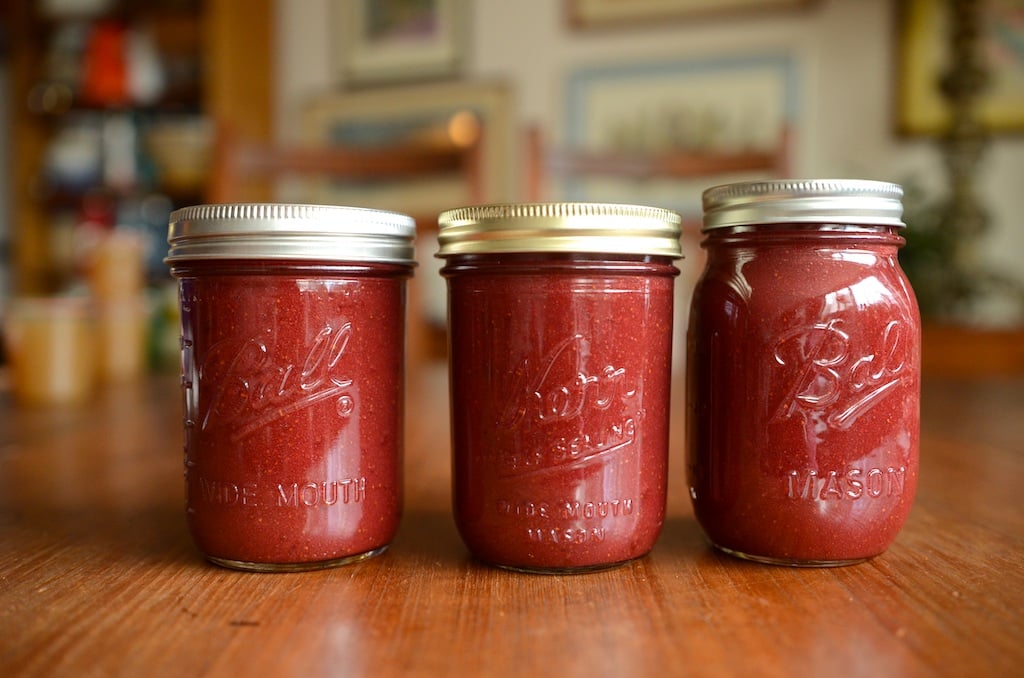
As promised, here’s how I turned the quince pulp leftover from making jelly into a cranberry quince sauce. Just so you know, I went pretty light on the sugar. I wanted something that would have the necessary flavors to go alongside turkey, but would still be good to eat throughout the rest of the year (as soon as I pop the first jar, I’m plan eating a big scoop with some cottage cheese and a few Ak-mak crackers).

This is the type of recipe that’s more technique that true recipe. That’s to say consider this a starting point. Use what you have and adjust the ingredients in order to make it taste good to you.

quince pulp

Continue reading

Related Posts:

Posted in holiday foods, jams, jellies, marmalades | Tagged | 7 Comments

November Can Jam: Rosy Quince Jelly

quince by the sink

It took me years to figure out that quince were edible. During my middle school years my family lived in a house that, years before, had been owned by a botanist. She had planted beautiful and exotic trees all over the property, many of which were impressively mature during our time there. Towards the back of the property, there was a cluster of fruit trees we optimistically called “The Orchard.”

chopping quince

There were four unidentified apple trees, a bedraggled pear tree that only produced one mealy piece of fruit per year and a mysterious tree that produced rock hard furry pieces of fruit that we had no idea what to do with. Season after season, we let these dense, inedible fruits ripen and rot.

boiling quince

It wasn’t until last year did I finally made the connection between that old tree and the fruit I’d come to know as quince. As soon as I realized what we had had and squandered, I felt a bit mournful. If I ever come across a feral quince again someday, I won’t make the same mistake.

boiling quince

If you’ve never worked with quince, here are a few things you should know. When it is ripe, it smells incredibly fragrant, clean and floral. However, for as good as the fruit can smell while sitting demurely in a bowl on the counter, during the cooking process it goes through a period of time when it releases a terrible scent, akin to my sister’s dirty feet.

It’s also challenging to cut and clean. The flesh is dense and resists the blade of the knife like the dickens (to use a phrase of my father’s). It requires a good deal more force than the apples and pears we’re all used to and so you’ve also got to be increasingly wary not to slip and cut yourself. I’ve come close a number of times.

quince pulp in a strainer

Quince is best known as the main ingredient in membrillo, a vividly hued paste that’s most popular in Spain as a accompaniment to cheese. It also makes an excellent jelly, because it’s so rich in pectin that it needs little else to set up into a delicate, spreadable condiment. What’s more, if you boil the fruit with water to extract the juice, you will still have a great deal of pulp leftover, which can become part of a jam or sauce. I combined mine with four cups of cranberries and now have four pints of tart, floral sauce, some of which is headed straight for our Thanksgiving table (that recipe will be up tomorrow).

quince jelly

Yesterday, I took four different varieties of my preserves to a cheese tasting that my friend Tenaya organized. Let me tell you, this quince jelly was so, so good paired with a Spanish goat cheese called Idiazabal (please don’t ask me to pronounce it). With Thanksgiving coming up, I can also imagine it smeared on a piece of leftover turkey to very pleasing results.

the three cheeses and their jams

The recipe I used is after the jump. Since there’s no additional pectin here, you can scale the recipe up or down as needed. However, I wouldn’t increase the size of the recipe too, too much, as it will then take more time to cook the jelly to the correct temperature.

Continue reading

Related Posts:

Posted in canning, jams, jellies, marmalades | Tagged , , , | 24 Comments

Open Jars: Shae’s Banana Berry-Jam Bread

Banana-Berry Jam Bread (photos courtesy of Shae Irving)

If you’re an avid canner, you’ve probably already discovered that quick breads are a friend to all those fruits and jams you put up during the warmer months. I often use them as a good way to finish up open jars of applesauce, fruit butters or even canned fruit. Shae Irving, she of the blog Hitchhiking to Heaven and the eBook that I recently had the privilege of giving away, has devised a new recipe that uses both blackening bananas and several generous dollops of jam. Here’s what she has to say,

If bananas are a staple at your house, as they are at mine, it’s inevitable that some of them are going to get away from you. They’re going to turn speckled brown and soft, and they’re going to beg you to turn them into banana bread.This is good news for folks who have a lot of jam, because it’s incredibly easy to enhance banana bread with a layer of a luscious preserve.

I chose olallieberry jam for this post, so that’s how the bread got its name. But you can pick any jam that looks irresistible to you — or that you need to use up fast. Apricot was also calling me.

I like this simple banana bread recipe because it contains a bit of lemon zest. Of course the zest is optional, as are the nuts. I added both and dressed the top of the bread with some candied lemon peel that I’d made earlier this year. Banana bread is forgiving, so you can experiment with your own add-ins.

Thanks, Marisa, for letting me visit and offer a post on your wonderful blog. It’s an honor to contribute, and I can’t wait to learn more ways to use my open jars!

Shae’s recipe is after the jump. Personally, I’m hoping to find the time to make up a batch sometime this weekend, as I’ve got plenty of open jars of jam that need to be used. I’m also going to leave you with one final photo. This is of Shae’s jam cabinet. I do love seeing all those glowing jars all stacked and lined up. Thanks again, Shae!

Continue reading

Related Posts:

Posted in baking, guest posts, preserves in action | Tagged , , | 17 Comments

How to Can Cubed Pumpkin

the neck pumpkin

About a month ago, I crushed the hopes and dreams of many a preserver, when I wrote about the reasons why pumpkin butter can’t be safely canned at home. In fact, the USDA says that because of its density, any pureed pumpkin product should not be canned. You can’t even pressure can the puree (don’t ask me how the commercial guys do it, because I’m not privy to their techniques. I do assume that there’s a great deal more heat and pressure involved than can be generated in a home kitchen).

peeling pumpkin

What I didn’t get into in that post is the one way that pumpkin can safely be canned, mostly because I wanted to try it out first before I wrote about it. Yes, you heard me right. Pumpkin is safe for canning if you cut it into one-inch cubes, pack it in water and pressure can the heck out of it.

chopping pumpkin

A couple of weekends ago, I walked the neck pumpkin that has been sitting in my living room since Labor Day Weekend into the kitchen and proceeded to peel, slice and cube. It took me the better part of an hour to break that sucker down (it weighted at least ten pounds).

cubed pumpkin

Following the directions in So Easy to Preserve, I simmered my one-inch cubes in a pot of boiling water for two minutes, filled my jars with the softened pumpkin and topped them off with the cooking liquid, taking care to leave the necessary one-inch of headspace on all the jars (I got nine pints from that pumpkin, with a bit leftover for eating mashed with butter and cinnamon).

simmering the pumpkin

The jars of pumpkin took a 55 minute trip through the pressure canner at 11 pounds of pressure (note: Thanks to my ancient stove with it’s five heat settings, I have a very hard time keeping my pressure canner at exactly the correct pressure and so always overshoot it a little bit. I was able to get it rest on 13 pounds for the duration of the canning and was plenty happy to be able to maintain a pressure so close to the desired pressure).

measuring headspace

When the time was up, I turned off the heat and let the canner rest overnight so that the pressure could come down gently and naturally. The next morning, I had nine perfectly sealed pints of tender neck pumpkin. I’ve yet to open a jar, but I’m sure I’ll find a few good ways to use these guys up.

However, I must confess that I don’t think that this technique is going on my regular roster of yearly canning activities. I say this because pumpkin (and most other hard skinned, winter squash) are naturally designed for storage. They can keep for months just has they are and don’t need the investment of energy and canning resources to be preserved for the winter. As I mentioned up above, I’ve had this pumpkin for more than two months. And until I used my trusty vegetable peeler to strip its skin away, it was in perfect, healthy shape and I believe that I could have left it there for at least another month or two before it was necessary to cook it.

That is not to say that I don’t see the virtue in having squash that is ready to use (because have no doubt, after 55 minutes in a pressure canner, this squash is cooked), I’m just not sure that it’s the best use of canning time for me. However, if this is something you regularly do, I’d love to hear the ways in which you use your pressure canned pumpkin cubes.

I have not written out the specific instructions for doing this at home (it’s late and I’m tired). However, the National Center for Home Food Preservation has a handy one-pager that details everything you need to know. Find it here.

Related Posts:

Posted in canning | Tagged , | 43 Comments

Canning 101: The Tools of the Trade

canning pot

Recently, I got an email from a reader, asking that I tell her what she needed in terms of tools in order to get canning. I realized that though I’ve been writing this site for more than a year and a half, I’d never managed to outline my favorite canning equipment.

What you’ll notice is nearly everything pictured here is dual purpose. Most of pots, pans and other tools I use for canning are simply the tools of my kitchen that just happened to get pressed into service on a regular basis for food preservation.

canning rack

First thing you need is a nice, roomy stock pot. You want something that can hold at least 12 quarts and is tall enough to allow the jars to be fully submerged with some space left at the top for bubbling water. You also need a rack to elevate the jars just slightly off the bottom of the pot. I like this old cake cooling rack that once belonged to my grandmother, but any low profile, round rack will do.

small pot

One thing you learn quickly when you start to can is that you need to simmer your lids in a small pan of water prior to placing them on the jars. This ensures that you’ll get a good, solid seal. Any little pan will do.

jam pot

Next you need a pot in which to cook your jams, chutneys, pickle-brines and more. I go back and forth between several sizes of enameled cast iron pots and…

8 quart all-clad

This 8-quart All-Clad pot. Honestly, this is my favorite pot at the moment (as you can tell by the fact that it was actually in use when it came time to take this photo. If you’re curious, it’s holding an apple-pumpkin butter that I’ll be posting about soon). It’s nice and wide and can be vigorously scrubbed if you happen to burn something in it. My husband would like it to be known that he bought this lovely pot for me after much obsessing on my part.

kitchen tools

It’s always nice to have a generous assortment of measuring cups, measuring spoons, sharp knives and a microplane grater.

funnels and lifters

These are really the only specialty canning tools I think are necessary. Wide mouth funnels are really helpful (and once you have them in your kitchen, you’ll start to use them for other things. At least I do). A jar lifter is nice to help prevent burns and a magnetic lid wand is quite handy.

skimmers and spatulas

A little mesh skimmer is nice when you’re making a super-foamy jam. I got that one three years ago at a giant Asian grocery store in South Philadelphia for less than two bucks. It has proven its price many times over. I’m also a big fan of these newer, coated silicone spatulas. There’s nowhere that mildew or mold can develop because the coating covers the entire thing. Next to it is a very thin scraper that is absolutely brilliant when it comes to removing air bubbles from pickles and preserved fruit.

jars

Jars. But you probably knew that already. They don’t have to be brand new, although the lids should be.

towels

A stack of clean towels and a couple of hot pads keep things clean, dry and burn-free. All good things.

quince

Finally, you need your main ingredient. I’ve been playing with quince quite a lot lately and will have two (that’s right, two!) recipes that use them in the coming days.

Related Posts:

Posted in canning 101 | Tagged , | 24 Comments

Classes, Tastings and Photos from the Flickr Pool

canning hydrangeas

Gorgeous hydrangeas from lelonopo.com

This weekend has gone by in a blur. Earlier tonight I finally paid a bit of attention to the quince juice I’ve had in my fridge since Tuesday. It’s now jelly (though it took a change of pots and several small burns to make it so). I’ve been sending plaintive wishes to the various gods of preserving that it finds its way to a nice set.

Pickled Hot Peppers

Lovely layered pickes by Meighan

While you feast your eyes on some of these stunning photos from the Food in Jars Flickr group, I have a couple of reminders to share. The first tidbit is that I have just two canning classes left in 2010. Next Saturday, November 20 I’ll be leading a class on Cranberry-Apple Jam and on Saturday, December 4, we’re doing an Apple-Pear Chutney. Both classes are 11 am to 12:30 pm at Indy Hall (20 N. 3rd Street). Cost is just $45.

Fridge Pickles

Oh my! Such pickles! By eatingstumptown.com

Later on Saturday, November 20, I’ll be teaming up with my delightful friend Tenaya (you may also know her as Madame Fromage) for a cheese tasting at Quince Fine Foods. This month, we’re pairing triple creme cheeses with three of my jams and chutneys. The tasting starts at 4 pm and costs $12. If you want to sign up, Tenaya has the scoop here.

Jar Labels

Old maps as jar labels. Brilliant! By putupwithme.com

My other bit of news is that the latest issue of Grid Philly is now available online and around Philadelphia. I wrote an article for them all about giving edible gifts and included three recipes. I’m totally in love with the Spiced Pear Bread I created for them and can’t wait to make it again. Click here and flip to pages 32-33 to check it out.

Related Posts:

Posted in classes and events, flickr photos | 10 Comments

Open Jars: Homemade Fruit on the Bottom Yogurt

Weck jars with fruit-on-the-bottom homemade yogurt (photo courtesy of Paige Colbert)

We’ve got our first Open Jars guest post today. This one comes from Paige from Oregon (she doesn’t have a blog, but you can follow her on Twitter here). A couple of months ago, she emailed me to ask my opinion on making fruit-on-the-bottom yogurt. I had to claim ignorance on the matter, as at heart I’m essentially a lazy cook, who simply scoops yogurt and jam together and stirs until combined. But I asked that if she decided to tackle the project that she tell me how it turned out. Well, she had great success (and used adorable Weck jars to boot). Here’s what Paige had to say.

I did it, and it worked great! After thinking about it a lot, I found myself making plain yogurt without enough time to make anything else, but remembered some half-full jars of jam in the refrigerator. I heated some strawberry-rhubarb and strawberry together, then some pear spice in a separate container until bubbly.

Then I spooned a tablespoon of jam into the bottom of a boiled jar and let cool maybe an hour. When the milk was ready, I added 1/2 cup per jar. I used a regular funnel (not a canning funnel) and kind of aimed it at the side of the jar and the jam wasn’t disturbed at all! The milk thickened up perfectly and I tried one and think the 1:8 ratio of jam to yogurt is just about perfect.

Interestingly, the 8 hours at 105 degrees made the jars seal! I’m not going to take the clips off, though, because I fear they would unseal at room temperature.

Thanks so much, Paige!

Also, thanks to all of you who entered the giveaway for Shae’s book earlier this week. There were 249 entries across the blog and Facebook and the winner is #46, the Windy City Vegan.

Update: No, homemade yogurt is not stored at room temperature. Paige was simply commenting on the fact that the jars created a seal thanks to the gentle heating period that the yogurt needs to set. Yogurt must be kept in the refrigerator. I have not done a post on homemade yogurt, but I’m planning to soon (I know, I’ve said that before. This time I mean it). However, if you’re anxious to get started, my process is very much like the one that The Frugal Girl details here.

Also, when Paige refers to the milk, she actually means the scalded milk that has been cooled and mixed with the yogurt starter. She didn’t tell me how she incubates her yogurt, but I do mine in a cooler filled with water that’s been warmed to approximately 190 degrees. The cooler keeps the heat of the water well contained and allows the yogurt a chance to set nicely.

Related Posts:

Posted in preserves in action | Tagged , , | 33 Comments

Green Tomato Chutney

weighing

Tomato season is moments away from completion. My tomato plants withered and blackened months ago, so any that have come into my kitchen since September had to either be begged, borrowed or bought. There are still a few vendors at my Saturday farmers market with precious half pints of cherry and grape tomatoes, but I know their days are strictly numbered.

halved tomatoes

There have also been a couple of farmers with baskets of big, firm green tomatoes for sale at Rittenhouse and it’s thanks to them I’ve been able play around with these under-ripe fruits. As a side note, can I just say what a wonderful thing it is that tomatoes are useful, edible and delicious both ripe and green. How many other fruits or vegetables are similarly blessed (well, papaya does spring to mind. But beyond that).

chopped tomato and onion

The ingredients are quite basic, as chutneys go. Chopped onion (that’s one small white onions) and green tomatoes (about 2 1/2 pounds).

building the chutney

Combine in a heavy, non-reactive pot with 1 cup of white vinegar (you could certainly use apple cider vinegar if you prefer, the jug of white simply happened to be at hand when I started cooking) and 1 1/2 cups of brown sugar.

spices

Spices included cinnamon sticks, star anise, cloves, red chili flakes and ground ginger. If you prefer fresh ginger, feel free to use it in place of the ground. I was simply trying to use what I already had in my kitchen.

green tomato chutney

As you can see from the picture above, I used a little teaball to keep the cloves contained, so that the finished chutney wouldn’t be to overwhelmingly clove-y.

The resulting chutney is a bit sweet, with plenty of tang and spice. It tastes a little like Christmas, but I think it would also be quite lip-smacking on a post-Thanksgiving turkey sandwich. I’m going to let it hang out a bit before I open it, to let the flavors mingle and marry a bit more before serving it up.

Do note that this takes at least an hour to an hour and a half to cook down into a finished chutney and that it cooks down significantly. I started with nearly 10 cups of raw ingredients and my final yield was just 2 pints. You could easily double it for a greater yield, but it will take even longer to cook down.

Continue reading

Related Posts:

Posted in pickles, relishes, chutneys | Tagged , , | 26 Comments

Hitchhiking to Heaven e-Book Giveaway

Shae's prize-winning jam

When I first started writing this website, I was one of the only ones out here blogging about canning, preserving and generally putting food in jars. Happily, in the last two years, a whole community of jam and pickle makers has sprung up. Folks like Kaela, Julia, Kate, Tigress and those happy goats are just some of the plucky preservation-minded writers who have leapt into the seasonal fray.

Another preserving blogger, who I had the pleasure of meeting last month at BlogHer Food, is Shae Irving from Hitchhiking to Heaven. Shae is an award-winning jam maker (truly, she won nine ribbons in the 2010 Marin County Fair) who happens to also be an accomplished writer. So, it was just a natural step for her to write a little e-book detailing her jam making techniques and favorite recipes. It’s called Hitchhiking to Heaven Prizewinning Recipes 2010 and it’s worth every penny of the $9.95 price tag.

I bought myself a copy as soon as I learned it was available and spent the next hour of my workday (shh, don’t tell) drinking it in (I love the instantaneous nature of the e-book). I find that the more I get into this world of canning, the more there seems to be to learn and absorb. Shae’s little book offers just the sort of detail that feeds my creativity and makes me want to leap to my feet and head to the kitchen (if any agents or publishers are reading this, I suggest you get in touch with Shae post-haste. She’s a gem and her writing is just lovely).

Lucky for all of you out there (and courtesy of Shae), I have one copy of this book to give away. Just leave a comment on this post and share what you think your prize-winning recipe would be. The comments will close at 11:59 p.m. on Wednesday, November 10, 2010.

Related Posts:

Posted in giveaways and winners | Tagged , , | 209 Comments

Quickly, Winners and More

measuring headspace

This weekend, I tackled a couple canning projects, both large (pressuring canning nine pints of a giant neck pumpkin) and small (a little batch of green tomato chutney). I’ll have posts up about both later this week, but thanks to Daylight Savings Time, I’m already up far later than my body would like. But I wanted to post the winner of the Anyone Can Cook and Anyone Can Bake books before the weekend ended.

building the chutney

The handy randomizer has selected #58, which is Kathie. Congratulations Kathie!

I also I just wanted to remind everyone that I have two more canning classes on the schedule for 2010 (I am totally gobsmacked at how fast this year has gone). The next is on Saturday, November 20 and the final one is Saturday, December 4th. Both classes are at Indy Hall (20 N. 2nd Street, Philadelphia, PA), run from 11-12:30 and cost $45.

Also, keep in mind that I’d be happy to do a canning class gift certificate, if you’re so interested in buying a class for a friend or family member (I’ll be announcing a late winter/early spring line-up of classes soon).

Related Posts:

Posted in classes and events, giveaways and winners | 1 Comment