White Peach Sauce with Vanilla (+ giveaway!)

white peaches

Until the summer of 2007, the only peaches I knew were aggressively fuzzy and yellow-fleshed. I was perfectly content with those peaches, until I encountered Beechwood Orchards and their white peaches. Fragrant and floral, without any of the pucker that comes with yellow variety, I was sure and well hooked. I’d buy and consume a full quart of those perfect fruits each week. At nearly $5 a box, they were almost always my most expensive farmers’ market purchase each Sunday (this was when I was in grad school and operating on a very slim margin).

peach pits

As far as eating out of hand goes, this summer I’ve swung back towards the acidic yellow peaches of my youth. But when it comes to cooking with stone fruit, I’m having something of a love affair with the white peach. You see, they smell like the best, most heady version of the peach-scented lotion I used during my teenage years, and I love how they take me back in time. They also taste terrific and I just can’t get enough.

peeled white peaches

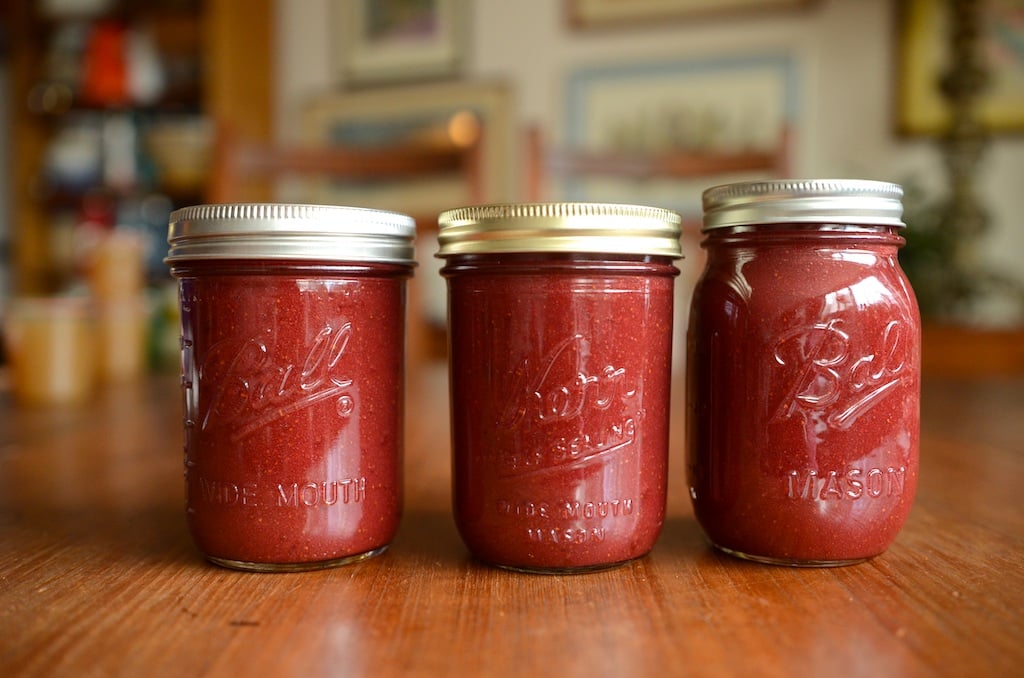
In an attempt to capture some of that flavor and fragrance, I halved and peeled nearly 10 pounds of white peaches and cooked them down into a vanilla bean-flecked, slightly sweetened sauce. I got ten pints of sauce from those ten pounds of peaches. Seven pints were processed just as they were (with the addition of 1 tablespoon of lemon juice per pint for acidification – white peaches are in the grey zone as far as safe levels of acid) and the remaining three were cooked down using the slow cooker technique into four half pints of butter*.

smashing white peaches

I’ve yet to open one of these jars to taste the post-process product, but going into the jars, it was smooth (I did use an immersion blender during the final stage of cooking to get everything to an even consistency), easy on the tongue and containing the very essence of summer flavor. I look forward to opening one of these jars come January and stirring this sauce into yogurt or just eating it directing out of the pint with a spoon.

83 | 365

*The sauce that was cooked down into butter was also acidified, to ensure safety. I did some research and found that when the average white peach is tested for acidity, it has a pH of 4.5. This is in the canning grey zone and is similar to modern tomatoes (which we also acidify). Yellow peaches have a greater amount of acidity and so could be made into a sauce without need for additional acid.

And now for the giveaway part (you didn’t think I was going to forget that, did you?). The folks at Nielson-Massey have given me three tubes of vanilla beans to give to my readers. Each tube contains two vanilla beans of the very highest quality. Entries will be accepted through Wednesday, August 18th at 11:59 p.m. Just leave a comment on this post and include your favorite way to use vanilla.


The Filling Station in Chelsea Market

The Filling Station

One of the wonderful things about living in Philadelphia is that it’s so close to so much, making it incredibly easy to visit and explore other nearby cities. This weekend I’m taking a break from the canning pot so that Scott and I can do just that. We’re wandering New York City, eating delicious food, and keeping our eyes peeled for cool stuff.

oils at The Filling Station

One of my hopes for the trip was that we’d get a chance to visit Chelsea Market. It’s in the building that’s also home to the Food Network, after all. One spot that particularly caught my eye was the newly opened Filling Station. They sell an array of olive oils, vinegars, flavored salts and sugars, all in reusable bottles and jars.

sugars at The Filling Station

Best of all, if you bring back your cleaned container, they’ll give you 10% off the price of your refill. This one of my favorite ways to buy just about everything and I just wish that more stores would adopt similar models. I left with two small jars, one filled with fragrant black truffle salt and the other with super-fine grey velvet salt.

Chelsea Market doors

Now we’re off to another food destination – the Union Square Greenmarket. Hooray!

Photos From Last Week’s LA Times Canning Piece

LA Times article cover

As many of you know, a piece ran in last week’s Los Angeles Times food section about canning and the bloggers who use modern technology to share what they’ve been putting up. That’s Kevin West of the site Saving the Season on the cover (if you’re not reading his blog, you really should be). However, if you flip one page in, you’ll find me grinning out from the second page of the article.

88 | 365

Living all the way on the other side of the country from Southern California meant that I wasn’t able to see the article in print the day it came out. However, thanks to the power of friends and the speedy nature of the U.S. Postal Service, I had a copy in hand by Monday afternoon (thanks Carol!).

I was so pleased to be included in this article, but what thrills me even more about it is simply that such a large, national paper is talking about canning in a way that is both interesting and respectful (this recent piece in the Seattle Times also struck a really nice tone). Hurray for good press for canning!

Canning 101: When Black Scum Forms on the Outside of Jars

mucky jars

You slave over a batch of jam, lovingly chopping the fruit and simmering it into sweet, sticky submission. At the end of a long canning session, you leave the jars with the rings on to cool on the counter, content in the knowledge that you’ve made enough jam to last until the following summer.

However, the next morning when you go to take the rings off, you find that they’re a little tough to turn. And what’s this? Black scum has formed around the rims of your jars! Oh no! Does this mean all your hard work is lost?

Happily, the answer to that panicky question is that the jars are perfectly fine, as long as the seals are still good. That black scum you see on the outside of my jars in the picture above is a result of a bit of blueberry jam (on the left) and white peach sauce (on the right) that siphoned out the jars during processing. It was trapped by the ring and left to sit for a day (sometimes it takes me a day or two to get around to removing the rings and labeling). During that time, that bit of jam and sauce reacted with the metal of the ring and formed that scum.

The way you handle a situation like this is simple. You just clean it off. Typically a simple wipe down with a sponge or damp cloth will remove any traces of it. However, if it’s resistant to removal, fill your sink with tepid water and let the jars soak for a few minutes. It should rub right off after that. Once the jars are clean, carefully dry them completely and gently, using the edge of the towel to wipe off that tiny bit of lid overhang.

Finally, when the jars are clean and dry, double check the seals to ensure that they’re still good. Make a thorough visual inspection to ensure you got all of it. Remember also to be careful when cleaning full, sealed jars as too much jostling and rough treatment can potentially break those carefully constructed seals. Oh, and while you’re cleaning your jars, do make sure to also clean the rings. They’ll have some of that residue on them and cleaning will extend their lives.

(I promised a few of you a Canning 101 post on pickling salt and how to substitute other types of salt in canning. I couldn’t quite get that post together tonight, but look for it next week.)

A Cheese’n Pickles Tasting with Madame Fromage

goat cheese and spreads

Long before I was a fervent jam and pickle-maker, I was a mild mannered grad student, trying to figure out how I wanted my life to look. It was Tenaya (then-professor, now-friend) who whispered in my ear, “You should keep writing about food.” I took her advice and soon my life was full of food blogs and the many wonderful people who write them.

She saw me, glowing from a life that food blogs (that one and these) had built and decided it might be good to start her own. Thus Madame Fromage was born. Tenaya’s blog is a happening spot of its own now, what with her guest posts on the Di Bruno Brothers cheese blog, the month cheese tastings at Quince Fine Foods and her many devoted followers.

It’s those cheese tastings that brings this post here today. For months now, we’ve been casually plotting to join forces for a tasting, pairing a few jars of things I’d made with a collection of specially chosen cheeses. In just three weeks, it’s happening.

On Saturday, August 28th, we’ll be at Quince Fine Foods (209 W. Girard Avenue) from 4-6 p.m., matching up my pickled cherries, pickled garlic scapes and some bread and butter pickles with cheese. I’ll also be chatting a bit about the canning process and answering any canning questions that may come up.

Please call or email to reserve your spot: (215) 232-3425 or quince@quincefinefoods.com. Workshops are limited to 12 participants and cost $12. See you there!

Pickled Sweet Cherries

pickled cherries

I grew up in a family with a fairly limited condiment scope. We ate ketchup on burgers, grainy mustard on hot dogs and sausage and dipped steamed broccoli florets into little puddles of mayonnaise. Pickles were cucumber dills, either eaten whole as a snack, or sliced and blotted before being stacked in a sandwich. Jam was strawberry or plum (made from the fruit off our backyard trees) and salad dressing was Good Seasonings, made from the spice packet in the branded cruet.

cherries packed in jars

This isn’t to say I grew up in a community of boring eaters. We were among the first people I knew to regularly stock teriyaki sauce and my mom liked to make the Good Seasonings dressing a little more interesting with the addition of balsamic vinegar or toasted sesame oil. Real maple syrup was the rule. In fact, my brief devotion to the fake stuff caused my father a great deal of anguish. There was always soy sauce in the fridge and we had a wicked pickled ginger phase after my parents’ early nineties trip to Hawaii.

bay and peppercorns in jar

In recent years, it’s been deeply gratifying to branch out beyond my childhood condiments (although I still firmly believe that ketchup on a hot dog is sacrilege) and explore a broader world of homemade flavor. However, until very recently there was an area I’d yet to broach.

Pickled fruit.

I toyed with a recipe for pickled Seckel pears last fall, but preserved them in a gingery syrup instead. I contemplated pickled blueberries, but opted to simply eat the last of my picking out of hand. I was uneasy about it, fearful I’d make something off-putting and end up wasting good food.

life is just a bowl of

However, when faced with nearly eight pounds of juicy, ripe cherries from the Washington State Fruit Commission (thanks Sweet Preservation), I knew the time was ripe to pickle. I consulted several recipes and concocted a brine that was sweet and tart. I added a few peppercorns for spice and a bay leaf for nuance to each jar, packed the cherries in and hoped for the best.

As you might have guessed, my expectations were far too low. These pickled cherries are amazing! They are sweet and puckery, and despite the water bath, managed to retain a bit of that snap and gentle crunch you get when you first bite into a really good cherry. I am smitten. If you are still able to get sweet cherries in your area I highly encourage you to make a batch.

Oh, and one more thing. If you live in the Philadelphia area, there’s going to be an opportunity for you to taste these, along with a couple other pickles I’ve made recently, so keep your eyes peeled. More on Monday!


A Canning Chat with Jim Coleman and WHYY

me, holding a jar of peaches
Mark your calendars, canners! This Thursday, August 5 at 12 noon (eastern time), I’ll be participating in a  web chat with Jim Coleman, host of the WHYY show A Chef’s Table. We’ll be answering canning questions between 12 – 1 p.m., so if you’ve got a burning quandary, now’s your chance to get an answer.

To participate, click here. I’ll be sending out reminders a few minutes before we get started via the Food in Jars Facebook and Twitter accounts, so follow or fan if you think you’ll need a nudge to log on.

Canning 101: Why You Shouldn’t Can Like Your Grandmother Did

DSC_0066

When I first started canning in earnest, every few months, I’d wrap up a collection of full jars and ship them off to my parents. I just couldn’t resist sharing all the delicious things I was making with them. One evening, my dad took a moment to call and thank me for the orange marmalade I had recently sent his way. During that phone call, he also made a request. Could I possibly make grape jelly sealed with paraffin wax, like his Grandma Bartlett used to make?

I adore my dad and am nearly always willing to go pretty darn far out of my way to do something to make him happy. Sadly, this was one request that I had to turn down. The reason? It’s just not safe to do it the way Grandma Bartlett used to do it.

Some of the vintage techniques you should avoid include:

Open Kettle Canning: This is the sealing method in which you pour hot jam, jelly or other preserves into a hot jar, quickly wipe the rim and apply the lids and rings. Then you simply allow the heat of the product to produce a seal. While this will typically produce a seal, you don’t have the back-up of the boiling water process, which means that you run a higher risk developing mold or other bacteria in your preserves.

Paraffin Wax Seals: The method my father remembers so fondly. In this technique, you pour thin layers of wax over your jam, until you built up about 1/2 an inch of wax on top of your product. The primary issue with this method is that there’s no way to check your seal. Additionally, these seals have a high rate of failure. My mother remembers her aunt frequently opening jellies sealed in this manner, only to discover that they were furry with mold under the wax.

Upside Down Sealing: This is sealing method found most often in Europe and is a variation on the Open Kettle approach. In it, you fill your jars, wipe rims, apply lids and rings and then, instead of processing you invert the jars and cover with a kitchen towel until they’re cool. While this technique will give you a concave lid and a fairly firm lid, it does not always produce a quality seal (and again, you lack the safety insurance that the boiling water process grants you). Additionally, if you do this with a firm setting jam or jelly, you’ll end up setting your jam up against your lid and not down at the bottom of the jar where it should be.

Steam Canners: A steam canner is a piece of equipment that looks like a cake carrier. It has a very shallow base with a high domed lid. You place it on the stove, pour a small amount of water into the shallow pan, put your jars on top and then cover with the domed lid. The steam then circulates to heat the jars. However, while steam can be hotter than boiling water, it can also exist at much lower temperatures as well. Additionally, it doesn’t have the same heat penetrating abilities as boiling water, so the heat of the processing pot will not penetrate to the core of your jars.

The way I look at canning is this. We all invest our time, money and equipment into our canned goods. It just makes good sense to use the most reliable processing techniques available, to ensure the best outcome possible. As far as I know, the most reliable process (for high acid foods) is a boiling water bath for the length of time prescribed by your recipe.

I think even Grandma Bartlett would change her ways if she was canning in the 21st century.

Blackberry-Apricot Jam

blackberry-apricot jam

Blackberry season has come to the mid-atlantic region and I couldn’t be more delighted. I spent my childhood foraging blackberries in the Oregon brambles and those sweet, tart, juicy berries are some of my favorite summer fruits. While they don’t grow wild out here in Pennsylvania in the same way they do out west, I’m lucky enough to have a good pick-your-own location.

smashing blackberries

The weekend before last, I picked just over eight pounds (and had a lovely couple of hours outside with my friend Shay). I spent the week eating them crushed into yogurt and straight out of the container. By Thursday night, it was time to turn them into something longer lasting. I smashed up a bunch, until I had a generous four cups of smashed berries.

rival apricots

I combined the four cups of mashed berries with four cups of apricot puree. Those apricots were lovely, juicy things that came to me via the Washington State Fruit Commission. They’ve just launched a website called Sweet Preservation that is dedicated to the art of canning and fruit preservation. Several weeks ago, they invited me to be one of the “CANbassadors” and help them spread word of this new resource.

Having gone to college in Washington State (go Whitman!), I’m happy to do what I can to lend my support. I also made whole canned apricots in a honey-vanilla syrup and pickled sweet cherries from the goodness that came in the box above. Stay tuned for those recipes, they’ll be rolling out over the next week.

blackberries merging with apricot puree

In the past, I’ve been something of a single fruit jam kind of girl. I like my preserves fairly simple and tasting of the fruit that it is. However, I’ve already made apricot jam, apricot butter and blackberry jam this season. But I had a hunch that a marriage of the two would be an interesting and worthy pursuit. Happily, I was right. This jam turned out to have the sweetness of the apricots and the tart, juiciness of the blackberries.

empty jam pot

Typically, when I make blackberry jam, I seed the blackberries by pushing them through a fine mesh sieve so that all the fruit and pulp winds up in a bowl and the seeds are left behind in the strainer. This time, I chose to include the seeds, since the apricot was there balancing things out. I find the seeds add a nice textural interest. However, if you aren’t a fan of seeds in your jam, you could absolutely use seeded blackberry pulp.

blackberry-apricot jam

Just so you know, as I wrote this post, I found myself struggling to remember what this jam tasted like (I’ve made a lot of jam lately). So I did was any good canner would do. I popped opened a jar to remind myself. That led to five minutes of eating the jam out of the jar with a spoon. It is that good. The open jar is sitting right next to me. As soon as this recipe is published, I’ll be back in the kitchen, looking for something upon which to slather it.


Site Wackiness – An update

Hello all, Scott here again (Marisa’s husband/tech support).

Just an update to let you all know that we’re still rooting around on the blog to get to the bottom of the wackiness Marisa mentioned yesterday.


Featuring Recent Posts Wordpress Widget development by YD