
I find myself functioning within the “better late than never principle” more often than I like to admit. My frequent delays bedevils many in my life (particularly my punctual husband), but as I built this career as a writer/teacher/canning crusader, I find that there is nearly always more for me to do than there is time in which to do it. So tasks back up, I take days to answer questions and I don’t always do everything I promised within the timeframe I had hoped.
Like this post on canning with one piece lids. I had intended to write it the week I posted the Fillmore Container giveaway, but it just didn’t happen then. Happily, it’s happening today. Better late than never, right?

So. When it comes to home canning, the USDA and the National Center for Home Food Preservation recommend that we use mason jars with two piece lids. These two part lids are recommended because they are easy to use, known to seal reliably, and it’s easy to tell if the jars sealed (remove rings and grasp edges of lid. If it holds fast, it is sealed).
One piece lids are a little bit more mysterious. For a first time user, there’s not a lot of information about which one piece lids are right for home canning, how to prepare them for canning and even how tightly you should turn them to ensure a good seal.

When you buy one piece lids for canning, you want to get ones that are lined with plastisol, have a button in the center (to better show that it has sealed) and are expressly designed for boiling water bath canning (do not order the ones that are for hot fill only). You don’t want to use lug lids, as they don’t fit mason jars.
When you’re ready to can with these lids, place them in a small saucepan (just like you would with your flat lids), cover them with warm water and place on the stove.
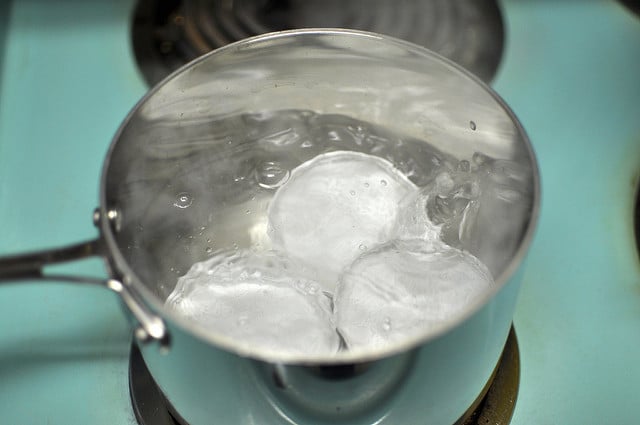
Bring the lids to a gentle boil, reduce the temperature and simmer the lids for approximately 10 minutes before applying the lids.

When you’re ready to close your jars, use a jar lifter to pull the lids out of the water, one at a time. Make sure to have a towel or hot pad handy so that you don’t burn your hands while tightening down the lids. When you screw this lids on, you only want to tighten them to the point when you feel the rim of the jar make contact with the sealing compound. Don’t go any tighter or the air won’t be able to escape and you will have compromised your seal.

Place capped jars into your boiling water bath and process as you would any other jar. When the time is up, turn off the heat, remove the lid from the pot and let the jars remain in the hot water for an additional five minutes. This extended heat exposure helps reduce siphoning and gives the sealing compound just a little bit more time to soften and develop a relationship with the rim of the jar.

Remove jars from water bath and place them on a folded kitchen towel to cool. Don’t hover over your jars, give them some time to create their vacuum. These lids often take longer to seal than their two piece brethren, so don’t start panicking if they take an hour or more to finally pop.
When jars are cool, test seals by pushing down on the lid of the jar. If the lid is firm and the button is concave, they are ready to be stored in the pantry. If you have any doubts about the quality of your seal, place the jar in the refrigerator and use the product promptly.

Can you reuse the one piece lids?
Only for pantry and leftover storage. Not for canning.
Hello,
I live in a country where canning jars are imported and get quite expensive. I am considering canning (something) for gift giving this Christmas and will not be intended to preserve anything for a long period of time. Given this purpose, I was wondering if single-lid jars (similar to the Tostitos salsa jars) would be okay for this purpose.
Would appreciate your insights. Thank you very much.
Read this post: https://foodinjars.com/2013/07/how-to-can-in-hex-jars-with-lug-lids/
Ooh… Thank you very much! ^_^
Hi! I canned a bunch of sweet pepper relish ( with lots of vinegar ), pickled jalepeños, tomatoes and bloody Mary mix ( which both have a good amount of bottled lemon juice). I used one piece lids that are recommended for waterbath canning. They all seem like they have a good seal, the safety button is totally concave, and when I press anywhere on the lid there’s no movement at all.. But the lid is a little bumpy. I regret using the one piece lid because it’s harder to be sure about the seal. I was planning to give all these as gifts this Christmas, but this is my first time canning and I’m wondering if you can tell me if I can be confident that the seal is good. Thanks!
I’m not sure that I know what you mean by the lid being bumpy. Could you elaborate?
can these lids be used in a pressure canner?
You have to ask the distributor from which you are buying them. Some are and some aren’t.
Can you use lug lids for bath canning mustards in jars that are not Mason?
As long as the jars are designed for water bath canning, you can use them.
Is It safe to can Virgin COCONUT OIL?
No.
Hello, I just bought a jar of home made apple butter at a country store. When I went to open it…the lid twisted off easily…no real effort…..should I worry that it is spoiled?
It’s difficult to say with one piece lids. Does the apple butter look and taste okay? If so, it’s probably fine.
Thank you, Marissa, for posting this information. I have some lids (also from Fillmore Containers) with the plastisol seal that I use for freezer storage of various foods and they are wonderful plus they come in cool colors. But regarding the spoilage of the apple butter, aren’t the pathogens that could be dangerous also tasteless?
Dangerous pathogens that are tasteless can’t grow in products that are high in acid. Apple butter is high in acid, so the very worst that can happen is that it will either develop mold or begin to ferment.
Hi, I live in India. My selection of jars is somewaht limited! I can get Eagle brand jars, with ‘airtight’ lid. These jars are not cheap. So, what I’m wondering is whether they will be suitable for canning, goods to be stored outside the refrigerator. I have noticed when I have made products and filled the jars, only hot products when I’ve filled the jars, when I open them after stori g them, in the fridge, there is definitely a vacuum created.
I have a relatively large pressure cooker, the Indian whistling one, so I can pressurise the jars.
Can anyone offer me any information which may be of use to me.
Thank you,
George
Can the one piece lids be used for pressure canning?
It depends on which ones you buy. Not all feature sealing compound hearty enough for the heat of the pressure canner.
THANKS for taking the time to post this!!! Most helpful.
Has anyone used these type of jars for apple butter…. Nakpunar 24 pcs , 1.5 oz Mini Hexagon Glass Jars with Gold Plastisol Lined Lids ……… https://www.amazon.com/gp/product/B0194UN7GA/ref=oh_aui_detailpage_o02_s01?ie=UTF8&psc=1
How do you know if they are sealed?
We need them for wedding favors. Thank you.
The lid goes a little concave and feels solid when pressed when they’re sealed.
Can you tel me what brand of lids you are using? We bought some for our jam making business that say they are safe for home preservation but they do not have a clear button on them. They do become concave when used, and seal, but do not have a button. Thank you.
They don’t have an identifiable brand. They’re from Fillmore Container, though.
You can use parrafin wax seal 1/4″ below rim (wax is not hard to do have used since i was 7 or 8 with grandma over 50 years now) then put one piece lid over top. Ifyou want to dress up put a circle or sqare of calico between wax seal and screw on lid, makes pretty for prizes or gifts or sales like at markets.
Unfortunately, that is not an approved method for sealing jars.
hi, an old post but I hope you can help me ~ differentiating types of lids. Are the one-piece lids for water bath only? Can I use them in my pressure canner, for things that need to be pressure canned?
The one-piece lids come in a couple different varieties. Not all are designed for the high heat of the pressure canner. You’d need to ask the retailer to make sure you’re getting ones that can stand up to the intensity of the pressure canner.
I’m selling homemade granola at a Farmers Market. I’m putting the granola in a mason jar with a one piece lid.
Is it possible to create a vacuum seal with this one piece lid and mason jar vacuum sealer?
I know I can put a protective shrink wrap seal around the lid for a security seal, but I’m looking to keep it fresher longer.
Thank you for any help.
Unfortunately, that’s not an area in which I have any expertise. So sorry I can’t help.
One can purchase many different products to sanitize lids and glassware without actually boiling them. Check out sites that sell brewing equipment and supplies. Some of these products have only a two minute contact time in tepid water.
Rinse in boiling water if you like afterword and use immediately. This is especially handy for lids and rings.
I can’t answer your specific question, as I am new to canning. But for dry goods like this, you might want to visit thriftyvac.com. You could seal products for sale in special vacuum bags, in mylar bags, or vacuum seal in glass jars for home use.
Their lids for glass jars are expensive, but can be used an unlimited number of times with their simple, plastic hand pump. They also have small plastic adapters available so you can reseal in the jar, over and over, using any type of foodsaver vacuum machine.
I have received large amount of one piece white canning lids with white seal how do I use these to pressure can meats? Do they vent if used in this way?
Those lids aren’t recommended for pressure canning.
Will the one piece jars seal like the two piece jars when filled with hot…say tomatoes? I’m trying it now. Also, if they don’t seal can I put them into a hot bath or the oven?
You ALWAYS need to do the boiling water bath with tomatoes. Always.
I read online that lug/twist plastisol lids should be used for water bath canning and continuous plastisol lids are for hot fill. I see in your example that you used continuous lids and wanted to know if you’ve ever heard about a processing difference lug and continuous plastisol lids.
Thanks for all your help! This website was very helpful when I started canning a year ago and now I’m an addict.
As far as I know, both versions of the lids with the plastisol lining can be used in a boiling water bath canner. But I’m not an expert in commercial processing. Fillmore Container is a really good resource for these types of questions.
Fillmore Container carries continuous plastisol lids that they specify are for hot fill or shorter (under 15 minutes processing time) water bath canning as well as continuous plastisol lids that are specifically made for longer water bath canning (15+ minutes processing time) or pressure canning.
I’ve never tried canning with lug lids, but I’d go by whatever the manufacturer specifies is the appropriate usage.
Thank you so much for the detail tutorial. Very easy to follow with the pictures included.
I’ve talked with several people who pressure can green beans with no water in the jars. They say the flavor of the beans is so much better, and they keep well. I’ve never heard of doing it that way. Is it safe?
I’ve never tried it. I can’t imagine they’d hold their quality well like that over the long haul, though.
I may try it on half a load and see what happens…as long as you think it’s safe!
Thank you
Okay so it has officially been 15 hrs since I canned my jam with one piece lids. Jam was hot, jars were in a 175 degree oven and I pulled out 1-2 at a time. I was in a hurry because I wanted to seal them quickly so some may have jam on rim. Lids were in a cake pan on the stove on 2 with just enough water to fill the bottom. 9/35 sealed and Im wanting to know if I do recan, reheat jam, and resterlize, how can I make sure they seal? Cover lids with water or 200 degree heating oven for the jars?
I’m afraid I don’t totally understand what you did here. There are two ways to get one piece lids to seal. You either process them in a boiling water bath canner or you fill and flip. The issue is not with how you prepared the lids.
Okay I’ll try the flip one. Thanks!
plastic peanut butter jars work great with original lids, just use a thick grade poly (saran wrap), as long as the jar is fully cleaned, all the original seal removed, and the waxy cardboard lid insert is present. I use the same process as the one piece metal lids, but DO NOT LET THE JAR TOUCH THE BOTTOM OF THE CANNER. Takes a few practice jars to get the right amount of head space “I generally go for about 1/4 inch”, but when you get it right, the jar will stay rigid “once cooled”, and you can remove the top and see the poly wrap has dipped in. Note, use only bpa free jars, and do not exceed boil temps, “no pressure canning” Great for acidic foods, and foods with a preservative such as salt or vinegar, but please do not expect to keep foods such as corn, beans, or anything that requires pressure canning. It will work for a seal, but the high temps are not there for pasteurization required for long term storage. Try it, you’re family will say “Wow Mom/Dad, this is awesome!!!”
Hi there! I have just received some new jars with white one-piece lids without the button and was hoping someone would have some information on how to tell when they are sealed. The website I got them from said they were fine to use for canning. Any information would be greatly appreciated 🙂
They should go concave in the center when sealed.
Hello there,
Can I use one-piece plastisol lids in a pressure cooker? I’m using this jar/lid combo, and it says the jar can withstand some pretty high heat, but says nothing about the lid. Your feedback would be appreciated! Thanks!
http://www.uline.com/Product/Detail/S-12756M/Jars/16-oz-Wide-Mouth-Glass-Jars-with-Metal-Lid-2-Opening
Annabeth, you should check with the company that manufacturers your one piece lids. I just don’t know whether they’re safe for the pressure canner.
I have just been given 40 cases of self sealing jars from a aunt that just passed away (NO LIDS). Do you know, can I use the standard two piece lids (that come with the 1/2 pint jars) with these self sealing jars? The jars are very cute (square shaped), I really don’t want to give them to my husband to put nuts and bolts in. HELP!
Do the jars have threads onto which a ring would fit? And are they of conventional mason jar mouth size? If so, then you can use regular lids and rings on them.
I made blackberry preserves about a month ago using the process you describe, however, I did not leave the jars in the water bath for the extra five minutes. Now, I just noticed that on some of them the button has popped back up, which I assume means the seal has been somehow compromised. Is this a common experience with canning? Does it mean I should throw out the jam? And, do you think this was due to not leaving it the extra five minutes after processing? Thank you!
It is not common to have the seal go bad in the manner you’ve described. It indicates that something is spoiling inside your jar. However, it should not have occurred because you didn’t leave the jars in the canner for the extra five minutes. Jars go bad for a number of reasons.
I recently bought some canning lids that are solid 1 piece lids, they have no center button, are these ok for canning in boiling water bath, I am a pickle maker in Maine with my own business and am unsure if these lids are duds and I take this as a loss and if I should stick with the two piece lids?
The best thing to do is to check in with the company from whom you bought the lids in order to determine whether or not they are safe for canning. The presence or absence of the button isn’t the only indicator.
I recently bought some hex jars and one piece lids. They do not have buttons to pop so how does one know that they have sealed sufficiently?
The center of the lid should be concave and rigid when pressed.
Where did you get the orange ‘do-flicky’ < high tech canning term, in the next to last pic? mine are all made of metal and seem spindly.
That’s the blossom trivet. I wrote more about it here: https://foodinjars.com/2012/01/a-new-canning-rack/
Great article – thank yoU! I’m looking for ways to can roasted garlic spread. It’s pure garlic (no oil), and is the consistency of maybe a marmalade. I’ve ordered a hex jar and a square jar – both with lug caps, to experiment with. I also have small jelly jars and 1-piece canning lids like the ones you use in this article. What do you think would be most effective, or would any of these options work? Is there any danger of the glass breaking if I introduce them into the hot water bath when the spread is at room temperature?
Thanks for your help!
Rae
Rae, a spread made of just garlic is not safe to can in a boiling water bath. Because it’s low in acid, the only safe way to preserve it is in a pressure canner.
If the button pops down after pushing on it and does not pop back up (stays firmly concaved) would you say it has sealed?
Yes.
Has anyone used the Bormioli jars from Italy? They have 1 piece lids and I’ve never used this brand.
I use them regularly and they work well. Similar process to the Fillmore product. A bit expensive, but pretty jars if you have a few gifts you’re giving. Lids cannot be reused, but additional lids can be purchased for jar reuse. I purchase mine at the container store.
Can you please tell me the real purpose for boiling lids for home canning? Is it a sterilizing process…..to soften the plastic seal……??? And, if a jar does not seal, can you try to reprocess with the same lid or do you have to toss the lid and use a new one?
It is not to sterilize (that happens during the boiling water bath). It is to soften the sealing compound. If you process a jar and the lid does not seal, it is best to start fresh with a new one.
Thanks so much for your timely post. I’ve been pondering these jars for some time, but the USDA has me well scared. I did break through my phobia and purchased 3 dozen jars to fill with preserves for Christmas gifts. I just have an anal question to get me over my phobia…I purchased the 6 0z jars, so I’m guessing I should process per the written instructions for the time given for 2 piece lids/1 pint jars. I shouldn’t process any more or less for the 1 piece plastisol?
You always process according to the recipe’s instructions, regardless of the style of lid you are using.
Thank you! I don’t know if my lids have buttons… Can’t wait to try these!
Marisa – great post. I am a novice canner, but I know that in Germany we had one piece lids and I could never understand why I needed to mess around with rubber bands and such.
I read somewhere that one can use mayonaise or other jars that have a good thread and a screw on lid in good condition, as long as they are properly sterilized.
On the popping, they don’t really seem to make a popping sound, but they are properly sealed and they can take several hours or even as long as the following day. Maybe that has to do with altitude and temperature.
Canning to me is one big experiment and I’m luvin’ it!
I’m definitely ordering some of those jars and lids – thank you for all the great information!
I have always been curious about canning. I too am interested if these plastisol one-piece lids have BPA in them. What are the advantages of using these 1-piece over the 2?
I don’t know if these lids have BPA in the lining or not. I would imagine they do, though, as it’s the industry standard.
The advantages of using these lids are that they look more professional (great for people who want to gift or sell their products) and that they are easier to use once the jars are open.
Do you know if the one-piece lids have BPA in them?
There is a link in the original Fillmore Jar Giveaway post to “one-piece lids” which goes to a Fillmore Container page of lids, but oddly enough that page does NOT show the correct lids for hot-water bath and pressure canning. Only “hot fill” lids are shown.
I gather that “hot fill” is the industrial equivalent of the now-deprecated “open kettle” method of canning. Probably in an industrial setting, this method of canning is safe because everything can be kept sterile.
The correct lids are called “G70 CT Gold Button Retort Plastisol”; here is a link to the correct page:
http://www.fillmorecontainer.com/G70-CT-Gold-Button-Retort-Plastisol-P277.aspx
I just received a dozen of these lids today, and plan to try them soon.
If anyone finds another source of these retort or “high temperature” lids, please post a link. I have found nothing, aside from the Fillmore lids. It would be nice to be able to get them in wide-mouth size.
Hello,
I am in desperate need of a one piece lid for my sauce that I sell on my website. I use a pressure cooked canner. Any suggestions?
Have you looked at the options at Fillmore Container?
Boo yah! That’s awesome! I’m going to experiment with one piece lids before training my clients – this is a great and super timely post. Thanks!
Hi Cheryle, we’re company that joined up with Marisa for the jar giveaways…We have a large variety of clear, smoothsided jars on our site. I fyou’re curious, there are some examples of some of those pretty jars “at work” …filled with goodness on our facebook & blog.
Just want to say that I love the bottom photo! I’ve been trying to think of ways to liven up my food photography, and the texture of that placemat is awesome.
Can you post sources for buying these lids- so thrilled about this and alway wondered. To that same point. Short of Wrek jars, do you have source sugg for plain jars sans the Ball logo etc ? Lets the fine tomatoes shine vs it all seen through MASON
Thanks
C
Go up to the link in this post for Fillmore Container Give Away. She’s got info on their plain jars and one-piece lids.
All American Container, Tampa, Fl
Thanks for this timely information. These would also be great to have for storing things in the jars after they have been used.
A quick question: I have some jars my sister gave me that have no threads for screwing on a lid. They almost seem to have had a lid that must have snapped on. Do you recall these jars? I think they are Ball jars, but I don’t know what to do with them. Perhaps I will just use them as votive candle holders. They are small and squat and quite pretty.
Jelly jar intended for a paraffin seal. USDA later decided that jellies should be sealed with real lids.
I’m pretty sure I’m answering my own question, but these can only be used once, correct? Just want to make sure it’s clear so folks don’t re-use them if they aren’t meant to be. Thanks for an interesting post – might try these next time I have a canning binge!
Just curious if you received an answer on this question. Can one piece lids be used more than once? Thank you
From what I’ve been told, it’s best to replace the lids with each use.
My wife and I regularly reuse vatious one piece lids with good results as the button lids are not easily available to buy new in New Zealand. We use the overflow method and fill to within a few millimeters of the top.
Provided the lid is in good condition (no rust, pitting etc) and the sealing band looks in good condition they work well. Probably a slightly higher seal failure rate but that’s generally not a significant issue.
I’ve always wondered about the one-piece lids. Thank you.
I actually love them plus I recycle the lids after they’ve been used. Once I open a jar using the band and lid and haven’t eaten or used the entire product, I replace it with the used one piece. Makes it easier to open and close — no fumbling!
I’m curious to know how you feel about using them. It seems they have a great advantage, in that you can use the same lid to close the jar when storing in the fridge after opening.
I don’t think we can get this type in the UK, but I would definitely switch if we could!
I really like the looks of the one-piece lid and use them interchangeably with the two-piece ones.
Scary! I think I will try that after I get more confidant about my two-piece seals.
Thank you Marisa! This post has perfect timing, even for seasoned canners.
What about the Leifheit jars where the cap does not depress
To the best of my knowledge, even the Leifheit lids will depress a little.
When filling a pint size jar, how much headspace is required?
It depends on the product, but typically you want around 1/2 inch.
Hi Iam responding how to use the one piece lids. I had talk to a guy about a year ago and he made salsa, he told me he turned the jars upside for 10 minutes 212 degrees I thought that was kind of strange was he telling me the rightway. Also about the plastic lids for canning barbque sauce ia that a good idea. Please email me and let me know what you think. Thanks
That’s a process that is commonly used in commercial food facilities, but is not recommended for home use.
For pity’s sake, these lids are not for the Processing! They are for after the canned item has been opened the first time! Who wants to mess with a two-piece lid every time you use the jelly? Sticky, sticky, sticky! A one-piece lid is SO much nicer than that. And if there is only one person to cook for, a whole quart of – beans? tomatos? whatever – is too much. So, spoon out the amount you need, and put one of these one-piece lids on the jar, and refrigerate it. As long as you use the canned goods in a reasonable period of time, there should be no problem.
Gail, one piece lids are for processing if they are the right kind.
I am looking to use one piece lids largely because I can not find smooth side jars, clear with two piece which I am comfortable using. A label can not be be put smoothly on jars that have 2 piece – all varieties I have found. Know of any smooth side with 2 piece?
Look at Fillmore Container. They have a number of smooth sided mason jars that can be used with two-piece lids.
Iam trying to get information on how to use commercial jar plastic and glass different shapes than regular glass jars. I am making BBQ sauce and would like to market the product but there know info on how to can with the different type of jars if you could help me or lead me to the direction I need to go I would really appreicate it. THANKS GLEN
Glen, I’m so sorry, but this blog isn’t a place to get advice on commercial production. I just don’t have that expertise.
Glen – Did you find a source for commercial applications of one piece vacuum seal lids and glass jars. I also want to market a food product (olive dressing), but have no idea where to look for the jars or lids.
And a source is needed for commercial equipment for filling, sealing, and boxing the end product..