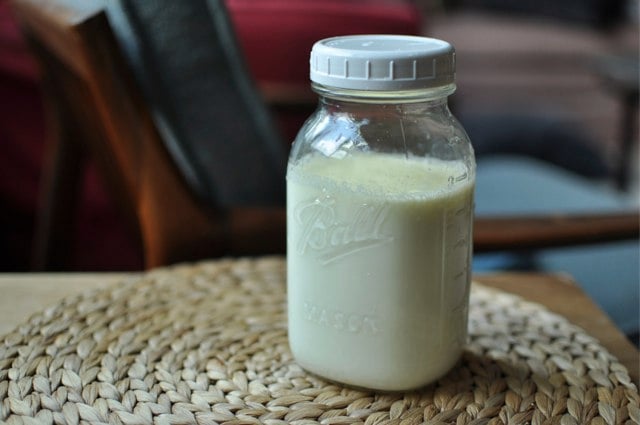
My personal yogurt consumption goes up and down. I’ll go for weeks eating it every day and then suddenly, I’ll stop and a month will go by before I have it again. I have no good explanation for this. It’s just the way things happen in my edible world.
I’m currently is a very pro-yogurt phase. I’ve been eating more than a quart a week and started feeling guilt about consuming so many plastic containers. It was time to restart my homemade yogurt habit.
Truly, making yogurt at home couldn’t be easier. I stop doing it out of laziness, but once I force myself back into the routine of it, I’m always glad (sounds like so many things in life, doesn’t it?).
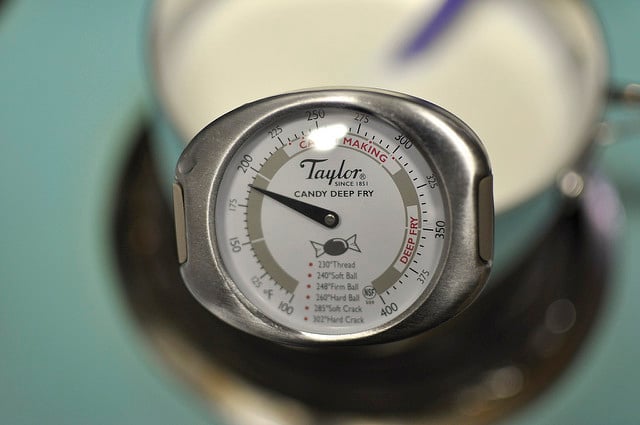
The first step is to heat the milk to 190-200 degrees F. You can use any milk you’d like. I made this batch using six cups of whole, un-homogenized milk (because it’s not homogenized, the cream will rise to the top, leaving me with a gorgeous, rich upper layer).

Once it reaches that temperature (take care not to let it boil), you want to cool the milk down to 120 degrees F. I do this by filling my sink with cold water and placing the pot in. The water helps reduce the temperature quite rapidly, so don’t walk away during this step.
Once it has cooled to 120 degrees F, whisk two tablespoons of yogurt into the milk. Over the years, I’ve tried using various amounts of yogurt to start my batches and I’ve actually found that the smaller amounts work better than larger amounts. A tablespoon for every 3-4 cups of milk just seems to work perfectly.
There was also a time during which I stirred some dry milk into each batch of yogurt I made. I’d heard it made for a thicker yogurt. In the end, I decided it had no discernable positive impact on the finished product and, if anything, left me with lumpy yogurt.

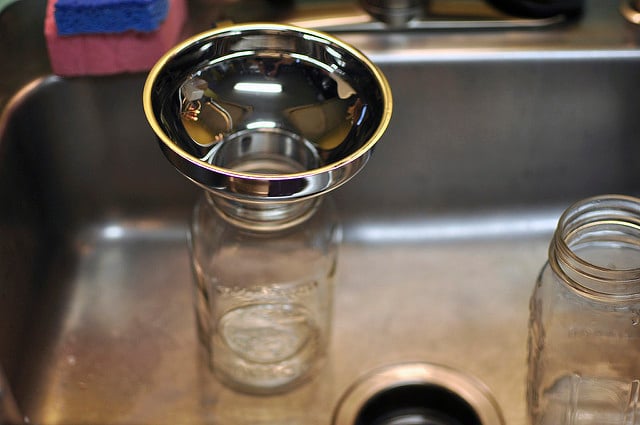
Once you’ve stirred the yogurt in, pour the inoculated milk into your jars. You’ll see that my jars aren’t entirely full. There’s no reason why you can’t fill them up to the top. I just didn’t have enough milk in the fridge to make a full batch. However, I filled the jars evenly because I wanted to ensure that they’d process at the same rate.
A note about the starter yogurt you use: Make sure to use a yogurt that you like. There are a number of different yogurt bacterias out there and they all turn out slightly different yogurts. Splurge on the starter in order to make something you’re happy with.
There are a number of ways you can keep your yogurt warm during it’s process. Some people have little machines. Others pop the jars in the oven with the light on. I’ve even heard that you can use a slow cooker or hot pads.
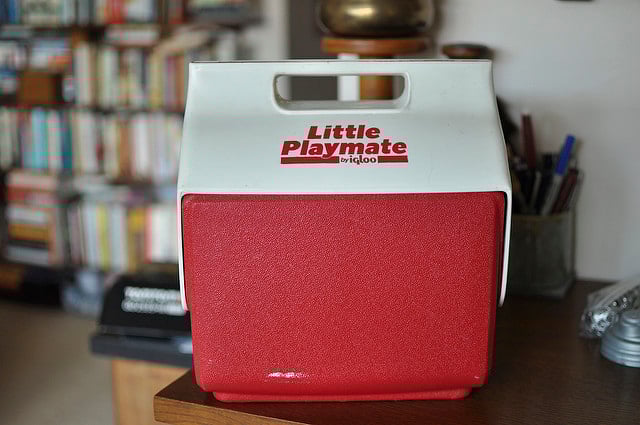
After trying all those methods, I’ve come to prefer using a cooler for this step (hat tip to the Frugal Girl for introducing me to this method). This Little Playmate holds two quart jars perfectly. I got it at a thrift store several years ago for a couple dollars, which has always pleased me.
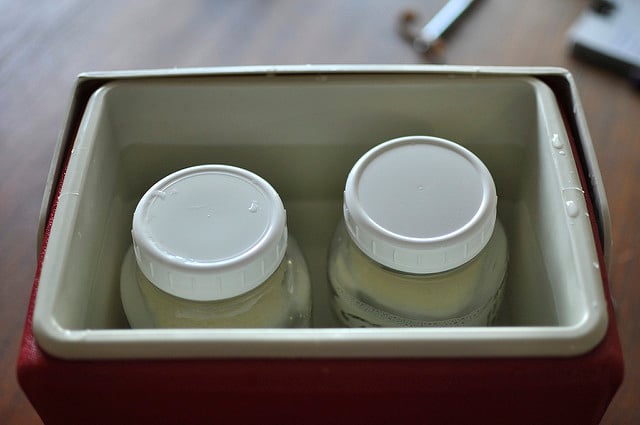
Place your filled jars into the cooler and add hot tap water until they’re submerged, but not floating. You want the water to be around 120-125 degrees F. I’ve found that this is exactly how hot my hottest tap water is, so I use that. Makes life easy, too.
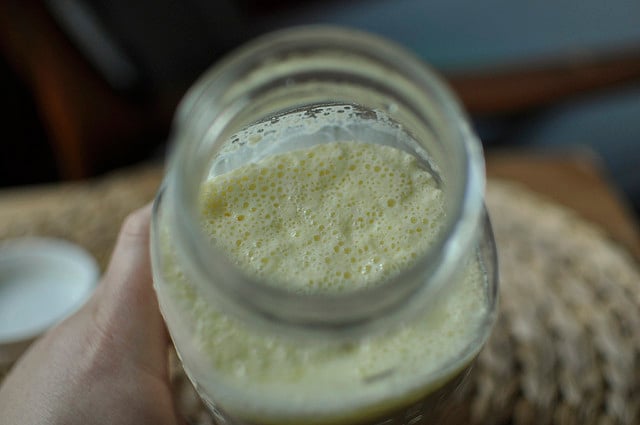
Once the jars are in the cooler and it’s filled with water, close it and tuck it out of the way for 6-7 hours. You can go as long as 8-9 hours, but keep in mind that the longer it sits, the more pronounced its tang will be. When I was working, I’d often start a batch of yogurt just before I left the house in the morning and let it process all day. It made for a tart yogurt, but I loved the simplicity of it.
When the time is up, remove the jars from the cooler and place them in the fridge. Use your homemade yogurt like you would any other kind of yogurt. If you’re interested in transforming your yogurt into a thicker product (along the lines of greek yogurt), all you do is strain it. Well Preserved has a good post on that, as well as suggestions for using up the resulting whey.
For those of you who regularly make yogurt, do you have any tips to share?

I wanted desperately for Frugal Girl’s cooler method to work for me, but I failed miserably 3 times – I think the cooler I used was too big, my house is too cold and my thermometer was not responsive enough.
I now use Little Miss Cruciferous’ method in a soft sided cooler that fits 6 quart canning jars perfectly and bought a better thermometer. I use whole milk (it’s actually 4%!) heat to 180F, cool to 105F, whisk in starter, pour into jars, fill other jars with boiling water, make it before bed, and come next morning I have 3 quarts of firm yogurt.
I used a single serving of plain Dannon yogurt as my starter, and I now just use some of last week’s batch to make this weeks batch.
My BIL’s father, a central European immigrant, just puts a pitcher of milk on the counter, whisks in some starter, and 2 days later he has yogurt he puts back into the fridge. (*!*)
I’m so glad you found a method that works for you! I imagine that your BIL’s father uses a different starter culture. There are some varieties that will turn into yogurt at room temperature. Two days seems like a long time, though. That might make me nervous.
I usually turn a plastic storage box on its side, wrap my containers in a towel and put them in it with a space heater aimed at them from about 12 inches away (usually overnight)
I could never get the cooler method or the oven method to work for me either, I live on the cold central coast :[
The hot water method in a cooler works for me, and I have a cold house. But, in addition to the hot water bath I also wrap my cooler in a Bulgarian Wool blanket. I suppose you could use any wool blanket, but the Bulgarians often wrap their yogurt in wool to incubate, so I use my Bulgarian blanket around my cooler. Works every time.
I tried making yogurt in jars and it wasn’t consistent, then bought the little Salton maker but only the middle jar would set, so I spent $60 on a yogurt maker from King Arthur Flour and have used that for several years. I always drank skim milk and the directions said to use some powdered milk to thicken it. I never had any trouble with it being lumpy. I guess I’d have to make a lot of yogurt to make the price worthwhile, but couldn’t make good yogurt with jars. Some days it was thin and other days I could bounce it off the wall.
Thanks for the straight forward tutorial. I’ve been wanting to make homemade yogurt, but haven’t had much luck. I think I’ll give your method a try!
This is something I’ve been meaning to do more often for years… No excuse, right? It’s easy, it’s cheap, and it’s healthy!
I too go with the slow cooker method. No temp taking needed, just milk, a crock pot, a towel and a starter saved from the last batch. I tend to flavor it as needed with granola at breakfast and fresh fruit.
Here are more details of the timing I use:
http://www.randomrecycling.com/2012/01/how-to-make-your-own-yogurt.html
Good luck!
With 4 kids, I make yogurt all the time. I bought a culture from Cultures for Health that will ferment at room temperature (except in the winter when I put it in the oven with the light on). All it requires is pouring milk into a mason jar, adding 1 tbsp of yogurt for each cup of milk, then covering with a cloth for 12 hours.
Great idea with the mason jars and cooler. I had been using my crockpot and wrapping it in a wool blanket. Always works, but then i have to transfer it to jars. I am gonna try your way for sure. A friend’s mom taught me how to make what she called “makat”. She was albanian. Anyway, she used half & half instead of milk and OMG!!!! it is sooooo good and as thick as sour cream.
I have never been so excited to try anything ever. As a total yogurt fiend (who is saddened by the plastic containers I’m constantly recycling), you may have just changed my whole life.
Question: Can you use a bit of your own resulting yogurt as the starter in the next batch?
Yes… that’s actually recommended by most of the natural-food folks I know.
Excellent! Then I just found my weekend project. Thanks!
Definitely, yes. 🙂
Yeah, so I swiped my parents 1960’s yogurt maker (it was a wedding gift but they’re divorced now so I figured they have no attachment to it!) and repurposed it in my own kitchen! The mercury thermometer is long gone, so I scald the milk (I’ve been making it for years and just gauge it by feel), let it cool a bit, add a small amount of sugar (to feed the cultures according to the directions–which are still around!), and yogurt starter (a tablespoon or so saved from the previous batch), pour it into the cups and cook away! I remember my mom starting it at night, and it being finished by the morning so we kids could eat it for breakfast with whatever jelly was in the fridge. (Now, I prefer it with lemon curd…..)
I can’t wait to try out your technique with some of my Mason jars!
I’ve tried to market this method to friends as “You can make yogurt without electricity!”…provided you have a gas stove and matches, that is! How easy (and green!)
As much as I loathe single-task kitchen gadgets, I am absolutely in love with my yogurt maker. I was also feeling the plastic guilt (especially since my city did not recycle that type of plastic until last year!) and really just want more control of my food.
I’ve never seen this method and think it’s awesome! Thanks for sharing.
My experience has been that my yogurt is much happier if I cool the milk to 111 degrees Fahrenheit; if I leave it hotter, it is thin & watery. Too much heat kills the culture. I also use my 1940’s era Wedgewood with pilot lights as a yogurt incubator –crack the oven door open with a wooden spatula handle, and it’s the perfect temp (~111 F). I would highly recommend testing your incubating heat source for the proper temperature BEFORE using it. And yes, homemade yogurt is the best. I usually make a gallon at a time; the clean, sealed jars keep very well in the fridge until i am ready to open them. It helps that I put a layer of clean waxed paper on the opening before I seal it as well.
I’ve been thinking that I need start making my own yogurt, so I’m definitely excited to see such a great discussion of everyone’s different methods! I even have a tiny cooler hiding away in the laundry room, just waiting for mason jars…
Will this work the same with raw milk, does anyone know?
Yes, it works well with raw milk.
Would love to win one of the those Recaps. Such a big fan of food in jars (generically), and now I’ve found your site. Yay!
I make my yogurt in quart jars– I actually heat the milk in the jars, so less clean-up. It takes a bit longer, but is easier for me.
I go in yogurt streaks too, so I keep some that I froze in mini-muffin tins on hand. I keep my yogurt warm in a large coffee thermos. It holds one quart of yogurt perfectly (and that’s how much I tend to make at a time), and always comes out great.
Marisa… Can I please just tell you how much I LOVE, LOVE, LOVE your blog. Seriously. I’ve been reading for years, and every time there is a post that really resonates with me I say to myself, “GOSH, I love this blog!” and this is one of them. I love the idea of being self-sufficient, and making yogurt was something that I tried once before, and was looking into trying again. Thanks for motivating me!
The recipes, stories, recipes, humor, recipes, advice and last but not least RECIPES are my favorite and many are my “go to” ones now… Thank you for all that you do, and for taking the time to make such an amazing blog that makes a huge impact on my life.
Ginny, thank you so much for the lovely comment! I’m so happy to hear that this blog resonates with you!
I have been drinking flax milk lately and so don’t generally have cow’s milk in the house. Do you thunk flax milk will work? I would really like to make my own yogurt. Or maybe almond milk?
I make yogurt the same way, except I use two of the hot/cold packs that you can microwave for the heat. Love all the great comments with tips. I will have to try using the smaller containers to see if it sets up better. I’ve found that it’s difficult for me to make yogurt in the winter (in Colorado) because I can’t keep it warm enough, but it works really well other times of year. Good thing I switch to oatmeal in the winter.
If you’re making yogurt using store bought yogurt as a starter, be sure to buy yogurt with active/live cultures. If they are live the container will say so. Much of the sugared fruit flavored yogurt doesn’t have live culture.
I also make mine in jars but I usually use jars that commercial food came in originally and save my real canning jars for, well, canning.
Thanks for posting. I’ll definately be giving this a try soon. I like being able to make common fridge items at home and know EXACTLY what’s in them. Preservatives just aren’t my thing.
I use unflavored gelitin in my home made yogurt (slow cooker method) it makes it thicker. I love to add fresh fruits and honey. My kids love to help make this and enjoy eating something they made from scratch 🙂 Also sometimes I add mango/peach necture it’s think and adds wonderful flavor.
Do you know if yogurt can be made with soymilk? The yogurt starter would be non-soy, but I love the taste of vanilla soymilk.
A friend of mine makes yogurt from soy milk, so yes! She didn’t mention any difference in technique.
Marisa…this is such a great post! Never made my own yogurt, but made my own ricotta cheese last year and found that to be easy enough, so I’ll have to try this. I like the heating pad or crockpot version as well.
Also, for those who may have backyard chickens or am I the only one here(?), they love yogurt and if you strain it, that water is good for them and most any other animals you may have…pour it over the dog’s food or let the cat just lap it up…very little goes to waste here…between my dogs, cats, chickens and potbelly pig…we keep things recycling!
I am in the experimental stage with making yogurt. I haven’t hammered out the perfect way for me yet but I love reading what works for everyone else while I keep trying. I have had varying results over the last several months of trying. I am always intrigued when someone talks about how ‘easy’ it is… Not my experience so far!! Ha! But I am going to keep trying until I can be one of those people… Love the post!
Thank goodness I am not the only one who is not finding it “easy”. I have had more batches of slightly warm milk than I care to admit. Pilot light did not work, heating pad did not work, yogurt machine sometimes works, etc. I am taking a break – but may try once I can get milk at my farmers’ market that opens in a few weeks.
I would suggest checking the temperature (over a few hours) of your heat source–111 F is the best temp for yogurt. any higher can kill the cultures.
A digital thermometer with a probe is the best for me.
I do it almost exactly the same way, except my cooler is a soft insulated bag, so I pour boiling water into two MORE canning jars and add them in there to keep the temperature up. And of course, you didn’t mention the best part — adding a spoonful of homemade jam to the yogurt when you eat it. Lately I’ve had pear-ginger yogurt, pomegranate yogurt, peach butter yogurt, habanero-berry yogurt…
What a great way to make yogurt! I am going to keep my eye out for an appropriate size cooler and give this a try. I have a yogurt maker with the small jars, but I like the idea of having it in the larger canning jars. Thanks!
I make yogurt a couple of times a week this way. It is so good and I use it in everything. I’ve found that if I drain the starter yogurt ( 2-3 tablespoons in a coffee filter and one of those one cup melita things for about 1/2 hour or so) my yogurt is a little firmer.
That’s a great idea, I’ll have to try it!
I once had an oven with a pilot light – tucking the inoculated milk in there overnight made perfect yogurt Every Single Time and was by far the easiest method I’ve ever tried. I’ve tried others since then, but they all have temperature control issues and are more complicated.
Hmm… I always strain my yoghourt (I like it thick!) so I never bothered pouring the milk into jars first — generally I pour it into a cast-iron pot (it holds the heat really well!) to leave it to work. After reading Karen’s comment, though, I wonder if my yoghourt might just turn out thicker if I made it in smaller containers? Something to try!
I’ve been making my yogurt in the crockpot for a while. Do you find that this is less runny? Crockpot yogurt tends to need a filter through cheesecloth after process…
The yogurt I make this way isn’t super runny, but the consistency also has something to do with the yogurt you use as your starter.
Good to know! I guess I need to find a starter thicker than fage greek!
I always make my own yogurt. It’s so easy! I use a electric heating pad (like the kind you’d put on a sore back). I set my jars on it, wrap them with a towel or two, then invert a large pot over them. The heating pad goes on low for 6-8 hours. The only issue I have, is that today’s heating pads turn themselves off after an hour, so I only make yogurt when I’ll be around to turn it back on.
I use canning jars to make my yogurt as well. However, I have switched to a strain that cultures at room temperature. Since, like you, I can go for weeks at a time without eating yogurt, I’ve started freezing a bit of the culture for my next batch.
I’ve been intrigued by those room temperature starters. I’ve meant to order one for the longest time.
Is it me but I have a hard time making homemade yogurt. It comes out thin – perfect for smoothies but nothing else or sometimes doesn’t even come together! I have tried all types of methods (including dried cultures) and still same results. I just put my yogurt machine in the garage. Is there something I’m doing wrong or is that how everyone’s yogurt turns out?
Meg, I wonder if you’re letting it go long enough? You could try straining the finished product to get a thicker yogurt.
I typically let it “cook” for 8 hours but honestly I have had to try 12 hours and it still looks like milk. I do find that if I use whole milk it at least has a smoothie texture. Is this the same texture everyone gets? Perhaps I am too used to commercial yogurt which obviously has thickeners in it.
Maybe your yogurt machine is broken? If it gets too hot, it will kill the active cultures that make it yogurt. Maybe try a different method to see if you can get it to go.
I’ve tried making yogurt a few times, but I like this because of the low maintenance… I think I’ll try to get back on that horse soon. That’s interesting about using a smaller amount of yogurt, I wouldn’t assume that but it makes sense. Thanks Marisa!
Marisa,
Thanks so much for the links – and I love the look of your yogurt! Many years ago I was involved in importing those exact coolers to Canada. 🙂
Like you I also am a major streak-eater. 🙂
J
Joel, you’re welcome! And how funny that you imported those coolers!
Making homemade yogurt always seems like something I *should* do, but never try because I’m worried that it will be too hard. Thanks for demystifying the process!
I too use canning jars! I’ve been using a tablespoon of starter yogurt per cup of milk. I need to try less! I let mine incubate in a dry cooler with a heating pad in it set to the high setting. I let it incubate for 6 hours. Comes out so thick I can turn the jar upside down and it stays put. Oh and I use whole milk.
I also started out the crockpot way but have been doing this way for a couple of years now! I do the oven-light method, as it’s the simplest (no added clutter!) and works perfectly in 8 hours — a work day or overnight. Since it lasts so long in the fridge, I also always use a half-gallon, poured into one half-pint jar and 2 quart jars. That way, I have the small one for my starter without having to remind my family not to finish the yogurt! 🙂
Smart to save some out for the starter!
Great post as always……..I didnt realize how easy it was to make yogurt……waiting for new canning jars (pint and a half) and then I am doing this recipe.
I make yogurt once a week. I use any kind of milk I have on hand, often powdered milk if I am running low on fresh. I add the powdered milk to increase the protein content of the yogurt. I heat it up in the microwave, so easy and you do not have to watch the pot on the stove. My microwave for one quart of milk is always 8.5 minutes to 185 degrees.Then I let it cool to 120 degrees on the counter without any special use of ice or cold water, just let it sit while I do other things. I use the little 4 oz canning jars because they make a nice single serving. I have a yogurt maker, I am into dead easy. If you get a yogurt maker, get one that takes any container, not one that you are forced to use the supplied container. It is only for convenience that I have the yogurt maker, for years I made it in a thermos . 6 hours work best, but often I go a bit longer because I make it at night so it is ready in the morning. Any excess I freeze in small starter quantities. Sometimes I buy milk in larger quantities than I can use while fresh and then freeze half of it for future yogurt making. I love homemade yogurt, it is so much nicer and fresher tasting than the store bought. 1 quart of milk makes 3 cups of yogurt, which is exactly the size of the larger commercial yogurt containers.
I love making yogurt! I use a thermos and a jar – very similar to your method but using hotter water (boiling) and colder milk (4C).
Often I’ll make it entirely from powdered milk, which is easier if I don’t have fresh milk on hand. The trick, if you’re adding powdered milk to fresh, or using entirely powdered, is to add it/make it up and let it sit in the fridge for an hour or so to let the powder fully absorb the water before you make yogurt with it. Adding some to your fresh milk does make for a thicker yogurt – but I certainly made some very ordinary, lumpy and total fail ones before I learnt to let it rest first!
Another tip is to freeze some of your freshly-made yogurt in an icecube tray, and use that as your starter next time. I use 4-5 icecubes per litre of milk (erm, a quart? I think?), sometimes a couple more for good luck if the culture’s been in the freezer for ages or I forgot to freeze it straight away. Saves going to get yogurt just for starter culture if you happen to go a while between batches. Just don’t use the icecube starters to cool down your milk from hot or you’ll kill the poor things (spoken from experience).
Thanks for the tip on letting the powdered milk sit for awhile to absorb. That’s obviously what I was doing wrong.
How much powdered milk do you add to a half gallon of fresh milk?
Hard to imagine a single day without my homemade yogurt… Indian meal is nearly incomplete without it..love this yogurt in jar recipe!
1. yum
2. where did you get the non homogenized milk?
I can get non-homogenized milk at local farmers markets or through the Fair Food Farmstand in Reading Terminal Market.
I love this! Will have to try this. I’m daunted by the sterilizing part of one of the sites I was using. I too used dried milk powder once and it was lumpy and the kids did not like it. I need to go back to making it and with fruit on the bottom. I agree, I hate wasting the containers over and over, and there’s only so much re-using you can do with those.
Can I ask, what are those white lids on the jars? I may have missed the post where you introduced them.
Thank you!
Those are the Ball brand plastic jar lids. They’re good for yogurt making because the metal rings can start to rust a little during the time in the cooler. http://amzn.to/IbeqqD
Thank you! This will be much easier when I store leftover stuff in the jars.
I make my yogurt in my slow cooker from a recipe I got from another blog; Crockpotting 365. I’ve used vanilla yogurt as my starter along with half a gallon of milk. The process is a little time consuming but the end result is GREAT! Nothing you can’t do over the weekend. I actually just made some the other day…..now I just need to figure out how to make it into chocolate fro-yo!! 😉
I do the same thing, and I use the same recipe, too. I never thought to use flavored yogurt as my starter, though. Great idea!
I love making home-made yogurt, but like you my consumption goes up and down, and I’d often rather go without than potentially waste yogurt.
I also usually strain my yogurt post-culture (either after letting it set in the fridge for a while, or immediately) for a Greek-style yogurt, but this makes it keep for a shorter duration as it is less “sealed”… and it doesn’t fit in the jars nicely any more!
I make homemade yogurt as well. I heat to 180 then cool to 110.
I have always used freeze-dried starter with probiotics however, this week,
I am going to try and use some of my yogurt as the starter. A test!
I worked at a hospital and was warned years ago by a Nurse to use a yogurt
machine, so that’s what I’ve always done. I know lots of folks make it using a
cooler, heating pad, oven, etc., I’m just a big chicken. My machine makes
7 six ounce small glass jars of yogurt. I only process my yogurt for 6 hours as I
like it a bit less tart. I never thought I would enjoy the flavor of plain yogurt,
but I eat it every day and love it. Try it, you’ll like it! 😀
I make mine the same way! I’d always read you must use plain yogurt as a starter, but since I always add sugar and vanilla to my milk once it’s scalded, I tried using vanilla yogurt as my starter and it worked great!! When I want to make yogurt, I pick up a half gallon of whole milk and a little cup of our favorite vanilla yogurt, which makes it easy for me!
Hey! I make mine in canning jars too! (And I made some last night.)
I only heat my milk up to 180 degrees, and I’ve been pretty neurotic about it so I’m glad to see you have a range that is higher … that means that I won’t wreck mine if I go a bit higher. That’s a tonne of stress off!
I was experimenting with all different ways to keep the temp even a few years back, light on in oven, in my slow cooker insert, in a cooler. I was getting such unpredictable results that it was making me insane. Then I read an old hippy on a discussion thread somewhere totally gaffawing all the technique exchanges, saying he simply wrapped his in his duvet for 7 hours (or so).
I now put mine in small jars — little jam jars as well as 1/2 pint wide mouths set in a plastic basket — after having read that the smaller the containers the better the set and wrap ’em up in a duvet. I rarely have bad results (can’t remember the last time) and there is nothing nothing like the first jar of yogurt, still warm, that I eat first thing in the morning fresh from the duvet (which works like a charm, and every time I think about that hippy, I smile). A small glimpse of heaven.
I love this post. I think you really capture the joy of yogurt making and the scrumptious results.