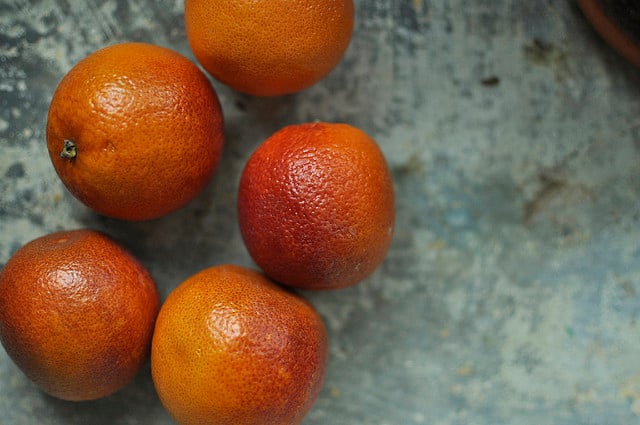
When I first started making marmalade, I thought it was the same as any other preserve. Chop the fruit, combine it with sugar and cook until set. I didn’t realize that citrus needed a more specialized treatment. You either need to cut away the tough, white pith or treat it in some way so that it tenderizes and loses its chewy bitterness.

This recipe uses an overnight soak to help break down the pith, providing a far superior product to the old blood orange marmalade recipe you’ll find on this site. The fruit becomes tender and it fully suspended in a ruby-hued jelly. Here’s how you do it.
Take 1 pound of blood oranges (approximately 4-5 tennis ball-sized oranges) and wash them well. Trim away both ends and slice the oranges in half.

Using a very sharp knife, trim away the core of the oranges and pluck out any seeds that you find. Set the cores and the seeds aside. Not all blood oranges have seeds, so don’t stress if you don’t find any.
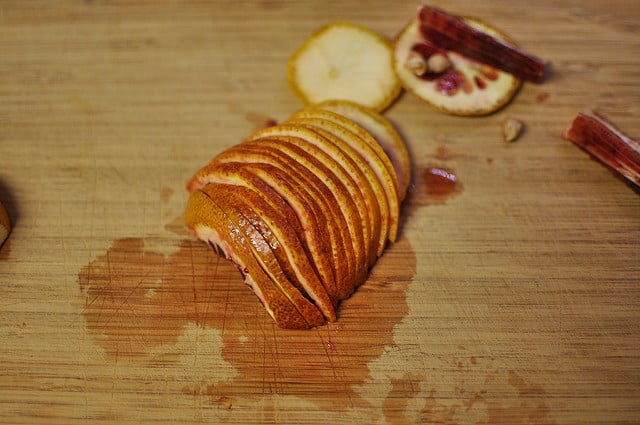
Cut the orange halves into thin slices. Go as thin as you can manage (I recommend sharping your knife before starting this project).
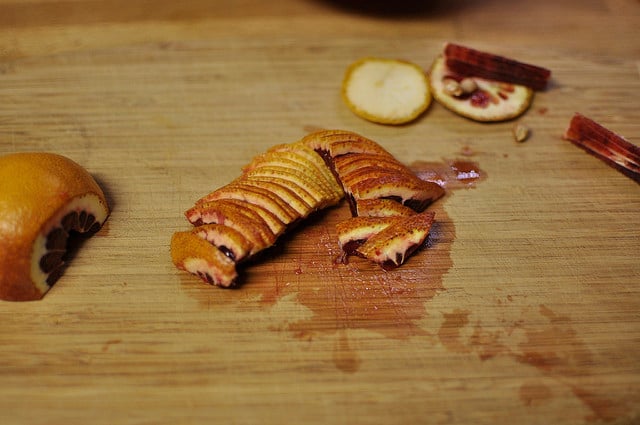
Finally, cut each sliced half in half again, so that you have a number of thin blood orange quarters.
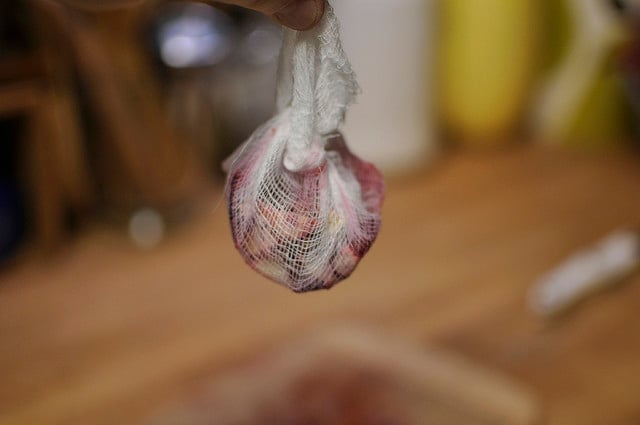
Bundle up all those seeds and pithy cores in a length of cheesecloth and tie it tightly so that nothing can escape.
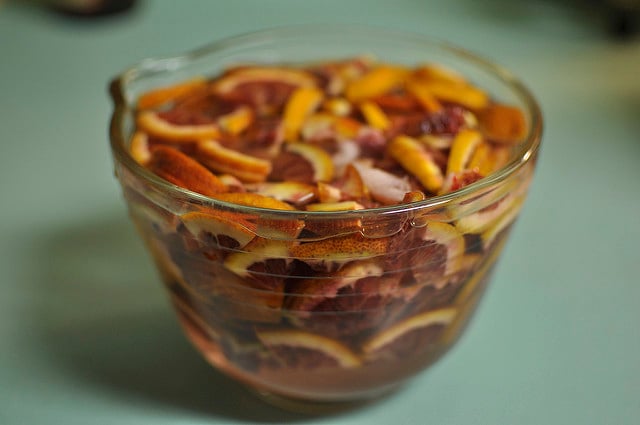
Put chopped oranges in a medium bowl and cover with 3 cups water. Tuck the cheesecloth bundle into the bowl and cover the whole thing with a length of plastic wrap or a plate. Refrigerate it overnight.

When you’re ready to cook your marmalade, remove the cheesecloth bundle. Combine the soaked fruit and water with 2 1/2 cups granulated sugar. If you happen to have a copper preserving pan like the one you see pictured above, make sure to fully dissolve the sugar into the fruit before pouring it into the pan.
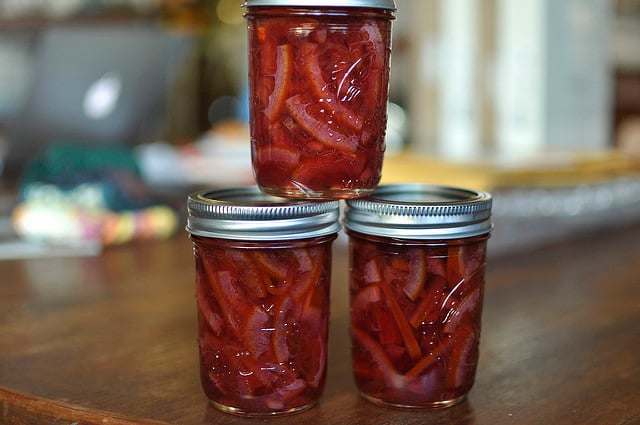
Bring the marmalade to a simmer and cook until it is reduced by more than half, reads 220 degrees F on a thermometer and passes the plate/sauce/wrinkle test. When it is finished cooking, pour marmalade into prepared jars. Wipe rims, apply lids and rings and process in a boiling water bath canner for 10 minutes.

When all is done, you should have three half pints of the most vivid red blood orange marmalade. I’m extraordinarily fond of this particular preserve on peanut butter toast, as you can see above. It’s also good on scones, stirred into yogurt or with crumbly homemade shortbread.

Any ideas for making mango marmalade?
Any ideas why this would turn GREEN when cooking? Could it bee that the fruit was sprayed with pesticides the sunk into the skins? They were lovely like yours when I began….
Thanks…
Notes from a chemist: IF you used a copper preserving bowl, the copper may have reacted with the acids in the fruit to form a copper-based salt. For example, copper acetate (formed when copper reacts with vinegar) is a dark blueish colour while copper citrate (formed when it reacts with citric acid) is an intense, light blue. I suspect it is the later. Copper citrate occurs naturally both in nature and in foods and is actually used, when large amounts are present, as a pesticide. Small amounts are harmless, but if the marmalade is really dark, I would dispose of it to prevent risk of diarrhea and stomach upset.
I made my first ever batch of Mandarin orange marmalade a few months ago. I opened a jar and it’s . . . Um . . . Firm. I bent a spoon trying to get it out of the jar. Do you suppose it’s salvageable? I’m guessing that I cooked it way too long, not recognizing it was “passing” the plate test. I tested a second jar, just to see if it wasn’t a problem with that one jar, but it was tough, too. If it’s salvageable, should I heat the jar of marmalade in hot water with the lid off and then refrigerate it and use soon? Or what? Thanks so much!
First, the recipe says there are three tests, and the batch has to pass all three tests. This is not correct; pick one test and ignore the others.
Second, the recipe doesn’t say that the 220 degrees figure applies only at sea level. You have to reduce the temperature at altitude. The USDA has a jam making guide that includes a chart for the correction.
Third, when my first batch reached 220 degrees (I live very near sea level), it had reduced by only about one third (and yes, I was measuring with a ruler). If you use the plate test, remove the pot from the heat while the sample cools, things happen very fast at the end. If you use temperature, remove the pot from the heat the exact second it reaches your temperature, don’t let it cook further at all. One degree makes a lot of difference in the end result. The USDA says that marmalade can be cooked again if it doesn’t set up enough; I have not had that problem, and so can’t comment.
Fourth, this has nothing to do with setting, but I think the rind should be thinner than shown in the pictures. Commercial marmalade rind is so thin it is nearly translucent. For one batch, use a very sharp knife. I bought a mandolin, which speeds the job up a lot, but I haven’t really gotten the hang of using it yet so it is only somewhat thinner. Also, the mandolin leaves a lot of rind that still has to be cut by hand.
Astrayelmgod, (took me a sec to work out the handle — nice!) thanks for saving me the time to not just type the equivalent of what you said above, but also the thinking. SO grateful, because like you, I try to assist when needed, but time is oh so short for me right now.
While there’s lots of room to play in the jam, jelly, preserve, and conserves (I routinely cut the sugar in half and usually don’t have to use the low sugar pectin — have no idea why, since the variety of fruit doesn’t seem to make that much difference. I got lucky with my first canning attempt, where I cut the sugar from the start, and have just been on a roll since. My problem seems to lie with using liquid pectin, but that’s another story.
Denny, I highly recommend buying a mandolin. It makes slicing *so* easy and *so* fast, and every slice is exactly the same size. It is a *severe* cutting hazard, so ALWAYS employ the hand guard (in extremis, you can use the *flat* of your hand as many chefs do, but I’d try to avoid it until you’re an expert). There are mandolins out there that cost a blooming fortune, but we bought the Oxo brand which was the second least expensive one at the time. We can slice down to 1/16″, and make a variety of shapes with different blades, including julienne.
I also agree with Astrayelmgod that the peel should be MUCH thinner. There’s so much pith in the jars above that even with soaking and alkaline processing, I can’t believe those jars are anything but a bitter yuck. (Sorry, FIJ, you know I love ya, but…)
It’s very difficult to remove *all* the pith, but you just don’t want that white bitter mealiness in your marmalade. Trust me. My first attempt at canning was a five citrus marmalade where I was *very* careful about pith. It turned out wonderfully, but it took hours and hours. I decided to make some sugar-free for my diabetic in-laws, but wanted to shortcut the process and juiced my grapefruit using a juicer.
I can’t tell you how bad an idea that was. It spit all the pith out with the juice, not the peel. The color wound up looking more like lemon curd — not at all translucent. That was bad enough, but it was nothing but one of the nastiest things I’ve ever eaten, and I’m game to try anything, so have eaten some weird stuff.
Since I had already done jars for ourselves, I didn’t taste this batch — my second cardinal sin in that effort. I had a reputation for creating great food that required pretty decent technique, and my first gift to them was completely inedible. (Of course, they were too nice to say anything, but we ran out and I had a jar of the other still here and opened it and KNEW how nice my in-laws were. 😀
Good luck fixing the batch!
Since I gave all my canning supplies away years ago, I am wondering if this marmalade could be frozen–instead of processed in a water bath…? I’m hoping you’ll say, “Just fine.”
Thanks
You could freeze it, or you could just let the jars seal and keep them in the fridge. They’ll keep 6-8 months unopened in the fridge.
Just made a double batch of this, and wound up with about 5 half pint jars (I think I would have gotten more out had I not been eating it as I went)! Absolutely lovely and just the right balance of sweet and bitter. Now on to the grape catchup recipe (planning on using it for pulled pork next week)…
Awesome! This recipe convinced me to try my hand at canning. Last month made my first ever marmalade using your blood orange recipe. Wow so easy. It took alot longer than I thought it would but the result was worth it. This marmalade is not bitter and suprisingly very sweet.
I’ve decided to try this “small batch” recipe as my first foray into canning. Have really been enjoying your site since I discovered it a few weeks ago.
So a quick question, I went ahead and got the small batch canner you recommend with the wire basket. If this recipe yields three half-pints, is it ok to process them sequentially? Only two of the Kerr half-pint jars will fit. Research on this seems inconclusive. Some say you must process immediately but other say you could process again the next day if the seal doesn’t work.
Thanks!
Krystal, I’ve found that as long as you do your best to keep the remaining jar as warm as possible and then add 2-3 minutes to the processing time once it is in the water bath, sequential processing is okay. Do note that I only do it for high acid with a great deal of sugar, as their risk of spoilage is low.
So this went pretty well. Thanks for the great recipe!
My only follow-up question is about the instruction to “simmer.” Many of your recipes say to boil or boil vigorously and I was wondering if you have a guide to what you mean by those terms. I simmered (gentle bubbles) this for at least 50 minutes and it never gelled. I turned the heat up some and it all came to together nicely.
This would be great on some toast!
Excellent recipe! Great pictures and easy-to-follow steps. In fact, I’ve documented the process on my own blog: http://asinspiredby.wordpress.com/2012/02/15/how-to-look-fancy-tip-2-make-homemade-marmalade/
Thanks!
I’ve made quick pectin based jams but was intimidated by long boil marms. This is a wonderful easy recipe for this first time marmalade maker.
I decided to make mine without a thermometer and over cooked my first batch. It was super thick but yummy. I doubled my second batch and it turned out perfectly.
I made my second batch last night – the first has been shared with friends and co-workers. Easy to make and tastes wonderful!!
Have been wanting to make blood orange marmelade for three years but never found the time. I bought oranges today but already thinking of additives = peppercorn, strawberries. Too many choices.
I finally got around to cooking this marmalade (my first in fact) and the jars are cooling on the counter. I got caught up with work (and life) and had to let the bowl sit in the fridge for a few days. I just tasted the congealed spot of jam from my plate test and it was so full of flavor! I think I’m gonna love this blood orange marmalade!
I made a triple batch up today; amazingly good. I added one lemon to the mix to give a little extra zing, and because I’m a bit of a chicken added some pectin during the last several minutes before bottling. This was my first attempt at Marmalade and I’m delighted. Thanks for sharing this easy recipe. You’re the best! http://tinyurl.com/7fwlxej
Hi Marisa, Just a quick note that I made this today and it’s wonderful. I used 4 blood oranges, 1 cara cara, and 1/4 c diced crystallized ginger. So pretty and good!
Another ‘why’ question for you…
I noticed a lot of marmalade recipes call for a lemon or two even if it’s in another fruit base. Is this for acid balance (taste), preserving qualities (safety), set up (texture)? And obviously it is fine w/o in this recipe?
Thanks!
Marisa,
Loved the blood orange marmalade! I doubled the recipe and cooked the mixture just shy of an hour at medium-high heat. I obtained 5 3/4 half pints.
I especially loved your shortcut method. So much so in fact, that I applied it on a 3 citrus marmalade I cooked this morning. The resulting spread is perfect for me since I prefer a slightly bitter marmalade with a nice chewy texture. I will probably experiment with other citrus fruits in the future. I no longer fear marmalade-making thanks to you!
I made this yesterday, Marisa, thanks for an awesome recipe. It is a little bitter, but I love it, way nicer than store bought marmalade that is too sweet. The only change I would make when I do the recipe again would be to cut the oranges into smaller, thinner, pieces.
Hi Marisa,
This looks wonderful! How tart/bitter is it? What do you think of adding some candied ginger, and/or using a combo of Blood Orange, Navel and Cara Caras?
Many thanks!
Emily
Emily, that’s a tough question to answer, because everyone perceived bitter differently. I don’t find this marmalade at all bitter, but when my husband tastes it, all he can taste is bitter. But, in the spectrum of bitter marmalades, I’d say that this one is fairly mellow. As far as adaptations go, I do think it would work with an assortment of fruit. However, since I didn’t make it that way, I can’t make any promises.
Ok, many thanks! I will let you know!
just made blood orange marmalade a few weeks ago using a similar- but even slower- method. 3 days! it does make a beautiful (and not bitter and wonderfully textured) finished product, though.
Oh my, the color on this is absolutely gorgeous. I love blood oranges! And the thought of combining them with peanut butter for breakfast… mmmm!
Your copper pot is gorgeous, although don’t you worry about the acidity of the citrus reacting with the copper? (One reason I’ve shied away from copper at home, although if you don’t have any problems with it, perhaps I’m being too timid…)
I went back and forth on copper for a long time. Here’s the blog post that finally convinced me that I’d be okay. http://hitchhikingtoheaven.com/2010/06/is-it-safe-to-make-jam-in-a-copper-pan.html
The most important takeaway from that post is that you never put unsugared fruit into a copper preserving pan. Only once you’ve combined the fruit with the sugar can you put it in there. And no low sugar preserves. I never do fruit butters in it.
This was a great post, thanks so much for linking to it! Fascinating stuff. We use giant copper pots all the time at work (they’re from the 1800’s, and our bosses do love to keep everything, even kitchen equipment, old-timey) but my pastry chef is very insistent that we never put fruit of any kind in them. Makes sense now, as our fruit is being cooked for ice cream toppings and probably doesn’t have the same sugar content as a jam or jelly. But they’re amazing for hot fudge and caramel cooking– gotta love that superior heat distribution!
Glad to help! And now all I can think about is making caramel in my copper pot.
Doooo it! Isn’t it great to have an excuse to make caramel? 🙂
Although I’ve been canning and even selling my own yummy jams for a decade I had never attempted marmalade. Until yesterday, that is, when I bought a 2-pound bag of blood oranges on a whim. What are the odds that a quick web search to find a suitable recipe lead me to your blog only a few days after you posted this recipe?
How nice to find a fellow preserver! Thank you for sharing this recipe. I opted to double the recipe and my fruit is currently prepped and resting in water for the rest of the day. I can’t wait to taste it! A couple of questions: how many half pints does your recipe yield? How long the marmalade must simmer before reaching the gel point?
Oooops… Just read the last part of your recipe stating the 3 half pints yield. So, I’m just wondering about the approximate simmering time, then.
Chantal, cook time varies greatly on the size of your pot, the heat produced by your stove and even the amount of humidity in the air. Mine cooked for approximately 25-30 minutes, but there’s no guarantee that your results will be exactly the same.
Hello Marisa,
Thank you for the ball park figure. I just want to allow enough time for making the marmalade. 🙂
Any thoughts on using this recipe and adding wine (possibly in place of some of the water)? I tried out a recipe for Beaujolais-blood orange marmalade that was posted on Serious Eats a couple of weeks ago, and while I *love* the combination of the citrus and wine flavours, it’s on the sweet side and requires commercial pectin, so I’m not inclined to repeat it.
I’m giving this one a try. I love marmalade but have always been a bit intimidated by all the prep work. Thanks for sharing!
must. get. over. my. jam. making. fear. now. because i need me some of this marmalade.
also? the cuppow is genius, surpassed only by those cozies!! man, what a lot of sweet goodness. love it. thanks 🙂
xo,
m
Hello – I love your blog and have been following for about a year. A quick question, please. Using the method you described above (using weight and water to determine sugar amount), is it safe to double or triple this recipe? Very excited to try it. Many thanks!
You could double it without issue, but I wouldn’t triple it. The reason for that is explained in this blog post: https://foodinjars.com.s164546.gridserver.com/arugulapesto/2011/01/canning-101-why-you-shouldnt-double-batches-of-jam/
I love my blood orange marmalade on peanut butter toast, too! I also really enjoy it as the foundation for a pan sauce for roasted pork tenderloin with fennel. Thanks for making our lives easier.
Hey there, just checking in on all my fellow can-jammers, and I’m happy to see you are still making great canned foods! Your marmalade looks beautiful!
a friend brought me 2 jars of blood orange marmalade from her last trip to europe. one from the famous orangey place, seville. and one from somewhere in italy. they both were soooooooooooo bitter i could not stand to eat them. which really put me off of trying to marmalade all this great citrus hanging on trees around me in florida. but i am going to try your method.
i’m wondering if european tastes for citrus marmalade is just different than what i expect. i ran into this with limoncello. what i make is a lot less bitter than what you buy imported from italy.
by the way delphina is now chef at Grazin in hudson ny. promoted as one of the first restaurants to serve animal welfare approved meat. pretty interesting. http://www.grazindiner.com
I don’t find this marmalade to be all that bitter, but I also know that people have different levels of bitterness tolerance. And many congratulations to Delphina! That’s quite an accomplishment!
Marisa, that is devastating. No chance of finding any blood oranges around where I live, and it’s the most beautiful marmalade I’ve ever seen. Very jealous.
So sorry to tempt you thusly!
Sounds delicious! I thought I was done with marmalades this year, but maybe not! I just made a Thin Shred Pink Grapefruit and Cranberry Marmalade, basically thin grapfruit shreds suspended in a grapefruit/cranberry jelly. I precooked the shreds a couple of times in water then cooked them with sugar and the cranberry/grapefruit juice that I has strained through a jelly bag after cooking. It ended up being a soft set jelly. Any suggestions on how to make a bit firmer?
You can always save the seeds, bundle them up in cheesecloth and cook them with the marmalade. That extracts the pectin from the seeds and helps produce a firmer set.
I wish I was more of a marmalade fan – these blood oranges look so beautiful in, and out of, jars… I’m tempted to try converting myself to the marmalade way just to take a go at these!
Beautiful looking oranges and marmalade 😉
I keep telling myself that with the marmalade surplus I already have from last year, that I’m not making marmalade this year. This is leading me into temptation – blood orange marmalade is truly one of my favorites and this is gorgeous as well easy.
Thanks for posting this recipe. I’ve hesitated canning jams & jellies, but this marmalade looks so do-able and tasty!
Dianne
It’s really very approachable.
This must be so delicious!
This sounds delicious! I have not made a marmalade yet, but definitely will try it this spring, love the color from the blood oranges!
Do you think I can make this batch even smaller? I’ve got 2 good size blood oranges now. I was quite unsuccessful with my last marmalade batch but want to try again. Just not with a big batch. I hate waste.
Side question: do you make blood orange curd in the same manner as lemon curd, and can you can it?
You could certainly make an even smaller batch. The way I calculated the amount of sugar to use was that I weighted the fruit and water and added half as much sugar. Knowing that, it shouldn’t be hard to calculate the correct amount for a smaller batch.
Oh my goodness, this looks amazing!!
It looks absolutely delicious! I have never tried marmalade, but I may just now… (I’ve made dozens of other types of jams and even won a recipe contest once with my cherry lime).
Cherry-lime sounds really yummy….would you consider sharing your recipe for that jam, please?
Your post was timely; my girlfriend and I have been on a marmalade making binge the last two weekends (after reading the blog for over a year). We made a bit over two pints of blood orange marmalade and a couple of pints of a meyer lemon – clementine marmalade this afternoon.
You mentioned in a recent post that you’d been working on a bunch of marmalades for your publisher? Did you happen to try an Oxford style marmalade? I grew up eating them and my girlfriend and I made a batch last weekend – the catch is that they’re much darker than all other marmalades (caramelizing the sugar is necessary), and they should have pretty serious chew [and they require Seville oranges, which are available here in Northern CA, but are very hard to find otherwise]. It’s a different beast – but very, very tasty.
Thanks for the blog – we’re canning and loving it!
I think there is an Oxford marmalade recipe in the book I was working on, but it wasn’t one of the ones I tried. I think there’s a recipe for it in the Blue Chair Jam Cookbook, though.
There are a couple of good recipes for Seville orange marmalade in Darina Allen’s Forgotten Skills of Cooking book.
I wait all year for blood oranges and bought my first at the farmers market this morning. Made curd and will do a batch of marm tomorrow. 😀
Thanks for the inspiration!!
What a beautiful post!
Thank you!
This method also works very with Meyer lemons and grapefruit. I actually don’t like marmalade that’s made with zest and supremed fruit as much because I like chewy as a food texture. The “candied” peels make me happy. It also makes me happier to just slice everything up and throw it into a pot.
wonderful.
one of these days i am finally going to try jam making.
it’s all the rage here on cape cod during the summer with that damn beach plum
but i want to make apricot…
At what point in the process to you take the things out of the cheese cloth bundle? And what the heck is supreming? Please enlighten me! I also have a totally unrelated question about canning baby food (pureed vegetables) and whether or not its safe to do with a pressure canner…? Please help?
Eileen, I updated the recipe above. You remove the cheesecloth bundle before cooking the marmalade. You can read more about how to supreme citrus fruit by clicking here.
As far as baby food goes, you’re actually not supposed to home can purees, which rules out most baby foods.
Eileen, another reader has this to say about baby food. “When my son was small I used to purée whatever we were having so that he had real food (have you ever tasted that store bought stuff?): that was never overcooked, with zero additives (like sugar, “modified” starch or other fillers) or, when we were going to have something that he just wasn’t ready for yet, I would also have fruits, veggies (and later on meats) done up ahead in the freezer.
Ice cube trays make an excellent mold and are a perfect baby-sized serving. Once frozen, you can pop them into a freezer bag for storage ’til needed. Then, when travelling, being already frozen they stay cold until it’s meal time (and you’re always ready to feed a hungry baby, no matter where or when: )”
Quick question: Is this method particular to blood oranges for any reason or would this process work with all citrus in making marmalade?
Thanks!
Donna, I’ve not tried this method with every other kind of citrus, but it’s also worked for me with regular oranges.
No supreming does sound very very nice… I made a three citrus/ginger marm for christmas presents and halfway though (several hours in) I swore that I’d never make marmalade again. Then I tasted the magnificent ambrosia and I retracted every nasty thing I said about citrus preparation.
Do you remove the cheesecloth bundle or do you boil that with the citrus?
Oops, sorry about that. You remove the cheesecloth bundle before cooking. I’ve updated the post above.
Whoa. No supremeing? Really?! The membrane isn’t a problem? The pith doesn’t overwhelm? How different is the end product from marmalade made the more labor-intensive way? Because you would not believe how much I royally suck at supremeing.
Nope, no supreming. The overnight soak does a world of good in helping break down the fruit. The end product does have a bit more chew than my Three Citrus Marmalade, but it’s still quite wonderful.
I just juiced an entire bag of blood oranges, but wished that I had done this with them instead.
I did however make a meyer lemon marmalade the same way, but the recipe I followed didn’t say when to add the water! So the seeds just sat in the lemons overnight and still turned out fine. Definitely going to use your method next time.