
I firmly believe in the power of pickles. A few slices of pickled beets can elevate a basic salad into something worthy of the word dinner. Lay a couple of dilly beans alongside your hot dog and and suddenly it could pass for something far more gourmet. Couple cheddar with some pickled garlic scapes (chutney is also good here) and your party guests will praise your cheeseboard abilities to the heavens.

Here in the US, pickles are inextricably linked to cucumbers and so that’s where I’m starting. However, there’s no rule that cucumbers are the only thing that can be pickled. This basic technique can be applied to green beans, okra, asparagus*, cauliflower, carrot*s and all manner of summer squash. Make a promise to yourself that you’ll expand your pickle horizons this summer. I don’t think you’ll regret it.
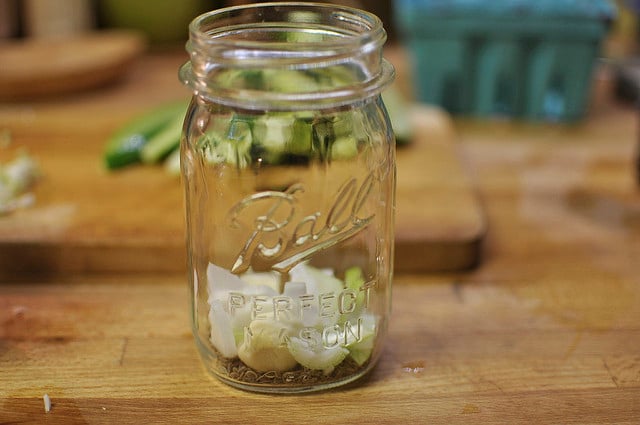
Many of my local farmers sell their kirby cucumbers by volume and so a single quart was my starting point for this recipe (I did weight them and had almost exactly 1 1/2 pounds of perfect, pickling cukes). I started by washing the cucumbers well, cutting off both ends (the blossom end has an enzyme that can contribute to limp pickles) and slicing them into wedges.
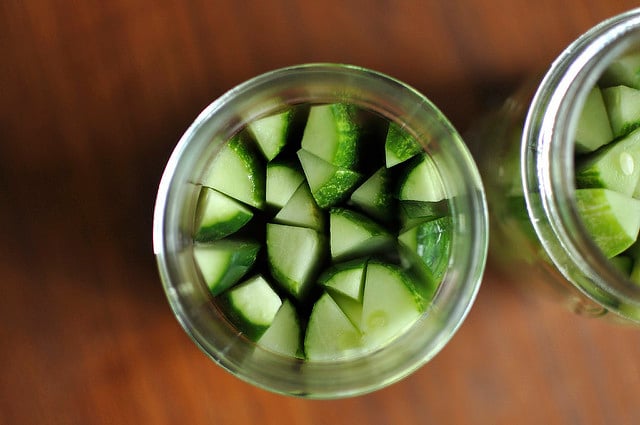
Once my cucumbers were sliced, I combined 3/4 cup apple cider vinegar with 3/4 filtered water and a two teaspoons sea salt. While that came to a boil, I prepped two clean pint jars. Each jar received one teaspoon dill seed, two peeled garlic cloves and one tablespoon chopped spring onion. Finally, I packed the cucumber spears into the jars. The quart of cucumbers fit perfectly into the two jars (makes sense since two pint jars equals a quart).
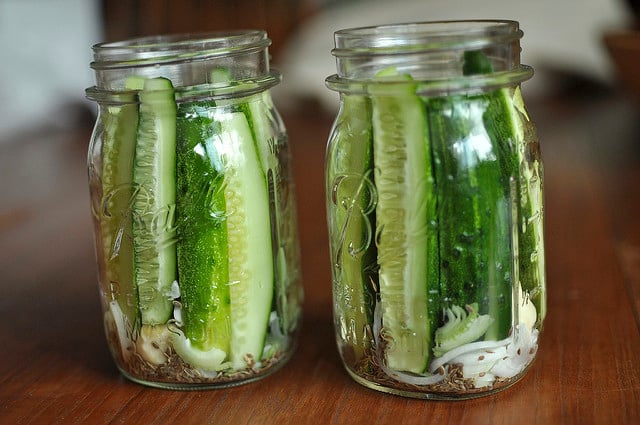
When the brine reached a boil, I slowly poured it into the jars, leaving a 1/4 inch headspace. Because these are refrigerator pickles (this means that they aren’t shelf stable and must be kept in the fridge) this is the point where the work is done. Once the brine is in the jars, you pop the lids on and tuck them into the fridge. Give them at least a day or two to cure and then nosh away.

*These vegetables need a quick bath in some boiling water before they’re able to be pickled. Spend the time and dirty the pot in order to blanch them for 30-60 seconds. The extra step will pay off in flavor.

Small Batch Refrigerator Pickles
Ingredients
- 1 quart kirby cucumbers approximately 1 1/2 pounds
- 3/4 cup apple cider vinegar
- 3/4 cup filtered water
- 2 teaspoons sea salt
- 2 teaspoons dill seed
- 4 garlic cloves peeled
- 2 spring onions whites only, chopped
Instructions
- Wash and dry kirby cucumbers. Chop ends off and slice into spears. Set aside.
- Combine vinegar, water and salt in sauce pan and bring to a boil.
- Equally divide the dill seed, garlic cloves and chopped onion between the two jars. Pack the cucumber spears into the jars as tightly as you can without crushing them.
- Pour the brine into the jars, leaving 1/4 inch headspace. Put lids on the jars and let them cool on the counter top. Once they’re cool, put them in the refrigerator. Let cure for at least a day before eating. Pickles will keep in the fridge for up to a month.

Just made these last night. It was super quick and easy! Can’t wait to try them!
I LOvE your cookbook and have been using it all weekend to can! Do you have any recipes or ideas for lemon cucumbers? My garden is bursting with them and I can’t keep up. Thanks for sharing!
Try them in relish recipes!
Can someone explain the difference between a slicing cucumber and pickling cucumber? I get that the seeds are smaller and fewer, but what’s the deal with the skin?
They are just different varieties. Pickling cucumbers tend to have a thinner skin but have a heartier texture. Slicing cucumbers have a thicker skin, but the flesh tends to be more delicate.
Can you use slicing cucumbers? Thats what I grew this year. Maybe make pickle chips by slicing them instead of cutting into spears??
You can use the for refrigerator pickles.
Hi Marisa,
What about the fear of listeria with the recipe? USDA remove fridge pickles from their website due to this – http://nchfp.uga.edu/papers/2004/04ift-picklesabstract.pdf
Jessa, that paper refers to lacto-fermented pickles, not quick vinegar pickles like the ones made in this post. As far as I know, there’s no danger to making pickles like these.
I have made refrigerator pickles for years and have kept them in the fridge for 6-8 months. Is this safe? My ingredients are similar to yours, although sometimes instead of onions, I put in spicy peppers. I’ve never had a problem eating or serving pickles after that long Generally once a jar is open, the pickles are gone in about a week. But the unopened ones have been in my fridge for up to 8 months. Just wondering if anyone else has experience with this?
Chris, that’s totally fine. As long as you’re starting with really clean jars and lids, and the brine goes in hot, those unopened jars of pickles can last up to a year in your fridge.
Thanks Marisa! I’m glad to hear it!
one thing I noticed with these measurements is that when I use a quart jar filled with pickle slices, I only get half a jar of brine. i have to double your recipe (1.5 cups of vinegar / 1.5 cups water) to fill one quart since 2 pints is a quart, I would think your recipe would fill a quart?
Does that mean I am overfilling with pickles?
Or am I fine as long as the vinegar to water ratio is 1:1?
Thanks Again!
I’m not sure why you’re experiencing that, but as long as you keep the water and vinegar in the 1:1 relationship, you can scale the quantities up or down without issue.
Hi, Ive just stumbled upon your blog via you guessed it Pinterest! (Lame I know, not everyone can be original and stumble upon your cookbook in a library) I am definitely getting your book.
I just did this small batch of refrigerator dills, with cucs from my garden. I had a small yield so this was bang on 🙂
Thank-you so much
Ive bookmarked your blog LOVE IT!
Bobbie P
From Red Deer AB
I have a couple of questions – on the refrigerator pickles, how long do they keep in the fridge? Also, my liquid is a little cloudy, is this normal? Can I use plastic screw type lids instead of the metal lids & rings? Brine jar in the fridge – how does that work?
Thank-you,
Maureen
i wondered the same thing about how long refrigerator pickles will keep. i know the liquid can turn cloudy and the garlic discolor, but they are still safe to eat. I just tasted some left in the fridge from the summer, and they seemed OK to me. let me know if you found out anything. i believe screw on lids are fine.
I find that as long as the vegetables are submerged and the liquid doesn’t appear to be developing a funky smell or any yeasty tendrils, they’re still good.
I made this brine about a week ago, changing the solid ingredients to preference or availability (including grape leaves for crunchiness), and just tasted them. They were my first ever foray into pickling, and I was very excited! I also put them all into one quart jar for ease. They were fine in all aspects except for the vinegar, which was so overpowering that they were barley edible! What did I do wrong?
I completely understand if you don’t respond, this is, after all, a very old post, but I thought I’d try anyways. 🙂
mine were overpowered with vinegar taste, so no one ate them. they’ve been in the fridge several months, so today i was thinking of tossing them. i decided to taste one before i tossed, and was surprised that they are now very good! maybe age helps the flavors mingle and mellow.???
The aging part is a huge element in pickles.
I added sugar, a little at a time, and kept tasting it until it toned the vinegar down. They turned out to be excellent pickles after that!
Have you ever pickled jalapeno’s? I’d love to know how! Thanks! Love your site!
Check the recipe index, there’s a blog post about it there.
I did not have apple cider vinegar and substituted white vinegar. I also added 2 teaspoons of sugar. Doubled the amount of garlic. I will never buy another jar of pickles again!! Thank you!
My questions is.. You said, They do need a quick bath in boiling water for 30-60 sec. Can you explain that better to me? After adding onions, garlic, cukes etc. to jar & putting lid on. Then put them in water & bring the water to a boil for 30-60 sec ? Or the liquid in jars have to boil 30-60 sec ?
Sandy, only the vegetables marked with an asterisk need a quick bath in boiling water to soften them before pickling. It is not part of the recipe instructions, it is simply a note. So if you follow the recipe as written, nothing needs a “quick bath in boiling water.” You only do that if you swap in carrots or asparagus for the cucumbers.
My daughter and I made these pickles today. Cant wait to see how they turn out!
Hi…I’m planning on trying my hand at these this week. Question though…does sugar go into these at all? Or does that make a different type of pickle? Can you do Bread and Butter pickles this way too? Can’t wait!
These aren’t a bread and butter pickle, so no sugar. I did a post about sweet pickles for Serious Eats yesterday, though. http://www.seriouseats.com/2012/06/in-a-pickle-bread-and-butter-pickles.html
I made these for the first time – my first experience with making pickles – an my garlic has blue on it? What should I do? Are they still safe to eat?
Yep, your pickles are still safe to eat. Sometimes garlic turns blue when it’s exposed to acidic environments.
It is a reaction to your water (copper). They are safe to eat.
My 13 year-old daughter just made these these with the cucumbers and onions she grew. She is planning to give jars to her teachers this last week of school since we have so many! I can’t wait to try them. This is the first recipe of yours I have been brave enough to try even though I have followed your blog for awhile. One day we will be brave enough to actually can something or make some yummy preserves on our own!
why would they develop mold?
Do you do the hot bath before you slice the cucumbers or after? I am going to try making these for the first time tonight!
Cucumbers don’t need to be blanched before pickling. Only the vegetables with the asterisk next to them do.
I have made two batches of these so far and they are fantastic!
I LOVE these pickles and am curious if there’s any reason why they can’t be processed for shelf stability. Thoughts?
Also, any way to get the cleaner, crisper flavor of a refrigerator pickle like this in a regularly canned pickle? I tried your garlic dill recipe and despite following processing times and properly trimming ends, ended up with a not crisp enough yet overly flavored pickle 🙁
You will never get the texture of a refrigerator pickle from a boiling water bath processed pickle. The heat always (ALWAYS) softens the pickle. It is the trade off.
Such a shame. Keeping in mind that they will be softer, can this recipe still be used with a processed pickle method?
Everyone that has tried these pickles love them. Can I put them in a hot bath canner and for how long??
I love pickled anything. I made a pickled jalapeno/onion/carrot mix once (escabeche) and they were to. die. for. Awesome on nachos.
Hi Marisa,
I got some beets in my CSA yesterday, and am thinking it would be fun to make refrigerator pickled beets. Have you done this? I’m having trouble finding a recipe that doesn’t include a bunch of sugar, and would rather do something like this basic recipe and have a spicier rather than sweet result. I wonder if the strong flavor of beets requires something more. What do you think? Thanks!
Hey Marisa– I finally got around to trying this. I love them! Just the right balance of garlic, onion, and dill. I used shallots from my CSA share, which worked out really well. I’ve already eaten almost a whole jar, it tasted so good!
I remember your jar of dilly beans that we had tried during your canning class on tomatoes a while back, so I will definitely be branching out and trying to pickle other vegetables very soon. I also bought my own Ball Home Discovery Kit, so I’m going to try to do some canning later on.
I’m really enjoying your Urban Preserving series. Thanks so much for imparting your knowledge on canning.
I am SO glad to hear that you like these pickles and that you’re getting more into pickling! Fantastic!
I am going to make these! Thanks!!
My son and I just made our second round of these since you posted. We’ve eaten the first four jars this week and just put eight more in the fridge for next week! He loved the spring onions so much, we made him a jar of onions only. Thanks! Love your blog. Makes preservation not so scary for the rest of us!
I just made two jars and only got the second jar about 2/3 of the way full before I ran out of cucumbers. I cut them into coins because I have a strange asian variety that curves and wouldn’t have worked well in wedges. I went ahead and filled both jars with the vinegar mixture, but want to make sure it is okay that one of the jars wasn’t full. Everything I see says “pack tightly”. Is it safe that the jar wasn’t full of vegetables as long as I filled it up with liquid?
do you have to use Kirby cucumbers? or can you use any kind that you have in your garden? I am new to pickling and am curious…thanks for the help!
Kirby cucumbers work best, but you can also use english (burpless) cucumbers. Regular slicing cucumbers contain a lot of water and don’t do quite as well.
Any ideas where I could find a kirby cuke this time of year? Maybe trader joes or whole foods? I have never heard of that variety.
Megan, kirby cucumbers just aren’t in season right now so you’re not going to find them easily. I’d suggest substituting English cucumbers for the kirbys in this recipe if you want to make it right now.
I’m new to pickling and am very excited to try out this recipe. Pickling other vegtables intrigues me but I’m not sure what to do with them. Pickled squash, carrots, asparagus, so you eat them alone? Put them on burgers and hotdogs like cucumber pickles? any suggestions? I want to try them but have not idea how to begin broadening my horizons. thanks!
Amy, you can do anything you want this those pickles. Eat them alone. Put them on a sandwich. Offer them as part of a cheese plate. Have them as a snack. Pickled asparagus goes really well in a Bloody Mary.
I just made these this weekend. I’m going to pop open the first jar this evening. They look yummy! Thanks for sharing…
How long do refrigerator pickles last? If you make as many as you can store, will they keep for months?
i just made this with some foraged wild asparagus! just out of curiosity, why do you recommend cider vinegar? would you say apple cider vinegar? i tried one jar with regular white vinegar and one with apple cider. i’m anxious to taste the results.
I just like the flavor of apple cider vinegar more than a regular white vinegar. You’re welcome to sub in the white distilled variety.
This is good stuff. I love refrigerator pickles and we are always knee-deep in cucumbers. I can hardly wait until we harvest! I always feel confident using your recipes.
You’ll pretty please post this to PD?
Wow, you make it look so easy, Marisa!
I’ve never made pickles before, and now I am very tempted to try it this season. 🙂 Thanks for sharing and inspiring people like me.
Funny that you mention the note about the jars sealing at the bottom – I just made a batch of roasted red pepper ketchup from “Put e’m up” and intended to keep the jars in the fridge and eat it up soon. They sealed anyway though. I don’t think it will really matter though, ketchup does not last long in my house!
I remember reading a delicious refrigerator pickle recipe on your blog last summer. I returned just now hoping to refresh my memory and wouldn’t you know I didn’t even have to search. Thanks so much for writing about this again! Off to refrigerator pickle some jalapenos for my dad for Father’s Day 🙂
I just made dill pickles last night. I didn’t have any garlic on hand but I am growing some in my backyard so I used the scapes instead. I put 2 scapes in each jars. They look very pretty. I’ll let you know how they taste!
How long do unopened refrigerator pickles last?
I think they are only *supposed* to last 3-4 months. However, I’m still eating a jar of refrigerator pickleds from last August. They are still crisp (I always add a fresh grape leaf for natural alum) and haven’t killed me yet. I’m just not much of a pickle person.
If anyone has a recipe for pickled garlic scapes they’d like to share, I’d love to hear it! I have TONS sitting in my fridge right now.
Hey,
I just posted below about scapes! I’ll let you know how they turn out 🙂
I love the Urban Preserving idea–small batches are doable for me. Do you have any small batch tomato canning ideas?
Thank you so much for your tip about the enzymes in the blossom end!! I’ve struggled with mushy pickles and this last batch I made were finally crisp. Now I know why: in my excitement for cucumbers, I had cut off the ends and eaten them since they threw off the geometry of the jars. They were the best pickles I ever made.
Can’t wait to try your version and the onion greens kimchi too!
I love your recipes! I swear by your garlic dill pickles and make them all the time. I like this small batch refrigerator version – it’s perfect for a quick snack for a weekend gathering. Thank you for sharing!
Seriously, you are one of my blogging heroes. Everything you do and write about touches my heart and takes me right back to my grandmother’s farm. I cannot wait to make your chive flower vinegar. My flowers are a day or so away from their demise.
🙂
Valerie
I always can dill pickles but I make sweet&sour refrigerator pickles. I don’t know why?
How much do I love your new Urban Preserving series? It’s great for those of us who live in small spaces, but also for those of us that are new to canning and preserving. Sometimes the prospect of five pounds of fruit and eight jars can seem overwhelming, I know this is one of the barriers I’ve faced in the past. But I can manage one quart of cucumbers or three jars of jam. I’m just waiting for a free afternoon to tackle your strawberry vanilla jam. Now I’m adding these pickles to the list too!
I made some fridge pickles last week. I put them in whole into a large jar (5 liters) with a vinegar/salt/water brine. I haven’t tested them yet, figured they’d need at least a week? I wish now that I had cut off the ends, I didn’t know about that enzyme. Oh well. My next batch of fridge pickles, I’ll try this recipe!
I see in the recipe “filtered water” – should I use distilled water or bottled water – do I need the minerals in the water? I’m on city water – will that work?
Seriously?!?! I LOVE YOU!!! I know almost nothing about pickles other than I love them and eat the hell out of them. Can’t tell you how happy I am to get inspiration from your blog and finally get the courage up to do some real canning this summer (I hope!). Thanks for this pickle recipe – it’s my favorite and now I know what to do! xoxo
The spring onions are a good idea! We’re looking at doing more refrigerator pickles too. Just canned (via pasteurization method) some pickled asparagus, and we’ve got some last-of-the-garden beets that are about to be pickled too.
Couple of other pickling resources I’ve found droolworthy
Pickled pink | Oregon Life | The Register-Guard | Eugene, Oregon http://special.registerguard.com/csp/cms/sites/web/living/food/25200156-44/jars-pickles-brine-goes-pickling.csp
Linda Ziedrich http://www.lindaziedrich.com/ (we’ve been having great results with her pickling and jam books)
Looks like this will be my first summer canning project. I love a good refrigerator pickle 🙂