This classic recipe for rosy quince jelly takes time and patience, but is well worth making. Quince are absolutely heady with fragrance and flavor.

It took me years to figure out that quince were edible. During my middle school years my family lived in a house that, years before, had been owned by a botanist. She had planted beautiful and exotic trees all over the property, many of which were impressively mature during our time there. Towards the back of the property, there was a cluster of fruit trees we optimistically called “The Orchard.”
There were four unidentified apple trees, a bedraggled pear tree that only produced one mealy piece of fruit per year and a mysterious tree that produced rock hard furry pieces of fruit that we had no idea what to do with. Season after season, we let these dense, inedible fruits ripen and rot.

It wasn’t until last year did I finally made the connection between that old tree and the fruit I’d come to know as quince. As soon as I realized what we had had and squandered, I felt a bit mournful. If I ever come across a feral quince again someday, I won’t make the same mistake.
If you’ve never worked with quince, here are a few things you should know. When it is ripe, it smells incredibly fragrant, clean and floral. However, for as good as the fruit can smell while sitting demurely in a bowl on the counter, during the cooking process it goes through a period of time when it releases a terrible scent, akin to my sister’s dirty feet.
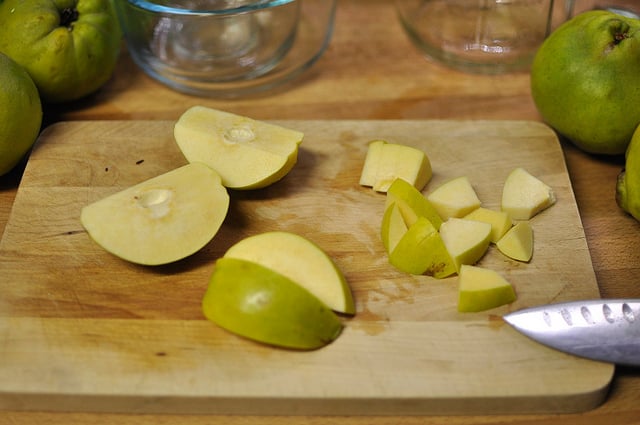
It’s also challenging to cut and clean. The flesh is dense and resists the blade of the knife like the dickens (to use a phrase of my father’s). It requires a good deal more force than the apples and pears we’re all used to and so you’ve also got to be increasingly wary not to slip and cut yourself. I’ve come close a number of times.

Quince is best known as the main ingredient in membrillo, a vividly hued paste that’s most popular in Spain as a accompaniment to cheese. It also makes an excellent jelly, because it’s so rich in pectin that it needs little else to set up into a delicate, spreadable condiment.
What’s more, if you boil the fruit with water to extract the juice, you will still have a great deal of pulp leftover, which can become part of a jam or sauce. I combined mine with four cups of cranberries and now have four pints of tart, floral sauce, some of which is headed straight for our Thanksgiving table (that recipe will be up tomorrow).
You could also use that pulp to kickstart a batch of this quince butter.
Yesterday, I took four different varieties of my preserves to a cheese tasting that my friend Tenaya organized. Let me tell you, this quince jelly was so, so good paired with a Spanish goat cheese called Idiazabal (please don’t ask me to pronounce it). With Thanksgiving coming up, I can also imagine it smeared on a piece of leftover turkey to very pleasing results.

The recipe I used is below. Since there’s no additional pectin here, you can scale the recipe up or down as needed. However, I wouldn’t increase the size of the recipe too, too much, as it will then take more time to cook the jelly to the correct temperature.

Quince Jelly
Ingredients
To make quince juice:
- 7 quinces
- 12 cups water
To make the jelly:
- 5 cups quince juice
- 3 3/4 cups sugar
- 5 tablespoons lemon juice
Instructions
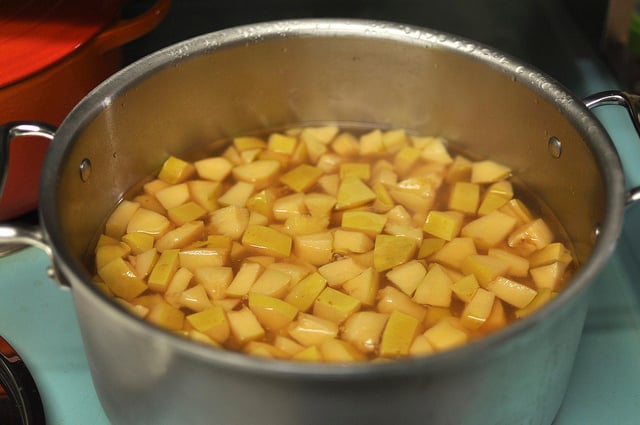
- To make the quince juice, core the quince and chop it into rough cubes. Combine quince pieces and water in a large pot and boil until the fruit and liquid turn a rosy color. This can take several hours, so do it when you have the time to wander in and out of the kitchen, keeping an eye on the pot. When it’s done, strain the juice from the pulp (don’t throw the pulp away!).
- At this point, you can either make the jelly or put the juice in the fridge for a day or two, until you have the time to cook it down.
- To make the jelly, combine the quince juice, sugar and lemon juice in a large pot (use something far larger than you think is necessary, this jelly bubbles a great deal). Bring to a boil and let it cook until it reaches 220 degrees. When it has reached the appropriate temperature, remove the pot from the heat.
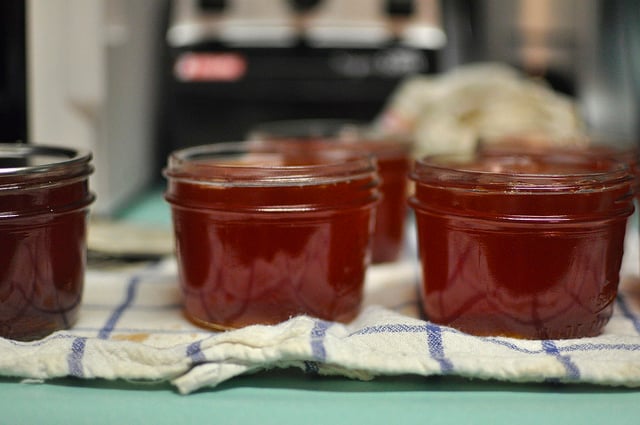
- Fill jars, wipe rims, apply lids and screw on bands. Process in a boiling water canner for 10 minutes. Let cool undisturbed for at least 12 hours. In the morning, check both the seals and the quality of the set. Because quince has so much innate pectin, it should be quite firm.
- Eat with cheese or smeared on a slice of cold turkey.

Thank you for your wonderful Quince recipes!
You’re so welcome!
I have a quince tree growing in the backyard. I bit into one of the green fruits about 6 years ago. It was so hard and bitter that I spit it out and never tried it again. We’ve lived here for 10 years and I’ve never seen more than a handful of fruit on the tree. This past spring I think it was mid April before all the snow was melted off our deck. Had tons of cold and snow all winter. This spring the tree had tons of flowers that have produced the most beautiful pear-shaped fruit of green with red sides with lots of speckles. We are beginning to have cool nights down to 48° already. The days go back up to 80s.
I have a Vita Mix so I’m going to try chopping them, seeds and all, before I cook them. I’m anxious to buy your cookbooks. I love to cook, bake and make jams. I’ve used the Ball book in the past. They have some nice recipes. Yours sound very interesting and tasty.
Thank you for this recipe. I have been given quince twice and never knew what to do with them! Def gonna make this now!
My first batch came out very firm, my second and third only got to the consistency of syrup. I am sure I did something wrong but haven’t figured it out. I did make each batch 1.5 size. Do I empty them out and reboil or redo adding some pectin? It tastes yummy!
When you increase the size of the batch, you drastically reduce your chance of getting a good set. Here are a couple blog posts that might help you.
https://foodinjars.com/2011/01/canning-101-why-you-shouldnt-double-batches-of-jam/
https://foodinjars.com/2011/08/canning-101-how-to-save-runny-jam/
Thanks (no brain no headache 🙂 )
Have mine in the aluminum steam canner right now~a lot of work for 4 little jars but it is so yummy!! I didn’t know what a quince was until I saw a box on the side of the road advertising them. It took a long time for me to get around to making the jam; I left the fruit on my porch in a basket and I could smell the floral fragrance when I was 10 feet from the porch~lovely!
Hi, I made quince jelly and I have to tell you I am on a roll with your book. I got it in time for strawberries in the Spring of 2013 and now we are in November and Fall and your book is actually a permanent “accessory” on my kitchen counter top! Back to the jelly, first time I made jelly out of 5,5 kilos of quince, 16 cups of juice, amazing ruby colour, even more amazing flavor and texture, all in jars. This is almost as good as your “small batch mixed stone fruit jam” which is the best jam of all I have made up to now. Thank you is not enough but if you could see the faces of my family and friends when they eat the treats, you would smile and be very happy for your book.
I just got my hands on 2 large bags of quince and am excited to make this…but I don’t see what the yield is?
Honestly, it’s been years since I made this recipe, so I’m not entirely sure. I imagine you’ll get 4 or 5 half pints.
Ive just made this recipe. Fantastic!
Now you said to keep the left over cooked quince pulp. Why? What do I use it for?
Thw quinces arrive in so many sizes very from very small to huge ones. Is it possible to give an approximate weight of the quinces for this recipe? many thanks!
I saw some quince at the H-Mart the other day and they smelled SO good, I just had to have some. So I got them and now I’m going to use your recipe to make some jelly! But before I do, I think I’m going to get some cut-resistant or Kevlar gloves to protect my hands! Maybe you should consider that – they are pretty cheap on Amazon (http://amzn.com/B003DZ02MA or http://amzn.com/B002FHEFS4). Happy Holidays!
Beautiful jelly, Marisa! @Kim W. re: quince in NYC, Locust Grove Farms has quince. They go to Union Sq. Farmer’s Market.
I am definitely going to try the quince and cranberry recipe this week. I have 2 quince trees in my garden and far too much fruit to use in the usual ways, i.e. crumbles, tagines and membrillo, or cotignac, as we call it here in France. I can’t give them away as everyone is in the same situation. If you are going to strain the juice, it’s unnecessary to peel and core them, but unfortunately, mine have worms in them, so I have to check each one. It’s difficult to find cranberries here in France, and just after Christmas last year, when I found some in a shop in their reduced corner, I bought the lot. They are still in the freezer, but now I know what to do with them, thanks very much. In September, I spent several days in the Basque region of Spain where membrillo is made in huge quantities, they called it “membrillo”. They also made it from kiwis and peaches which grow in abundance there. I also use the quinces in recipes where I would normally use apples, so recently made a lovely squash and quince chutney.
I can attest to the fact that this is a spectacular recipe. It tastes divine with hard Spanish cheeses and with soft goat cheese. I am still dreaming of this pairing.
I’m definitely going to try this! Can you post your recipe for Cranberry and quince as well? I think that would be a real treat for Christmas 🙂
I will have to try quince jelly & goat cheese! I don’t core my quince before I boil it – I read somewhere that the seeds and core are rich in pectin.
Actually, “membrillo” is the name of the fruit in Spanish. We call the jelly-like paste “ate” pronounced “ah-teh”.
Angie, for some reason in the US, the paste gets called membrillo, while the fruit is called quince. Funny how things get shifted.
Right.
I live in New York City. Where in the hell can I OBTAIN quince?
Kim, check the NYC greenmarkets. I get mine from Beechwood Orchards, they come to a variety of Philadelphia farmers’ markets. I can’t imagine that there aren’t a few orchards bringing quince to New York.
I found quince in my grocery store in September and didn’t know what it was. I googled it and found some recipes so I bought all they had! Made quince jam, it looks beautiful but turned out more like a paste, pretty stiff but with such an interesting flavor. Really great with cheese. I will definitely try this recipe if I can find anymore. Looking forward to the quince/cranberry sauce recipe tomorrow! Happy Thanksgiving!
Whoops….sorry….It wasn’t your recipe for Quince Cranberry and Ginger preserve…it was tigress’s….SORRY!
I have a difficult time finding good quince. I did make your Quince Cranberry and Ginger recipe but I don’t think the fruit was totally ripe. I now know that it should have been more fragant but it was still delish. For next year I am going to try to find a online producer to purchase the fruit so that I can make this jelly and other combinations using it. Thanks for helping me learn about this fruit! 😉
Good recipe to have! I actually bought a jar of quince preserves over the weekend to enjoy with some goat cheese and the wee jar set me back more than $9!
Joy, I will bring you quince jelly when next we meet.
OMG this looks so yummy!!!!!!!!!!!!
XOXO,
http://outfitidentifier.com/
i too made a quince cranberry sauce last year! it was amazing and made me seriously question the oft-heard-at-this-time-of-year chestnut, that the only good cranberry sauce is the ordinary sort 🙂