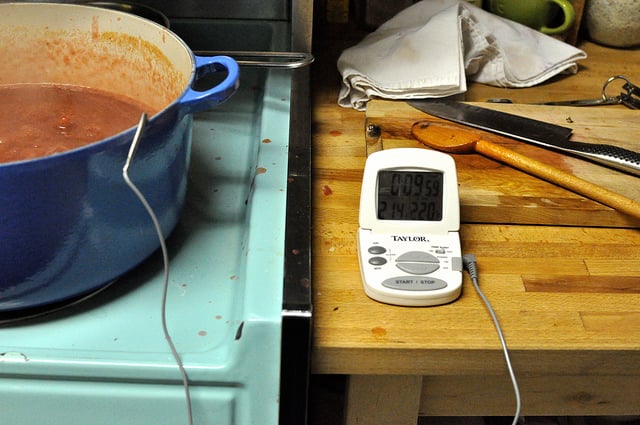
One of the trickiest things about making jam is achieving the set sweet spot. Cook it too long and you worry about the integrity of your cutlery as you reach in for a spoonful. Cut the stove time short and when it comes time to eat, the jam threatens to run off your toast in sticky rivulets (do know that jam this consistency is still amazing on pancakes or in yogurt. Call it a rustic syrup or old fashioned preserves and your friends will still be wowed).
First off, know that even the most experience jam maker has an off day here and there. The same recipe can yield a perfect set on Saturday and make an unfortunately sloshy batch on Sunday. Jam is influenced by the width of the pot you use to cook it, the ratio of sugar to water in the fruit, the amount of pectin in the fruit (as well as whether you add additional pectin), the elevation at which you’re cooking and even the amount of humidity in the air.
Here are a few things to keep in mind as you prepare to make a batch of jam…
- As I mentioned above, the width of your pot can influence the set of your jam. Always choose the widest pot you have at your disposal that also has enough height to let the jam boil vigorously. More surface area means faster evaporation and ample height means you can crank the heat and let it boil. Getting the water evaporated out of your cooking jam at a speedy clip is integral to having a nice, spreadably sticky jam.
- Take the jam’s temperature. Jam making is much like candy making in that you’re applying enough heat to the fruit and sugar to raise the temperature over the boiling point of 212 degrees and alter the structure of the sugar. The jam reaches its ideal set point at 220 degrees, so keep careful watch. Know that if you reduce the amount of sugar in your recipe too drastically, you may not be able to get your cooking jam up to the set point.
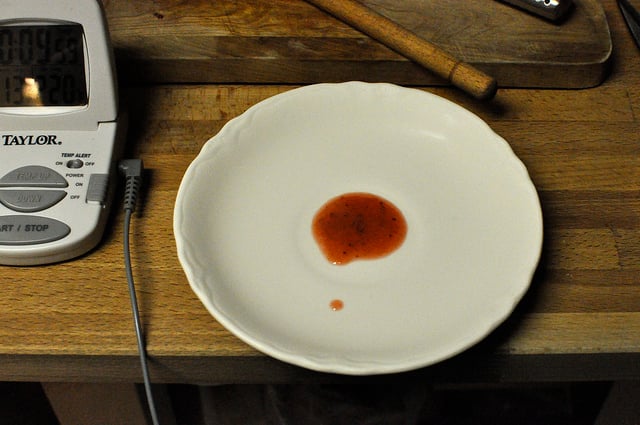
- Before you take the jam off the heat, try the plate test. At the beginning of cooking (or even before) stash a couple saucers or sandwich plates in your freezer. When you believe the jam is cooked, grab one of the plates and plop a small spoonful at the center. Let it sit for a minute or two and then gently prod the puddle of jam with your finger. If it’s formed a surface skin and seems to be developing a certain solidity, it is done. If it is runny and saucy, give it a few more minutes.
- Another test is the sheet test. Here, you stir a spoon through your jam and the remove it from the pot. Holding it over the cooking jam, watch as the remnants on the spoon drip back down. Do they fall back in runny drips, like rain on a window? If so, it’s not quite done. However, if they seem thick and run together in more of a sheet, your jam is finished.
- Cooking times are estimates. When the recipe gives an amount of time for you to let the jam cook, know that that is only an approximate time. The recipe writer doesn’t know how hot your stove cooks, whether you’re in arid New Mexico verses sticky Philadelphia or what size pot you’re cooking the jam in. Use your judgment.
- Additional pectin can help improve set, but it isn’t always a panacea. I’ve had jams that included additional pectin end up runny and then made others with no additional pectin that have firmed right up. Additionally, I’ve found recently that my beloved Certo liquid pectin isn’t working as well this year as it did in years past. I don’t know if they’ve changed the formula, but it’s thrown me off and made me remind myself of the basics of set all over again.
What are you tips for making sure your jam sets well?

I’ve used apples in the process to add pectin before. Example: Strawberrie jam recipe from Pectin box + 1 apple cut up. Remove the apple before jarring. Adds extra pectin to the recipe. Anyone else use this?
Thanks so much for the info about the 220 degree set point! I had runny jam, so I put it back in the pot with just a tablespoon of extra pectin, and brought it to the 220 degrees. It set perfectly! The next batch I made, no extra pectin, but brought it to 220 degrees and it is PERFECT! Obviously my cook time was much shorter than needed to make the jam!! Thanks again!!
Just a suggestion. On the previous page it says “bring to temperature”. Perhaps that could also say, “usually 220 deg.”
Thanks for the suggestion! I will make that change!
i have made jelly, and this batch is runny, new season, i dont want runny jelly. i see that meny things can make it thin and runny, i am about to start jelly, i have heard a wooden spoon is a must, is this true, also adding a teaspoon of butter will help make it a dark color , lets get to the point, how do i make normal jelly not to thin, and runny
have you ever used Pomona’s pectin? i’m looking for wholesale pectin and buying ball brand liquid pectin is so expensive.
I have. It’s good pectin, but sets up differently than classic fruit pectin. You have to adapt your recipes to use it.
Hello. I clicked on the couple of spots on your site where it indicated that I might find help for my poor runny crabapple jelly. But both links have been removed so that this help no longer exist.
Please, if you’ve any solutions for me, contact me. Thank you very much.
Jo-Anne Lemaire, greenjo@xcelco.on.ca
Jo-Anne, I’m unsure what you mean when you say you’ve clicked a couple of spots on my site and the links have been removed. All links should be working. Did you see this page on how to remake your jams and jellies if they didn’t set up? https://foodinjars.com/2011/08/canning-101-how-to-save-runny-jam/
If I am making a jam and the recipe calls for 1-3/4 oz. powdered fruit pectin, can I substitute the Certo liquid pectin and if so, how much do I use. I believe it comes in 3 oz pkg. Any help would be appreciated.
Lucy, I actually don’t recommend the Certo liquid pectin. I find that it doesn’t hold particularly well. That said, 2 packets of liquid pectin equal one box of powdered pectin.
So, being a total newbie to jam making, I do wish someone had mentioned that it is possible to burn jam. I was watching my temps quite avidly and it just did not seem to want to get to 220 and them all of a sudden was at 225 and I smelled burning. Am pretty perturbed, but I guess I will at least know for next time. Maybe something to warn others of?
In the ways that sugar absorbs heat before it changes its characteristics, it takes a long time, relatively, for a “stage” to be reached. Once that stage is reached, the temperature tends to shoot up rapidly until it is near the next “stage.” Keep this in mind when/if you do candy, too.
I am confused, you are HEATING food on a stove with SUGAR in it up to a temp of over 225 degrees and you didn’t know the product could burn????? Errrrrrrrrr Cooking 101 is recommended!
First of all…loose the temp probe! look at the product as it boils, see that it has thickened and then you are ready to take it off the heat!. Don’t be a slave to cooking directions ( or recipes, except when it comes to pies, cake, jams and jellies!)
I do see how the burning sugar could be overlooked in some directions. When the directions are very specific in other areas (down to the type of pot & exact amount of sugar required) it can be confusing to someone when a step isn’t mentioned such as the possibility of burning the sugar. But it’s a learning process. Don’t let this intimidate you. Ive been cooking for 25 years & sometimes forget to stir because I want to follow the recipe to the T. It’s all good though. Keep trying & you will get it.
I used Certo premium liquid fruit pectin. This was my first attempt and it failed miserably. I have a very runny syrup. I am thinking that I may have put too much Certo in and under sugared. I always cut sugar because I prefer healthier. Unfortunately, I read right on the box (after I was supposedly finished) that exact amounts of sugar are crucial. So, I went back to the stove and poured the remainder of my organic sugar and let it cook for a couple of minutes. Again, not knowing really what I was doing. How do I save this beautiful chunky syrup? Maybe corn starch and blending it a bit? Thoughts?
Here are my tips for how to save runny jam. https://foodinjars.com.s164546.gridserver.com/arugulapesto/2011/08/canning-101-how-to-save-runny-jam/
Also, for what it’s worth, I’ve found that in recent years, Certo just doesn’t work as well as it should. I use Ball brand liquid pectin to greater success.
Mix it with vodka, refrigerate it, and drink it as an after dinner liqueur.
Has anyone else had trouble with Pomona’s and jelly? Both times I’ve used it for jelly the end product has been cloudy, a problem I’ve never had with any other pectin or no-pectin jelly. I’d love to be able to make a reduced sugar jelly but I hesitate to try Pomona’s again.
P.S….I also have seed-in black raspberry putty on my shelf–:(
Does anyone have advice for setting a gel for Mock Strawberry Jam made with green tomatoes and strawberry flavored gelatin? I tried 5 cups tomatoes to 3 cups sugar to 6 oz Jello and it is syrup 🙁 Still good–but not the jam I was hoping to give my family who loved the last time I made this. I waterbathed it.
Hi! I have a bit of a weird question…
I canned about 8 jars of plum jam. But, now, I think I want to change the recipe to include some different spices and add more pectin to help it set.
Is it possible to empty all of the canned jars, reheat/ season and re-can??
Thanks a bunch!!
Carine
incredible post for the jam newbie – my jam making has been going well, but this answered so many curiosities I’ve had… off to read the other topics that also look like they’re answer so many questions I’ve had!
I’ll be looking up Pomona’s pectin – I made jam using 15 quarts of strawberries and 2 batches (out of 6) didnt set up. It was a new recipe (to me), strawberry/balsamic/black pepper, and I love the taste so I’ll leave it as is. However, next year I will use Pomona’s. Peach season is next here in Connecticut so I’ll try Pomona’s with that. Thank you, everyone, for the excellent information, I read every post and learned so much. <3
I’ve been making grape jelly this morning and have not been able to rely on my candy thermometer and so have been watching carefully to get just the right gel….not too sticky, not too loose. Most of the time, I don’t know how it’ll turn out until it’s completely cool and shelved. One thing I really hate is a stuff jelly — that takes a knife to cut into it. I’d rather go with less cooking than too much. I have found that sometimes syrupy jelly will suddenly gel perfectly while on the shelf a few days.
One thing my MIL taught me years ago was to mix homemade crab apple juice or homemade apple juice (instead of pectin) to jelly recipes for a nearly perfect gel. She would mix half apple juice with whatever the other juice was. In today’s grape jelly I am making it half ‘n’ half of each juice. It makes a nice tangy jelly where the grape flavor dominates the apple — just what I want. Apple seems to be subtle enough in flavor to mix with other juices without changing the taste too much.
Love your blog.
Jody
Just did taste test on 4 BB jams….Pomona pectin version won hands down. Less sugar!
and btw, fyi, from Pomona’s website:
“The monocalcium phosphate powder that comes in its own packet when you purchase Pomona’s is a food-grade rock mineral source of calcium made up of two minerals, calcium and phosphorous. The food industry uses it as a yeast nutrient in baking, an acidulant in baking powder, and a mineral supplement.”
Happy Canning~
At 220F I always get glue. I’ve gradually come to stop just as soon as it drifts above actual boiling. Bad thermometer, or is there a sort of gray area of sets between 215 and 220F?
I’m getting ready to make jam and bought Ball’s pectin since I’ve had trouble in the past with setup. Here I’m reading how everyone’s afraid of Dextrose (a natural corn sugar) but are willing to use Pomona’s which contains Monocalcium phosphate. After reading about that product, there’s no way I want to use a byproduct of fertilizer. Be careful what you ask for!
http://en.wikipedia.org/wiki/Monocalcium_phosphate
I love Pomonas Pectin too. I use low sugar and often add a some honey to the recipe as well. Just recently I had a batch that was the most splendid strawberry jam I’ve ever tasted, the subsequent batch was runny and slightly bitter. I really feel that with making anything, you have to give it your full attention and a little love (as cheesy as that sounds) the second runny batch I was flustered and hurried to make it, and it didn’t come out great. I guess patience is a virtue after all.
Canners please be aware that common pectins
found in the supermarket usually contain dextrose.
This is a sugar which in the U.S. is derived from
corn or corn syrup. You can bet that this
corn is genetically modified.
I for one don’t want to add something
like that to the fresh produce I’m canning.
Pomona is also available at
Amazon, canning pantry, and Sprouts markets,
and in the package is a tel # for a wonderful lady
to answer questions. Happy Canning.
I use “Pomona’s Universal Pectin, pectine” It is pectin extracted from citrus peel. Its jelling power is activated by calcium, not sugar. I use 1/2 the sugar required in regular jam. I am very happy with it. Just did a batch of blackberry and peach. Am so glad I found this at my health food store.
The web site is: http://www.pomonapectin.com.
I just had my first really successful set without pectin last week even with less sugar than called for and was REALLY happy with it. I used the plate test that you describe here – which I got from my old Joy of Cooking. The blueberry jam came out tasting more fruity than sweet and set up nicely. Now I know what to do and I don’t have to worry about whether I have the right pectin for the recipe.
FYI…the jell point temp is 8 degrees F higher than the boiling point of water wherever you are at….at sea level, that would be 220F. If you are above 1000 ft, you’ll need to adjust. Here’s more details on it:
http://motherskitchen.blogspot.com/2010/06/can-jam-berry-jams-without-boxed-pectin.html
I bought a fancy French unlined copper jam pot (http://livingsmallblog.com/2010/05/20/blast-from-the-past/) and I can’t sing it’s praises highly enough. Love love love it. We don’t have any fruit yet, but the grove of sour cherry trees down the block in the abandoned lot is starting to ripen up so I see preserves in my future. I actually like a looser, less jam-like preserve myself — I don’t like sweets in the morning, and tend to use mine up in baked goods. But the unlined copper pot is fabulous — the copper makes it a cinch to be precise with heat, and the width of the pot makes for easy evaporation. It was well worth what I paid for it (on the addictive eBay France).
I echo the love for Pomona. If you’re a serious jam-maker, you can order it in bulk directly from the manufacturer (make sure you order the calcium as well).
Nice post! It’s a topic that can’t be covered too much. And you and I use exactly the same jam pot. (It also looks as though your stove may be as old as mine.)
My thermometer broke, so I’ve had to rely on old fashioned methods. I recently had an epiphany as I figured out what jam looks like as it is reaching the sweet spot. After boiling for a while, it morphs from looking like liquid boiling to syrupy, thick bubbles. I stir it for a minute, and then I start testing it for a proper gel point, but it usually takes a couple minutes of syrupy boiling. Remember to always take it off the heat while testing.
Thank you so much for that pointer. It never would have occurred to me to take something off the burner to test the temperature. You are absolutely right!
Thanks so much for your website! I’m new to making jam/jelly also (I’ve only been making fruit butters for the past year so I haven’t had to worry about pectin), I just made my first batch of watermelon jelly last week. It was so popular that it sold out at my local farmer’s market so I need to make some more this week. I didnt know anything about checking it’s temp, I just took some samples out & tested it in the frig. I used Ball No Sugar needed Pectin mixed with a small amount of sugar & 1c agave nectar for the whole batch (5-1/2pints)& it turned out great. I’m planning to make several more flavors of jam/jelly throughout the summer following the same procedure. Just wondering if anybody else has experimented using agave nectar to replace regular sugar? I don’t like things too sweet & I also have several customers who are diabetic/watching their sugar so I’d rather not have to use equal amount of sugar to fruit to insure a good “set”/gel.
I’m glad to here about Pomona pectin. I’ll have to give it a try. And I never thought about the wider pot being better. I’ll have to keep that in mind when I go shopping for a new pot. Thanks for the tip.
Oh, Man! I should have checked my email yesterday… the tips might have made my afternoon go more smoothly. I just did a 4lb batch of strawberry jam. Unfortunately the yield was about double than stated in the directions [using Ball No Sugar Needed Pectin], so I had to scramble to prep more jars [and wait for the first jars to be processed]. So I might have six 8oz and four 12oz jars of runny jam after all. But they would sure taste good on some soaked buckwheat pancakes!! When I am done the Ball NSN packets, I’ll be ordering Pomona online. I know it’s more expensive than conventional pectin [but has more way to use], and I bet it would bust my budget if I bought at Whole Foods.
I’ve been using Ball No Sugar Needed Pectin for many years and I cannot remember a failure. I like that the max amount of sugar per batch is 3 cups. I often don’t use that much unless the fruit is *very* tart. I just made 2 batches of yellow plum jam last weekend and used Ball NSN pectin–to 5 cups of plum ‘slurry’ (I ran the plums through my largest screen of my food mill) to 2 cups of sugar, jelled beautifully perfect, it is just sweet.
Love the blog!
I echo previous comments about Pomona’s pectin. I just discovered it this year and was instantly hooked! Not only does Pomona’s allow you to create jams that actually taste like the fruit you make them with and not just sugar, but I’ve found that it makes many more batches than Ball pectin. Amelia, the difference between Pomona and Ball (aside from amount of pectin you receive per packet) is as Paper Dolly Girl said: Pomona’s Pectin is activated by calcium and not the sugar -which allows you to make delicious fruity jams with half the sugar. I’ve also had great luck doubling recipes, which is risky using other pectins.
Ive made 2 batches sour cherry, 2 batches of blackberry and 1 batch of blueberry with liquid pectin this year. One of the cherry and 1 of the blackberry did not set, which I thought was pretty weird but since I’m new to jamming I figured it was beginner’s error. I just picked up packet of Pomona’s so I’m glad to here good reviews. I’m going to try that next!
perfect timing for this post as i’m making jam tomorrow!! xo
thanks for the specifics on these. i know it is something that people used to learn from their mom’s. or grandma’s. (something similar to the way the water temperature feels before you put in the yeast. it is hard to explain this with the written word, but you did a great job.)
http://cuisinenie.blogspot.com/2010/07/cauliflower-and-blue-cheese-soup.html
i am a guest blogger on cuisine nie.
not sure if you know “nie”
she is a blogger who got in a plane crash ….. while she takes care of herself, blogher is keeping her blog going with guest bloggers.
I didn’t know about the wide pot either. I once made a raspberry jam that was hard as rock. Heat it up in the microwave for sauce. I use Ball pectin right now. What is the difference in Pomona’s and Ball?
I always use Pomona’s Universal Pectin and recommend it to anyone who will listen. It’s available online, at Whole Foods, and at other natural food type stores. I prefer a low-sugar jam for many reasons, and Pomona Pectin gels on the calcium content of the fruit, not the sugar. So I am free to use as much or as little sweetener as I want. Almost ten years ago when I was first starting canning, I didn’t use added pectin, but found myself disgusted by the amount of sugar I had to add and also discouraged by the flavor after actually cooking it to 220 degrees. Using Pomona Pectin gives me consistent, fantastic results.
I’ve dabbled in jams over the years; some successful, some not so much. I overcooked a peach jam once and it was the oddest texture! I did *not* know about using a wide pan but it makes perfect sense. Thanks so much for that tip!
I’m intrigued by the apple pectin concentrate, will have to try. I’ve done both over and undercooking. It took a while to adjust to a new kettle, so I would suggest the plate test most heartily. Also, I have forgotten to stash the freezer plates, but I think that room temperature plates also work. It might not be as fast, but the test does work within a minute or so.
I was really beginning to get frustrated with myself and thinking that maybe I had pushed my jam limits. It brings me great comfort that there are a cloud of witnesses that can also testify to liquid pectin troubles. I just wish that I it hadn’t messed with my MI strawberry lemon thyme jam and made it into ice cream sauce. 🙂
And can you use that thermometer for candy as well?
I heard from more than one person over the last year or so that if you use a copper pot to make jam in, you don’t need to worry about adding any pectin as whatever you make will set regardless. Good idea I thought, must try that and then nearly fainted when I saw the price (much closer to 200 euro than I’d like!) When I was visiting my sister in France in May her local supermarket happened to have copper preserving pans on sale (not great quality but for 28 euro well worth the experiment I thought). I’ve made two jams so far – strawberry made just using ordinary raw cane sugar which didn’t seem to be setting too well at all but rather than burning it I eventually gave up (had forgotten that I have a thermometer – spot the still-newbie jammer) and just potted it up. By the time it had cooled, it was well firmed up and apparently that happens with strawberries anyway. The other lot was just a small amount of cherries I was given which made up one large pot of jam. I used 1:1 jam sugar for that and it cooked and set really quickly although not quite the four minutes promised on the packet.
Just back from the market and will be doing some more jam later or tomorrow. Am interested to keep trying this experiment of whether the copper pot really does help or not (so far, it seems to me that it’s mostly just an old-wives’ tale).
Such a great primer! Just last week, I made a peach jam using powdered pectin that had a mysteriously soft set.
I prefer powder pectin. I use a box and 1/3 and have had very good luck with it this year and last. Before that I was ending up with a lot of sauce for ice cream.
Even though I have made some jams and preserves, I do not have a lot of experience with added pectin. Does it affect the flavor of the jam at all?
I do have experience with overcooking jam. I overboiled a batch of strawberry jam last year and ended up with a very unpleasant strawberry putty that tasted like dark amber caramel. Yuck. Won’t do that again.
Thanks for the great site!
I had a batch of strawberry jam not set up this year. I also used liquid certo. What a relief to know it is not just me. I’ve used certo for many years and this is the first problem I have had.
This year i have been experimenting with using extra “natural” pectins in some of my canning. I added redcurrants to some of my jams, and also made apple pectin concentrate, and tried using that. Both worked really well. For some things I will use Pomona’s pectin, but it made me happy to find an alternative option as well.
To make things even more complicated, I thought my jelly would never set in the pan, and so I canned it thinking that I would just have to use it over pancakes instead of on toast. Then a week later I crack open a jar, and lo and behold, it’s a firm jelly. That was definitely a WTF moment.
I’ve made several batches of jam this past week, and all but one round set up fabulously. Of course, the one batch I made without any added pectin proved to be more of a “spread” than a jam, but I’m sure it will still be wonderful! One thing I did notice is that I could never get my digital thermometer to read over 210, maybe it was the thermometer type, or maybe I didn’t have enough sugar. Either way, I use the sheet test for each, and find it to be quite accurate.
Your blog and links have been so helpful for this jam newby! I’ve gotten rave reviews on the strawberry vanilla bean jam, though I must admit it was quite hard to keep from eating those vanilla bean macerated strawberries by the spoon full. 🙂
attention everyone
i made seedless blackberry jam acording to recipe on surejell box but jam did not set. dont panic . empty jam or jelly back into pot put in candy thermometer boil until reaches 210 -220 degrees wash jars use new lids, can, boiling water bath 10 minutes jam will set!
I’ve noticed in the last year or so that the liquid certo isn’t what it used to be either. I wonder what is up with that?
I finally had to throw in the towel and go with something better and more reliable – Pomona’s Pectin. It’s a life/jam/jelly/sanity saver!