One of the very first recipes I posted to this blog was one for Orange-Ginger Marmalade. I’m having a bit of a hard time wrapping my brain around the fact that I’ve nearly cooked my way through an entire year of canning since then and that it’s time for marmalade, once again.
I’ve learned a great deal about preserves since then, and I think that this approach to marmalade is easier and more sensible that the one I originally took. This one used the outer layer of citrus zest, but discards the inner pith, making for easier chopping and a more tender product. I’m completely delighted with the way that this batch turned out, and last night, when I served it at a party along side a long of goat cheese, I felt so proud that it was something I had made in my own little kitchen.

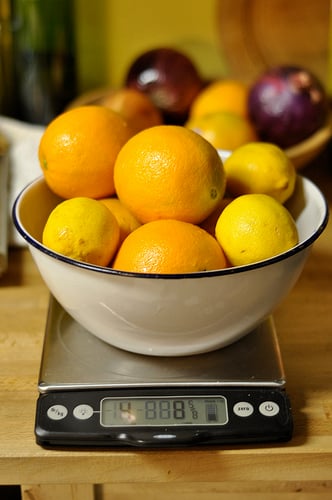
To begin, weigh your fruit. Conventional fruit is fairly uniform in size these days, but there can still be a great deal of variety in weight, depending on storing conditions and length of time off the tree. I used 2 pink grapefruit, 3 lemons and four navel oranges and had approximately 4 and 1/2 pounds of fruit. Feel free to add or subtract a lemon or orange to achieve the right weight. Scrub your citrus well, so that you can feel good about including all that lovely, fragrant zest in your preserve.

Using a vegetable peeler, remove the zest from your citrus. I tried every peeler I own (at least five) and found that the serrated peeler you see above did the best job. Please take care when using one of these tools though, as those little teeth are incredibly sharp. At one point, I slipped and ended up with a series of punctures in the tip of my pinky finger. Not pleasant when working with acidic citrus.
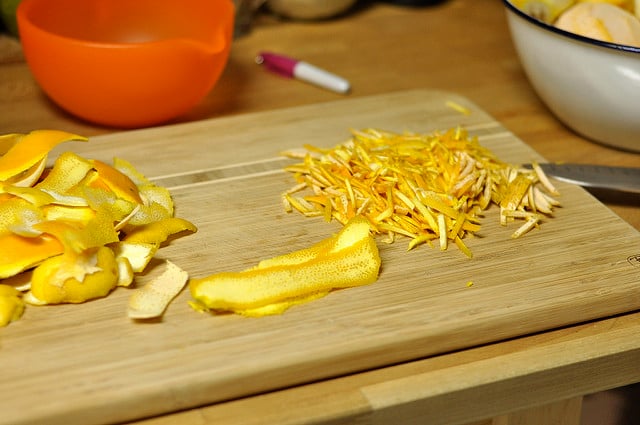
Once your citrus has been stripped, chop the zest into fine ribbons. I found that the best way to do this was to stack four or five strips of zest and then mince them (mind your fingers!) into bits about 1/4 of an inch wide. I found that my 4 1/2 pounds of fruit yielded approximately 2 1/2 cups of zest bits.
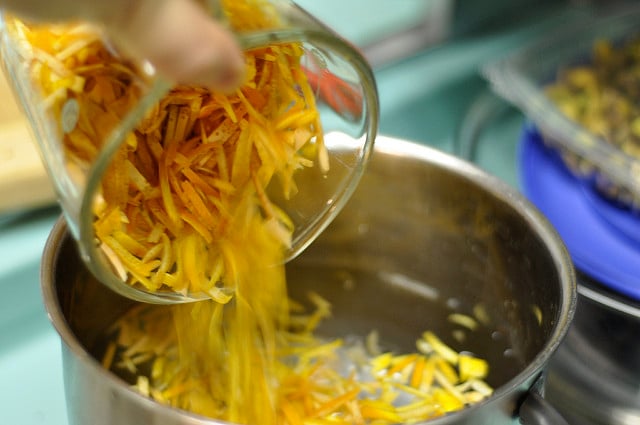
Fill a medium-sized pot with 6 cups of cold water, add your zest ribbons and bring to a boil. Simmer the zest for half an hour, until it’s tender and uniform in color. While it boils…

Use a sharp paring knife to break your naked fruit down. Take a grapefruit and cut the north and south poles off (to give yourself stable bases). Then, working top to bottom, cut the white pith off the fruit (you want to expose the interior surface of the fruit). When all the white pith is removed, use the knife to separate the fruit from the membrane of the fruit (this technique is called supreming and there’s a helpful tutorial over on Coconut & Lime, if my written instructions aren’t doing it for you). Collect the naked segments in a large measuring cup and reserve the membranes and seeds.

When all the fruit has been broken down, gather up the reserved seeds and membranes in a piece of cheesecloth. Bundle it up well and tie off the top, so that none of the seeds can escape. One does this because the seeds, membrane and pith contain a great deal of pectin. You will boil this bundle with the fruit while you make the marmalade, so that you extract the maximum amount of pectin from your fruit.

At this point, the zest should be done boiling. Drain the cooked zest, reserving the boiling water. This liquid has been infused with a great deal of citrus flavor and so some of it will be used in the marmalade.

Finally, it’s time to make marmalade! In a large, heavy-bottomed, non-reactive pot (a stainless steel or enameled dutch oven is your best bet there), combine the zest ribbons, the citrus segments (approximately 4+ cups), 4 cups of the zest cooking liquid, 6 cups of sugar and the cheesecloth bundle.

Bring the pot to a boil. It’s a good idea to use a big pot for this, so that you have plenty of room for the marmalade to bubble. Pair that large pot with a instant read thermometer with a temperature alarm, and you don’t have to watch it the entire time. Set the thermometer to 220 degrees (that’s the point at which the marmalade will achieve set), place the thermometer probe in the pot (balancing it so that you keep the cord away from the burner) and feel okay turning your back to do some dishes (return to it every 4-5 minutes to stir). This will need to boil for 30-40 minutes, in order to reach and sustain 220 degrees.
While it cooks, you can also prepare your canning pot. Position a rack at the bottom of your canning pot and place your jars on top. Fill the jars and the pot with warm tap water until the jars are just submerged. Add about 1/4 cup white vinegar. Place the pot on the stove and bring to a boil.
Wash the lids and rings with warm, soapy water and set aside.

Once the marmalade has reached 220 degrees and has stayed there for at least a minute, check the potential set by putting a small dab of the hot marmalade into the middle of a cold plate. Let it sit for a moment and then nudge it with your finger. If the surface wrinkles and seems firm, it is ready. If it is still quite runny, boil it for several additional minutes.
Once the text yields a good result, turn the heat off and remove the pot from the burner. Using a pair of tongs, grab the cheesecloth bundle. Squeeze it gently over the pot a few times to remove any syrup that it is holding.
Remove the pot from the hot burner and stir for about a minute. I’ve learned over the years that this helps the zest distribute itself evenly throughout your preserve (I hate it when the solids clump towards the top of the jar, and this helps prevent that from happening).

Fill your jars (this recipe makes approximately 3 1/2 pints), leaving 1/4 inch of headspace. When they’re all filled, wipe the rims to remove any sticky residue, apply the lids and screw on the rims. Carefully lower the filled jars into the canning pot (don’t forget to put a rack in the pot). Process in a boiling water canner for ten minutes (starting the time when the pot returns to a boil).
When the processing time is up, turn off the burner and remove the lid from the pot. Let the jars cool slowly in the water for five minutes before removing them from the canner. Place them on a folded kitchen towel or wooden cutting board to cool.

When the jars have cooled enough that you can comfortably handle them, check the seals. Sealed jars can be stored at room temperature for up to a year. Any unsealed jars should be refrigerated and used promptly.
Here’s my serving suggestion: Spread spoonfuls on freshly baked scones, drink black tea with milk and sugar, and pretend you’re in Gosford Park.

Three-Citrus Marmalade
Ingredients
- 2 pink grapefruit
- 3 lemons
- 4 navel oranges
- 6 cups of sugar
- 4 cups of zest poaching liquid
Instructions
- Wash and dry the fruit. Using a vegetable peeler, remove the zest from the fruit. Cut the zest strips into a fine confetti. Combine the zest in a pot with 6 cups of cold water. Bring to a boil, reduce temperature to medium high and simmer for half an hour.
- While the zest cooks, cut the white pith away from the fruit and separate the fruit from the membranes (see instructions above for greater detail). Collect the interior fruit in a large measuring cup and set the membranes and any seeds aside.
- When all the fruit has been broken down, bundle the reserved pith and seeds into a length of cheesecloth, tying the cloth well so that no seeds can escape.
- Drain the zest, reserving the cooking liquid.
- In a large stainless steel or enameled cast iron pot, combine zest, citrus fruit, 4 cups of zest cooking liquid, 6 cups of sugar and the cheesecloth bundle.
- Bring to a boil and cook vigorously until the mixture reaches 220 degrees (this takes between 30-40 minutes).
- When the marmalade reaches 220 degrees and sustains it for one minute, remove the pot from the heat. Grab the cheesecloth bundle with a pair of tongs and squeeze gently to remove any syrup.
- Stir the marmalade for about a minute off the heat, to help the zest bits become evenly spread throughout the preserve.
- Fill prepared jars (see above for jar preparation instructions), wipe rims, apply lids and screw rings. Lower into a prepared boiling water bath and process for ten minutes (starting timer once the water has returned to a boil).
- When the time is up, remove the lid from the pot and turn off the heat. Let the jars rest in the cooling water for five minutes. When that time is up, remove jars and set them on a folded kitchen towel to cool.
- When the jars have cooled enough that you can comfortably handle them, check the seals. Sealed jars can be stored at room temperature for up to a year. Any unsealed jars should be refrigerated and used promptly.

Two things: I’ve never had homemade marmalade and I MUST watch Gosford Park. I bet it came out when I had too many children hanging on my ankles -there are great gaps in my movie watching because of that.
I do like the storebought stuff I’ve had, but I’m betting homemade is much better.
This is pretty much how I make my marmalade – using the zest, supreming the fruit, and then squeezing the juice out of the remaining membrantes. Though I toss the pith and membranes and use commercial pectin. I find my marmalade is less bitter this way.
I can see how using the membranes/seeds/pith for their pectin would increase the bitterness. I like your work-around! -Marisa
Oh, me! Pick me!
Finally! You’ve managed to make marmalade look pretty simple. Now I just need to get my snowy butt to a market where the citrus is likely to have less wax.
The Fair Food Farmstand often has organic and unwaxed citrus this time of year. -Marisa
Good morning. I first found your site while looking for blackberry jam information. I am also a *jar* person. I have canned for many years, but have never made marmalade. Is this the recipe you used during your recent class? Seattle is a little too far away to travel from for your class. (not to mention the snow causing problems with the airlines.) I am excited about trying to make marmalade. Thank you for the pictures and help.
It’s always good to hear from another jar person! Unfortunately, my class was canceled because of low enrollment. However, this is the recipe I was planning on using. -Marisa
wow, that sounds great! i’ve never tried my hand at citrus preserves, i’m thinking that i’m going to have to tackle it!
This sounds really yummy!
I just got a beautiful enameled dutch oven for my birthday. Maybe I should put it to good use with this recipe!
I think you should! -Marisa
I’d love to win this. I had an epic marmalade fail just last week, and am in danger of swearing it off! Change my mind!
Beth, don’t give up! I have complete confidence in your marmalade abilities! -Marisa
Heh. You’re going to get me canning things yet. Up until this point, I’ve made any number of excuses for why I avoid the process (time, experience, equipment, time). But, orange marmalade??!! How can I resist?
It would be a shame not to give it a try, when there’s all this gorgeous citrus in season! -Marisa
Supreming – so that is what that is called! The marmalade sounds and looks delicious.
Great description! But I’m still afraid marmalade might be too much bleeping work for a canner with two small children. 😉
Remember in “Gosford Park” when Dame Maggie Smith says: “Bought marmalade? That is rather feeble.” Hee.
Emily, I love that scene. I think of it every time I make or eat marmalade. -Marisa
I can’t say I’m a marmalade fan, but then again, I haven’t tried this marmalade. Maybe your marmalade will inspire me to can again, as I’ve been in a bit of a winter (it makes sense though, doesn’t it?).
A question: I recently found 3 jars in my pantry whose lids had popped up, but they still felt sealed. I put them in my refrigerator, but do you think they’re ok?
Please, trash those jars immediately. Raised lids indicate the presence of bacterial growth (as the bacteria grows, it releases gas, which leads to the firm raising of lids). -Marisa
The detailed directions you give here are among the best I’ve seen for marmalade.
I just tried using a ton of reserved mandarin peels to create a marmalade, and while the flavor was good, it was far too thick. I need to adjust the recipe, and this recipe of yours will help me figure out how to make it work. In fact, I think I’ll just start by doing your recipe here, step by step, to get a feel for it before I start riffing away.
Thanks for the great resource.
Christina, I’m so glad that you’re finding this post helpful! Good luck with your next batch! -Marisa
Our CSA has been all about citrus citrus citrus lately- and this recipe is PERFECT!
I am so excited to have discovered your blog! Preserving has always intimidated me, but your pictures and recipes are so tempting I will just have to get over it. I am really looking forward to poking around here.
Thanks Robin! -Marisa
Looks yummy! I’d love to try….
Oh, this looks good. I got the canning bug this summer and this looks like a perfect next recipe to try. My husband is half Scottish and LOVES marmalade.
As per usual this looks outstanding!! I love the bright colors. This is something we definitely need more of in the dead of winter.
This looks divine! I’ve got some cheese cloth that needs a use and this marmalade might be the perfect way to bust it out. Plus, it will go very well on the muffins I intend to make with the whole wheat pastry flour I need to use up. Marisa, your jar would be a good comparison to assure I followed your instructions just so:)
Oooo count me in this giveaway! I love marmalade and this looks fantastic!
Marmalade rocks!
A wonderful recipe, we just moved in with a lemon tree. I don’t understand why everyone doesn’t have citrus here in CA!
Summer, I don’t understand people who live in sunny CA and don’t have citrus trees. If I lived there, I’d immediately plant a mini-orchard. -Marisa
I love marmalade! Yours looks tasty.
My marmalade did not turn out well last year, so I would welcome the chance to try some proper marmalade. If I don’t win, I supposed I will have to go ahead and make this. Perhaps it was too much pith… Looks so delicious.
mmm… that looks amazing. and i love, love, love the step-by-step pictures.
This looks like beautiful and delicious marmalade! I would sure love to win a jar. I just made your Honey Lemon Apple Jam (which turned out wonderfully by the way – thanks for a great recipe!). I have some lemons left in the fridge and this may be the perfect reason to pull them from the fridge and start canning again!
Laura, I’m so glad to hear that the Honey Lemon Apple Jam worked out well for you! You should definitely make this marmalade. There are a lot of steps, but it comes together easily. -Marisa
The first time I ever tasted orange marmalade was in Oslo, Norway. It was different, but I liked it. I was 12 years old and was on a visit with my sister and maternal grandparents. I remember the food well; although I grew up on my grandmother’s Norwegian cooking, there were even more “exotics” to be had once in Europe. I also remember my first salmon, a whole, wild-caught filet broiled with butter; and open-faced sandwiches with egg and tomato.
Oh Kristine, what wonderful food memories! -Marisa
You take such lovely photos of the food you create!
Paula, thank you! I do my best! -Marisa
Wow, Marisa! Your photos are particularly vibrant! And I love that bit about Gosford Parl, since that line in the movie has always stuck with me, and I haven’t seen it since it was in theaters! How nice to have a stocked pantry, and so much of it this year was thanks to inspiration from you. This marmalade will have to make the docket for next year, while we eat up and enjoy what we have… Unless I win, then I promise to make proper scones to enjoy this with!
Goodness, thank you! I’m so delighted to hear that you’re enjoying your stocked pantry. I find that it makes life so much easier and more enjoyable to have a few homemade jams and pickles tucked away. I also applaud your restraint and decision to step back and choose to eat up what you have instead of making more. I don’t possess that particular variety of self-control. -Marisa
I love marmalade and have been wanting to make some, but I think I’ll have to save this recipe for next year.
I love marmalade! Will have to try this recipe, I confess, I’ve never tried to make it myself.
You can do it! -Marisa
Oh this looks delicious! We use the Orange Marmalade I buy at the Farmer’s Market instead of duck sauce on our Chinese food. Your instructions are very thorough but I have a few questions (I’m still learning to can this year so you’ll have to excuse me ;o)
1. Do you have to weigh your fruit or can I just count out the same amount of fruit like you have? 2. I’ve heard that preparing your jars by running them thru the dishwasher & heat dry makes this process quick for having them ready? 3. I have a steam canner so is it still 5 minutes that I run them for?
Thank you for your beautiful, easy to read blog. I’ll get canning yet!
1. I weigh the fruit because size can vary greatly. You want between 4 1/2 and 5 pounds of fruit for this recipe, and so it’s good to count it out and then weigh it, to ensure you have enough. I’m going to go back into the post and clarify that point better. 2. You can certainly use your dishwasher to sterilize jars. I don’t do it because I rarely have an empty dishwasher when I decide to make jam. 3. Just so you know, the USDA does not recommend the use of a steam canner, as it doesn’t allow for the same level of penetration as a boiling water bath does. However, the USDA is often over-cautious. I’m not passing judgment on your equipment, but I have no experience with a steam canner, so I can’t even hazard a guess as to how long you should process your jars in it. -Marisa
Sorry, Evil Tinkerbell. 🙂 You can blame my mom & dad.
I’ve never tried marmalade before, is that bad?
Lauren, I am aghast. You’ve never had marmalade?!
My mom grew up in Florida and learned “supreming” at 4H. I learned by watching her! Sometimes people are impressed when I present a bowl of “ambrosia” (citrus fruit salad) made with individual segments, but to me, that is just how you do it and it is no big deal! I’d love to try your marmalade!
Fran, it’s interesting how people think that supreming is a big, fancy deal. I’ve found that once you get comfortable doing it, it makes for quick, easy to eat fruit salads (and of course, marmalade prep). -Marisa
Usually I am not so into marmalade but this recipe looks delish! Pick me and prove my assumption correct?!
Thanks for the blog!
Of course I want a chance at that gorgeous marmalade! Nice job with the zest and supreming–I never have the patience for it!
I have not made any marmalade yet in my canning experience. I am more into pickling right now. I might try a marmalade or two soon. Enjoy all the snow you are getting.
Me, me, me….
I love your blog, thank you so much for sharing!
Please enter me to win the marmalade! I’ve been quite proud of the marmalade I’ve canned, but never did the cheesecloth part … I must try that! Thanks!
Lovely! I’ve made Meyer Lemon Marmalade and this multiple citrus recipe looks intriguing. Thank you for sharing.
ohhh this sounds so delicious!
This looks like so much better of an idea than the giant vats of marmalade that got me into this whole canning thing. I’m surprised I was still interested after that!
Actually, now that I think about it, I’m pretty sure I still have jars of not set marmalade lurking in the back of the pantry, waiting to be reprocessed.
Recently, my mom re-cooked and canned some marmalade she had made that did not set. She cooked it to 220 degrees and re-canned it. And it worked! -Marisa
This looks fantastic–thanks for sharing! I just recently made 3 citrus marmalade using tangerine, orange and bergamot…and I’d love to taste yours!
i had scones yesterday and pondered marmalade and making my own, too bad you beat me to it!
Send it to Oregon! Pllleeeeaaassse!
Hi Marissa!
I’m changing my handle on here, since there’s already another Lauren floating around 🙂 I have a marmalade question. I made a batch of lemon ginger marmalde a few months ago using the technique you used, and it turned out great. the only thing is, those carefully extracted segments breakdown completely, which makes me wonder, why bother? Why not just remove the zest, then cut the lemon in 1/2, juice it, and save the seeds for the pectin bag?
When I make seville orange marmalade I cut the oranges in 1/2, juice them, then rip the membranes out before chopping the skin. This obviously makes for a more robust marmalade since I include all the pith, but the texture of the jelly is very similar to my lemon marmalade.
My lemon ginger marmalade has proven really popular, so I want to make a ton more, but separating the segments is a royal pain in the you-know-what, do you think the simpler method might work?
Well, hello Evil Tinkerbell! The only problem that I see with your method is that you lose a bit of volume. You could certainly do it that way. -Marisa
Why do contests work? So funny that I’ve known about your blog for months & this is the post I choose to click on. Though in my defense, I don’t think I’ve ever seen one of your blog post tweets before.
But I totally subscribed because reading about canning is yummy. And I’ve heard your jars taste incredibly yummy, too.
Maybe one of these days I’ll actually give it a try.
The allure of a contest is strong! 😉 And not to toot my own horn, but the rumors are true. My jams are pretty yummy. But I’m sure your jams would be yummy too! You should definitely give canning a try. -Marisa
The marmalade looks delicious!! I’m so enjoying your blog and want to start canning myself soon!!
There’s not a thing you put in a jar (that I’ve tried) that I haven’t loved!
Aww, thanks Steve! You’re an excellent, appreciative taster! -Marisa
meeee!
I just made the citrus marmalade, Is it suppose to be runny?