
When I was 11 years old, my cousins in Walnut Creek, California sent us a jar of homemade lemon curd. They kept chickens in their backyard, had lemon trees out front and so made jars of curd using these homegrown ingredients to send to friends and family for the holidays. It was love at first taste.
For a couple days, I kept up the charade of sharing this sunshiny jar with my parents and sister, dolloping scant spoonfuls onto toast like everyone else. However, on the third day, I couldn’t continue to resist. I removed the half-full jar from the fridge, snuck to my room and ate the balance of the jar a spoon while reading a book. I am not to be trusted when it comes to lemon curd.
Speaking of meyer lemons. One of the magical things about Southern California is that they just grow on trees there. I was born in Los Angeles and for my first nine years lived amidst that magical bounty. Our Hawaiian mailman taught me to eat the tender blossoms from the the guava tree along our front walkway and my grandma Bunny had a tree that produced heaps of sweet/tart Meyer lemons each year (my mom used to squeeze them and freeze the juice into ice cubes).
Having lived in colder climates for the last 21 years, I am startled when I am reminded that there are places where people can just walk outside and pick citrus (and that I was once one of them).
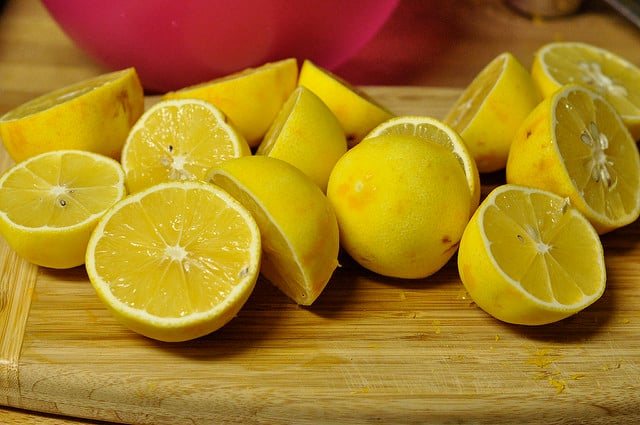
For those of you who have yet to taste a meyer lemon, they’re thinner skinned and sweeter than your typical lemon. They are also intensely fragrant, and give this curd a lovely, delicate taste/aroma.

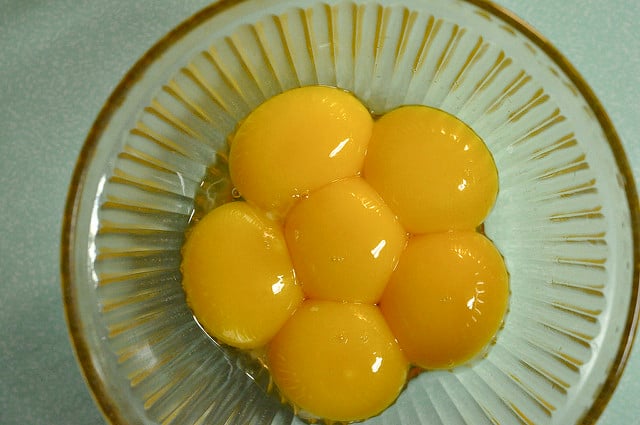
Making curd is time consuming, but once your ingredients are all assembled, it goes quickly. This basic recipe makes just a single pint, but happily you can easily double or triple it without any ill effects. Separate six eggs, tucking the whites into a jar for later use (I’m thinking of making a batch of meringue cookies tomorrow).
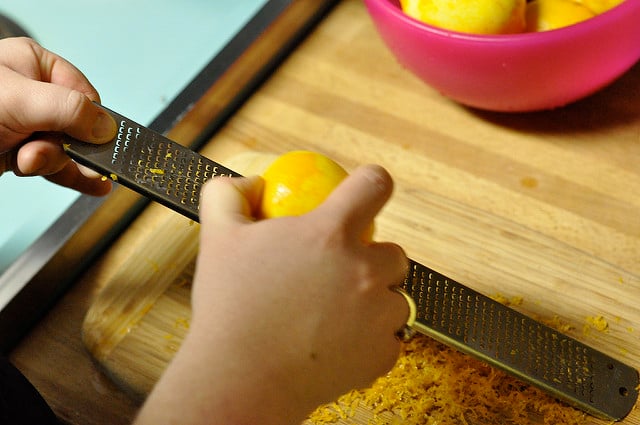
Zest three juicy meyer lemons (make sure to pick ones that seem heavy for their size). Juice the lemons (always buy one extra, in case you don’t get quite enough juice).

Measure out 1 cup of sugar and set a heavy bottomed pot over low heat. Whisk the egg yolks together with the sugar. Pour in the lemon juice, add the bits of zest and switch to a wooden spoon for stirring (using a whisk past the initial step will aerate your curd and your final product won’t be silken).
Don’t worry if your curd looks texturally weird during cooking, a quick trip through a fine mesh sieve at the end ensures that the finished curd is perfectly silky.
When the sugar, egg yolk and lemon juice have thickened (it takes 10-15 minutes of cooking over very low heat and near-constant stirring to get to this point), stir in the butter until it’s melted. Remove the pot from the heat and pour the curd through a mesh sieve that you’ve perched over a glass or stainless steel bowl.
Gently work the curd through the sieve with a wooden spoon, removing the bits of curd and any curdled bits of scrambled egg.

You can process lemon curd to make it shelf stable, but it doesn’t have the shelf life of other jams and preserves. You won’t want to keep it more than two months (but with something this good, I truly doubt you’ll have it hanging around that long). Process half and quarter pints in a boiling water canner for 20 minutes (starting the timer when the water returns to a boil so that they get the full effect of 20 minutes of boiling water processing).
For those of you who like recipes in a traditional format, sans narrative, it is after the jump.

Meyer Lemon Curd
Ingredients
- 6 egg yolks
- 1 cup sugar
- 3 meyer lemons juiced (you should get a generous 1/2 cup. Make sure to strain it, to ensure you get all the seeds)
- zest from the juiced lemons
- 1 stick of butter cut into chunks
Instructions
- In a small, heavy bottom pot over medium heat, whisk together the egg yolks and sugar.
- Add the lemon juice and zest and switch to stirring with a wooden spoon, so as not to aerate the curd.
- Stir continually for 10-15 minutes, adjusting the heat as you go to ensure that it does not boil.
- Your curd is done when it has thickened and coats the back of the spoon.
- When you determine that it's finished, drop in the butter and stir until melted.
- Position a fine mesh sieve over a glass or stainless steel bowl and pour the curd through it, to remove any bits of cooked egg and the zest.
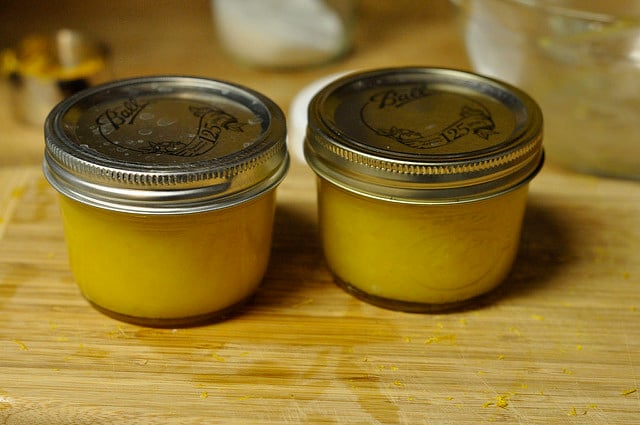
- Pour the curd into two prepared half pint jars, leaving 1/2 inch of headspace. If you want to process them for shelf stability, process them in a boiling water canner for 20 minutes (start the time when the water returns to a boil).
- According to So Easy to Preserve, it is best to process only in half-pint jars or smaller, as they allow better heat infiltration.
- Eat on toast, stirred into plain yogurt or straight from the jar with a spoon.

I just made this recipe (x5) with regular lemons off of the tree in my front yard. It is good, but not as tart as I’d like. I think next time I will use all of the zest from all of the lemons and maybe increase the quantity of lemon juice just a bit to make it more tart. The texture is lovely and I am sure it will taste divine with scones or muffins! My husband and I just planted a rangspur lime tree and I cannot WAIT until the fruit ripens in a few months so that I may make curd with that fruit!! Thank you for passing along this great recipe!!
I’m long on grapefruit and a newbie to canning. Is grapefruit on its own acidic enough for me to put up grapefruit curd?
I live in NZ, and I wondering how much do you define a stick of butter to be (pounds or grams is fine)
A stick of butter is 4 ounces, a quarter of a pound or 1/2 a cup. I hope that helps!
Hello,
Thanks for this great recipe. I have a question about shelf stability. I’m new at canning but am anxious to start. I am making this lemon curd today with my leftover lemons from limoncello.
If it is properly canned, and I think I get why water-bath canning is appropriate here (high acid in the lemons) why does it only last a few months? If I pressure can it, would it last longer? Would that destroy the curd?
Thanks in advance for your answer. I’ll be checking in to your informative blog often.
Cheers,
Kai
Kai, the reason it doesn’t last on the shelf more than a couple of months is that the texture begins to degrade. It will be safe for much longer, but it may start to separate. You wouldn’t want to pressure can it, as that would over cook the curd. You could freeze it if you’re looking for an alternate way to preserve it.
Okay so two things of concern. One lemon & limes is okay to boil can and keep on shelf…what about say graoefruit and orange? Second thing what do I do with all the left over egg whites? I hate to waste them?
Three great things to do with egg whites; meringue cookies, coconut macaroons, or homemade marshmallows. The marshmallows are awesome because you can flavor them. I have done brandy or cinnamon ones to drop into hot chocolate.
Yeah… the shiraz curd might have been a mistake. (Fortunately I only made a half bathch.) While it has sort of an interestingly complex flavor, it is WAY too sweet. It is also a horrible horrible color. Can the amount of sugar in this recipe without ill effect?
Of course, I am still considering doing a balsamic vinegar curd, and maybe a blackberry cabernet curd… Is a certain level of acidity necessary to get a proper set-up?
Rachel, the acidity level is really important for safety more so than set. It’s really not safe to can curds other than lemon and lime.
That is good to know! I am not really planning to properly can any of it–I want to, but I am lacking necessary equipment and still rather intimidated by the whole process.
When you say, “it’s not really safe to can curds other than lemon and lime”, does that mean it is still okay to make other curds and store it in jars in the fridge? Additionally, if you use something with the same pH as lemon or lime juice, does that make it safe?
I made this today! It is so amazingly flavorful–worlds better than the store bought variety. I am planning to make a key-lime curd, a grapefruit curd, and a vanilla-orange curd. (Like your creamsicle jam!) I want to process it to be shelf-stable, because I want to mail some to my sister, but I am a little afraid to start. The boiling I think I can do, but the “prepared jars” bit is kind of intimidating.
I am staring down half a bottle of shiraz that we had with dinner last night, and. Wondering if it could be made into curd. Hmm….
This sounds absolutely delicious. As a complete novice in the kitchen, is it safe to assume that the filling in a lemon meringue pie is lemon curd just like this? It sounds like I would only be two steps away from pie after making this…
Matt, it is essentially the same things.
Mmmm… Just made this recipe (doubled) last night and had it on some fresh blueberry scones this morning. YUM!
I just finished making curd out of my navel oranges. Divine! Some one has to come up with a way to safely can this (orange) so I can gift it.
I just made this, doubled the recipe and it came out great. My teenage daughter came upstairs to lick the bowl and said mournfully, “you put it *all* in jars?”
I love this post and I will go forth and make some curd. Thank you for the gentle nudge. And the great backstory. I love a good backstory.
Off topic but how many people have a grandma named Bunny? Mine was Bernadette but she was known to everyone as Bunny.
I love the recipe and would like to make it, since we live in citrus country here in southern Spain. I can deal with the cup measurements (brought them back from a trip to the US), but how much is a stick of butter?
A stick of butter is half a cup or four ounces. I plugged four ounces into a converter and it said that it’s approximately 113 grams.
Thank you!
I love lemon curd.It’s my new favorite food item and then now I find out I can can it,hot dog! I made lemon curd for this (http://www.epicurious.com/recipes/food/views/Blackberry-Lemon-and-Gingersnap-Cheesecake-Pudding-360229) recipe and well I was sold on it.I live in the south and I don’t see meyer lemons much,I came across some at Trader Joe’s and I knew just the recipe to make! Thanks Marisa.
What a great instructional piece this is – I am reading carefully as I just made meyer lemon marmalade and now looking at doing curd! Thanks
I had a jar that lasted nearly a year in the fridge, but I can’t make any guarantees.
Marisa, how long do you think this would last if processed and kept in the fridge?
Made this in November. Canned it but stored it in fridge because I wasn’t sure when I’d get to eat it (and I was trying not to eat it all myself!). I brought it into the office today for a holiday party. I’m serving it along with 5 jams/fruit butters to spoon onto shortbread. It’s getting rave reviews. Thank you for a wonderful recipe!
I’m wondering if you can think of a vegan versionof this (maybe you know one off the top of your head). I LOVE lemon curd, however my vegan version which contains no eggs and is thickened with cornstarch cannot be processed after setting or the cornstarch thins out and the curd loses it’s thickness. any ideas?! I did do the method where I keep everything super hot until I put the curd in the jars…and they seemed to seal on their own…but how long is this good for? (I want to give as gifts at christmas).
Thanks!
m
Melissa, it is quite unsafe to skip the processing step when making jams, curds, jellies and butters. Additionally, I don’t have any method for making vegan curds. The only thing I can think of is that you look into Clear-Jel to use in place of cornstarch.
Heather, as far as I know, it is not safe to water bath process caramel and chocolate sauces (anything that has a dairy base is a no-go).
Dina, it is safe to process the lemon curd. You do not end up with scrambled eggs. The egg yolk has already been tempered and incorporated into the rest of the ingredients, so it can’t scramble.
Hi, I came here because I love making lemon curd but I have the same questions as a few people above – whether it’s safe to home-process lemon curd, and, will I just end up with lemony scrambled eggs. Has anyone else actually tried processing the lemon curd? I’d love to hear how it turned out before I try my hand at this… thanks!
I also had questions about water bath processing products with dairy (eggs, butter & heavy cream specifically). I have a wonderfully recipe for lemon curd that I would love to be able to sell but have been too scared to process it. Also I was worried about ending up with a jar of lemon flavored scrambled eggs. If you say it is safe, I’ll try it but maybe only give to my family first. I found a vegan lemon curd recipe that uses parsnips as a base that I’m going to try too. I also make a delicious caramel sauce (with butter & heavy cream) that I would love to be able to can. As it is now I just pour it into jars & keep it in the frig. Any idea if that would be safe to water bath process too?
I’ve never had it so it sounds really different to me. The colors make me want to just take a bit anyways. I’ll have to keep in mind when I feel like making something yummy because this looks delish!
Christy, Home♥Mom
I know you addressed the safety with respect to eggs but what about the butter in it? I was under the impression that you can’t home can anything with dairy?
I just made this. I licked the spoon, and the spatula, and the rim of the bowl, and the bottom of the strainer. I think I like…
Emily, I apologize for leaving that out initially (I’ve updated the recipe above to it includes headspace). So Easy to Preserve advices that you leave 1/2 inch headspace when canning lemon curd.
Marisa, dear, what should the head space be on a jar of lemon curd. I processed mine last night leaving a 1/4 inch head space, like for jam, and I don’t think it was enough; it clearly overflowed, although oddly, the jar sealed okay.
I left 1/2 inch of headspace on mine and I had two out of nine that overflowed but still sealed. Those are just the two that I will be using first I guess 🙂
Tks for this marvellous recipe!!
nina
You can freeze lemon curd for much longer than you can keep it canned. I just used a jar from 3+ months ago and it tasted perfect! The only problem is I have such a small freezer…
My curd was regular lemons though, and the meyers sound so good, I’m definitely going to restock using your recipe!
Thanks, Marisa! It looked so yummy, I was willing to try it, regardless. I think little treats like lemon curd would be great to have on hand for easy presents and a great morale boost in case of an emergency situation.
Another Marisa, that’s awesome that you can make it in the microwave!
Nicole, you can certainly make this recipe with regular lemons.
Sylvie, according to So Easy to Preserve, it is perfectly safe to water bath process lemon curd. I haven’t done it personally, because it’s not the sort of thing I want to have around (too indulgent!).
For my husband birthday early in the month I made a lemon meringue pie – one of his favorotes – using home made lemon curd with regular lemons and ONE Meyer lemon from my potted tree (was not a good year for lemons for me). Their flavor is indeed so much more pronounced!
I never thought of water-canning the curd because of the eggs. Was that the first time you did it?
Those lemons are so beautiful. And such a nicely written post. I was always amazed when I saw citrus laden trees in California. It was like being on Mars.
Yum! Having just eaten most of the Dori Greenspan’s lemon tart I was wondering if it was possible to can curd. You just answered my question! But 2 months’ worth of curd is probably not enough to carry me over to next citrus season…even if I totally gorge. ahem.
Oh, that looks scrumptious. Can I just stick my finger in? Question, can you make this recipe with regular lemons? I can’t imagine someplace warm enough to have citrus everywhere.
wow… that looks good! i’ve been wondering how to make lemon curd. thanks for the post. 🙂
Too funny–just last weekend my sister-in-law and I were discussing whether or not you could preserve lemon curd. We suspected, with the butter and eggs the answer was probably not unless you are an industrial op! (I think we also agreed it was a bit irrelevant as we’d probably eat it before it could ever spoil in the fridge anyway). Thanks for this post!
I just LOVE lemons and lemon anything! I have GOT to try this when I find some lemons for a good price again! Never heard of Meyer lemons before!
Mmmmmm – lemon curd is *so* good. To make other citrus curds (tangerine curd is particularly delicate and yummy), I usually still use 1 lemon and substitute other citrus for the rest.
This is actually a good thing to do in the microwave, though it’s not hard to make on the stove-top, either. There’s a good recipe in “The Complete Book of Small-Batch Preserving” – basically, you mix all the non-egg ingredients together and heat on high until the butter’s melted and everything’s hot. Then you gradually add the hot lemon mixture to the eggs, whisking constantly. Then you microwave (uncovered) on medium heat for a minute or two in 30 second intervals, stirring every time. Stop microwaving when the mixture has thickened and strain if you don’t like the little bits of cooked egg that can develop.
I LOVE lemon curd – any citrus curd, actually. I’ve made lime curd and orange curd using the identical recipe. And I saw that Nigella Lawson has a recipe for cranberry curd.
I’d like to mess around with some Meyer lemons – I’ve only used regular ones.
The lemon curd looks incredible. And I bet it tastes divine.
Wonderful! Even as far north as the Bay Area, where I grew up, Meyer lemons spill over the sidewalk in suburbs – oh how I wish I could come across that today, northwest of Seattle. Might have to call in a few favors from my CA peeps after reading how do-able you make this recipe sound. I have never made it but love the little jars of it from England. I too have been known to sneak lemon curd with a spoon – so delicious.
I’ve never made lemon curd, but this looks fantastic! I’ll have to get some lemons soon and make this. Your pictures are so bright and cheerful, it’s making me long for warmer days too!
I find it so exotic that people can outside and pick citrus in their backyard. Love lemon curd – will need to buy some and try this!
I’ve never tasted lemon curd and I ran across a recipe last night on another site. I was glad to see your post about it this morning. Lovely, just lovely! Looks delicious too!
Darby, it is so good! I divided it between two jars, and I’m taking one over to my cousins today, so that I’m not tempted to eat the whole darn batch.
Amy, how lucky are you to have a Meyer lemon tree! I can only imagine that this already-delicious curd would improve dramatically with super-fresh fruit.
Fran, you could use regular lemons without making any major adjustments. However, if you want the sweet/tart flavor of Meyer lemons, try substituting the juice of one mandarin orange for one regular lemon. Also, conventional lemons aren’t quite a juicy as Meyers, so you’ll need one or two more. And yes, you can do the exact same thing with lime juice/zest for lime curd.
I am SO doing this. I have never put lemon curd in yogurt, but since I fell in love with putting jam in greek yogurt thanks to you, I am sure this suggestion is also excellent. Until now, my preferred lemon curd media were popovers and scones.
I have questions, though…if I can’t find Meyer lemons, can I use regular ones in the same recipe? Will I need more sugar? And is “lime curd” good? I’ve never heard of it, but is there any reason why not to make it?
By the way, there is a new post up on Evil Mad Scientist Laboratories about making marmalade. They usually do geekier projects than that, but I think this canning thing is really spreading!
my Meyer Lemon tree is bursting with lemons. came upon your post on just the right Sunday. Thank you!
Yum… cannot wait to try this one!! I’d like some RIGHT NOW! 🙂