
As a kid, I was fascinated by the lives of long-dead historical figures. I devoured those blue-bound “When They Were Young” biographies, absorbing the childhood details of Helen Keller, Susan B. Anthony and Clara Barton. I was a particular fan of Betsy Ross, in part because I’d taken the walking tour through her cramped colonial home in Philadelphia’s historic district (later, when we were back in California, I delightedly wore the Quaker sunbonnet my grandmother bought me at the museum gift shop).
One aspect that I found particularly entrancing in these “biographies” (looking back, I realize that these volumes were probably far more fiction than fact) was the way in which food preparation was detailed (this is also why I read and re-read all the Little House books).
There’s one scene in the Betsy Ross book that has always stuck with me, in which she (as a seven or eight year old) is given the task of tending the apple butter, as it slowly cooks over an open fire. She uses a wooden paddle to scrape the scum off the top of the butter and a long wooden stirrer, with which to ensure that the butter doesn’t burn on the bottom of the pot. I found this description, of a little girl being tasked with such responsibility, so very appealing. As a child of similar age, I longed to participate in the activities of food preparation, and to have a hand in making things from scratch.
However, in those days, our applesauce came from a jar and the only thing we spread on bread was strawberry jam from a large, blue plastic bucket (the one with a white handle and lid). It wasn’t until my family moved to Oregon a few years later, and we found ourselves in a new/old house with gnarled old apple trees down at the very back of the property, did we even attempt to make apple butter (there is little in the world that tastes better than apple butter made from antique, windfall apples).
These days, homemade fruit butters are an integral part of my summer and fall preserving routine. After the jump, you’ll find my general fruit butter technique, it’s not a specific recipe, but instead a flexible approach that can expand or contract, depending on how much fruit you have. I also have a half pint jar of pear butter to give away. If you want it, leave a comment by Friday, September 18th at 11:59 p.m.

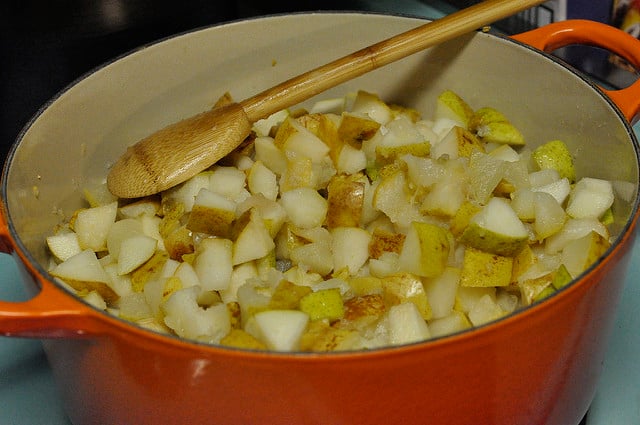
I tend to make fruit butters in a two (or more) day process. Starting with the whole peaches, pears or apples, I simply cut them into chunks (the apples get peeled, but I leave the skins on the peaches and pears) and cook them down into sauce with a little bit of water. When they can be squished with the flat side of a wooden spoon, I puree them with an immersion blender. If you don’t have an immersion blender, you can use a regular blender (working carefully in batches) or a food mill to create a smooth sauce from the cooked fruit.
Now you begin to cook the sauce down into butter. This can take anywhere from three to five hours on the stove top at its lowest setting, depending on the amount of butter you’re making, the width of your pot (wider pot means more space for evaporation) and the level of heat that you cook over. This is best done on a lazy Sunday afternoon, so that you can give it a stir every 15 or 20 minutes. If you have a splatter shield, the kind typically used for frying, I’d use it here, as fruit butters can get a bit sputtery while cooking down.
Alternately, if you don’t have that kind of time, you can put your fruit sauce into a slow cooker and let is slowly cook down overnight or while you’re at work (I don’t recommend letting it go in the slow cooker for more than eight hours, so if you’ve got a long commute, you might not want to do it during your workday). You can also make the sauce one day, refrigerate it overnight and then cook it down into the butter the following day (or even a few days down the line).
While it cooks down, I like to add 3-4 teaspoons of cinnamon, about half a freshly grated nutmeg, some ground cloves and several cups of honey and/or sugar. The amount of sweetener is up to you, although you should add some, as it helps with the preservation of your finished product. I typically start with two cups and then taste, adding more if necessary. However, because you’ve concentrated the natural sweetness of the fruit, you shouldn’t need to much sugar or honey. I also will add the juice of 1-2 lemons, if I find that it needs a punch of acidity. Keep tasting, as it’s the best way to find a balance of spices and sweetness that works for you.
Once the butter is thick, seasoned and spreadable, get your jars out. I find that my typical batch makes 5-6 pints of butter, but your mileage will vary. Pour the hot fruit butter into clean jars, wipe rims, apply lids/rings and process in a boiling water canner for 15 minutes (starting the time when the water returns to a boil). When the time is up, remove the jars from the water and let them cool on a towel-lined countertop. When the jars are cool to the touch, check the seals by removing the rings and lifting the jars by the edges of the lid. A good seal means that the lid will hold fast.
Label your jars of fruit butter with the variety and the date. Store in a cool, dark place for up to six months.

yum! this sounds devine!!
I have a bushel of asian pears. Would you make pear butter with them? Other suggestions? thank you
Malia, I’ve never made pear butter from asian pears, because I’ve never had more than three or four of them at a time. However, from what I’ve heard, they make exceptional butter. -Marisa
I’m a new reader of your site and I love your insight! I’ve been thinking of trying apple butter one of these days, but I’ve never even heard of pear butter! It sounds yummy!
It is nice to see that I am not the only one who read and re-read the Little House books, and was fascinated by the food prep! I think I might need to try some pear butter this year. You are inspiring me to try new things this year (this is only my second year of canning/freezing, and I love it!)
Oh, me loves me some fruit butter! I am spending the day Friday making tomato paste and marinara sauce. I have a large bowl of wild plums in my fridge too, that I’m trying to decide what to do with now. Oh, the choices.
Wow! I never thought about trying this, thanks for idea!
I will start making apple butter this next week. Oh, the flavors of childhood all sealed up in a jar of goodness. YUM!
Half a nutmeg? Are we missing a measurement? (not that I measure spices in my applesauce, but…)
I’m finally going to break down and try my hand at apple butter this year – sounds fairly simple!
You’re not actually missing a measure. I meant half a nutmeg (the whole kind), grated. If you only have pre-grated nutmeg, use about a teaspoon. -Marisa
Last year, my brother and sister-in-law had an old-fashioned apple butter making event on their farm for friends and family. We peeled and cut 15 bushels of apples the night before, put it in an old, huge brass pot, and the next morning, lit a fire under it. The stirring paddle had about an 5 foot arm, and attached paddle in the butter had holes cut into it. It cooked down by at least half, and was very difficult to stir at the end. It was a good time with a fun bunch of people, and really did harken back to the times when people did food preparation communally.
I’m really interested in getting into canning and preserves and was thinking about a fruit butter as my first attempt. This looks delicious. Hopefully I’ll have the nerve to give it a go!
Jes, definitely try it. Fruit butters are really easy to make. -Marisa
I envy people with access to sweet apples! Even to buy . . . Anybody ever do a crabapple butter? What do you think? I’m planning on jelly–probably the better choice for crabapples. I’m interested in pumpkin butter, too.
Thank you so much for posting this recipe for fruit butter. I’ve been thinking about making some for a while as Christmas presents for my family. I’m not too sure how they’ll like it…last time I gave my parents some yellow tomatoes my dad refused to eat them because they weren’t “real” red tomatoes. *Sigh* Fruit butter isn’t real butter either but he might eat it if I say it’s just super thick jam. Thanks again for the recipe.
I made apple butter for the first time last weekend. I think we might have the same cast iron enamel pots. Is yours a Food Network one? My spoon looks the same and everything. It is my favorite pan to use for cooking down food to can, and for making soups. I have been looking for a canning blog to follow for a few months now. Glad I run across yours, it’s ,my favorite!
Recently, we bought apple butter at the store (I know- shame on me. I didn’t realize we were out and the boys wanted pb&ab sammies for lunch the next day.) When they tasted storebought apple butter for the first time, my oldest said “What is this? I thought you got apple butter!” I’m so proud! I usually make apple and pumpkin butter and ginger-pear preserves (all of which can be used to make an incredible quick bread), but would love to try my hand at pear butter!
My husband loves all of the fruit butters. I have never tried making them, but used to can a lot. So, maybe I will give it a try! You make it look so easy.
I made pear butter last week but wanted a punch so cooked it down in ginger beer. It added flavor and sugar and turned out great. Thanks for the very interesting and inspirational blog, I really enjoy it.
I made a beautiful tasting butter. I got the recipe off the internet. It is called Vanilla Pear Butter. It also has some real butter in it. Highly recommended.
My only question is: Can you water bath something with butter in it? Will it seal?
3 1/2 lbs. ripe Bartlett pears, peeled, cored & quartered
1/2 cup sugar
1/4 cup lemon juice
1/2 cup butter
2 1/2 tsp. vanilla
1. Combine pears, sugar and lemon juice in a large, heavy pot. Bring to a boil over medium heat. Cook, covered, 15 minutes or until pears are very tender and mushy.
2. Drain pears well over small, heavy bottomed saucepan, reserving liquid. Bring this liquid to a boil. Cook over medium heat, stirring alot, because it will burn easily, until it has reduced to 1/4 cup. Stir in butter.
3. Place pears in blender and process until smooth. Pour into a large bowl. Add the hot reduced liquid mixture. Stir in vanilla. Store in jars in the fridge for up to 4 weeks.
This recipe includes too much dairy butter for safe processing.
I make jam and quince paste every year, but haven’t run into fruit butter. Sounds interesting and I suspect my boys would love it. I’ll bookmark this for next autumn (April/May down under).s
Can’t wait to try making my own apple butter this year. Would love to try some pear butter as well.
Oh my goodness. I grew up with apple butter, but have yet to try the pear variety. Pears are my most favorite fruit and I would love to sample your recipe. Would it be laying it on too think to mention that my birthday is this Saturday, the 19th?
Looking forward to future posts!
Would doing a slow cook in the oven be an option? I am thinking about the tomato jam post I saw on Hunter Angler Cook and he cooked tomatoes in the oven for hours.
It is almost apple season here and Butters are definitely on the list.
You could definitely do a slow cook in the oven. -Marisa
Any ideas for pumpkin butter? My brother gave me some great pie pumpkins – I saw a jar of pumpkin butter at an Amish store and would like to try to make a small batch….
Sally, I’ve never made pumpkin butter, so I don’t have a go-to recipe. It’s something I plan on doing once I get back from my honeymoon though, so stay tuned. -Marisa
Pear butter, pear butter, pear butter!
Hey! I’m in Philly too! Last year I stopped at a strangers house and asked if she planned to use the beautiful pears on her tree. She said “no, but what do you plan to do with them?” I made pear butter for the first time, took her a jar to say “thanks” and used the rest as my Thanksgiving gifts. I did use the crock pot, and did stir quite often! I enjoy your site- thanks!
Yay for fruit gleaning! Good for you for getting those pears! -Marisa
i am all about entering contests recently. i would provide a Fine Home for your delicious butter. thanks!
I love fruit butters too! I made peach butter overnight in the slow cooker. When we woke up the next morning, the whole house smelled DIVINE. Then we ate it on some homemade biscuits and all died and went to heaven. I’m hoping to get some apples at the u-pick to do apple butter with. But, I’d love some pear butter too!
I am right there with you about childhood books with descriptions of food preparation! The Little House are so wonderful for that — especially Farmer Boy, which, as I recall is all about food. I am reading my 6 year old the All of a Kind Family books which are filled with descriptions of traditional Jewish delicacies.
I must say, I want to do fruit butters, especially some of those ginger-pear butter recipes I’ve seen but the cooking time is scaring me a bit.
Emily, if you’ve got a crock pot, it’s really the best way to go. You can wander away from it without worrying that it will scald, which is a wonderful thing. -Marisa
I wish you had posted this like 4 days ago before I too began the epic adventure of making peach butter. The recipe I had said it would take up to….UP TO….and hour to cook down. Yeah, it took two and a half and it probably could have gone longer. Well, we’ll see how this batch goes, I can still get some good peaches here in RI so maybe I’ll try again or just move onto the apple butter. I definitely need to try it with added spices. I had wanted to do a rum peach butter. Maybe next weekend.
I love making apple butter but I’ve not tried it with anything else. What an excellent experiment.
Just found your blog and LOVE IT! I’d love to try your butter – both eating the one you made, and using your recipe to make my own! Can’t wait!
I know my mom would use her apples to make apple jelly, then the “leftovers” from the jelly juicing process, she would use to make apple butter.
I had some awesome pumpkin butter recently – so I think my first attempt at “butters” will be some pumpkin butter.
I hope to go apple picking in a few weeks and make my first batch of fruit butter. Pear sounds divine!
I am not that into apple butter, but I would like to try pear butter to see if I like it better.
My mouth is watering at the thought of fruit butter and memories of my granny’s apple butter. In other words, “Pick me, pick me!” ^_^
Ooh- would love to win that pear butter. I put up two batches of peach butter last weekend, and tonight need to start peeling the box of apples to start on the apple butter. I cannot wait to smell my house while it’s cooking! (I use a large roaster crock-pot)
i havent made pear butter, but i’ve made peach and apple this year already! it turned out wonderfully, i did the slow cooker method, overnight.
that pear butter will be mine!!
Ooooh, to have pear butter… My boyfriend and I went picking a couple of days ago and I was very disappointed with the pear yield–which turned out to be none. The orchard we went to had gotten blight on the Boscs (and it isn’t quite time for them here yet anyway) and their Bartletts were too well picked over to get anything without ladders. I was awfully sad, as I had been looking forward to doing my own batch of apple-pear butter. Perhaps I’ll just have to get enough for a small batch from the grocery. *sigh*
I so love fruit butters, and I so love this blog. You’ve inspired me! And I’d love to try your pear butter, it sounds fantastic!
Ooh, pear butter sounds divine. I might have to try this.
Id love to win a jar of fruit butter. Ive only ever had apple butter and it wasnt homeade!
I recently started canning and have really enjoyed your blog. I haven’t tried any fruit jams or butters yet – though I really want to!
Also, in a prior post, you mentioned pickling okra. Do you plan on sharing the recipe?
Melissa, when I pickled okra, I used the same brine that I used for the pickled asparagus. Pack the jars by inserting half the okra with the tips pointing up, and the rest with the tips pointing down (so that you have two layers of interlocking okra. Top with hot brine and process just like the asparagus. -Marisa
I love apple butter! (True to my Penna Dutch roots, I like to eat it with cottage cheese as a snack…)
Why do you suggest only storing it for 6 months (as opposed to 1 year, like for jams and jellies)? Thanks!
How many pounds of fruit do you use to make your batch of 5-6 pints?
Elaine, to be perfectly honest, I’m not sure (which is why I didn’t include a number in the post). I’m guessing that I had between four and five pounds of pears. I typically fill my 5 1/2 quart dutch oven up 4/5 of the way to start and then the fruit cooks down from there. -Marisa
Reading Little House on the Prairie and all those other books also gave me a thirst for the homestead/homemade life. I loved reading about tending to the farm, raising animals, and cooking from scratch. Hopefully one day we can start our own little farm, maybe even with a bubbling brook down the way.
Fruit butter sounds divine, and is next on my list once I can get a hold of some pears. Hoping to swipe some tonight.
I love fruit butters… have made nectarine, apple and paradise (using the ratios of apple, cranberry and quince that go into paradise jelly). I usually make pears into a gingery jam, but think I’ll try some as butter this year, too.
I’m looking forward to when the apples are in full bloom to make apple butter.
Would love to try a jar of yours.
I’ve never tried fruit butter either, but oh how I want to!
I have fond memories of eating apple butter as a kid growing up in Pennsylvania Dutch Country. I make my own applesauce but I’ve never gone the extra step to make apple butter. It sounds easy enough, though. I may give it a try this Fall!
I have never tried fruit butter, but may have to if I get to taste yours. Thanks for the recipe.
I love your website! I made some apricot butter from our backyard garden and it turned out nice & spicy. But how do some canners get that dark dark color with their apple butters?
Kathy, the deep color comes from the long cooking times and the addition of cinnamon. -Marisa