
Last October, Scott and I filmed an episode of Fork You with Scott Gryzbek of Zukay Live Foods. Zukay makes a line of probiotic condiments and Scott (Gryzbek) came on the show to teach us some basic fermentation techniques. We made pickled daikon, an apple-pear chutney and sauerkraut. The episode was really fun to film and it piqued my interest for fermentation as a means of preservation.
Unfortunately, I let the chutney ferment a little too long and the sugars turned to alcohol, so we never got to taste that one. However, both the pickled daikon and the sauerkraut were huge successes. We polished off the daikon some time ago, but the sauerkraut has been hanging out in the fridge, waiting for a good application.
Sunday night, we planned a simple dinner. We had a coil of supermarket kielbasa in the fridge and two pounds of brussels sprouts that I was going to halve and roast with onions and garlic. Scott said, “Too bad we don’t have some sauerkraut.”
In a flash, I remembered the jar that was tucked in the back of the refrigerator. He sliced up the sausage and tossed it in a frying pan with about half the jar of sauerkraut. Ten minutes later, the sausage was browned and the sauerkraut was translucent and pungently aromatic.
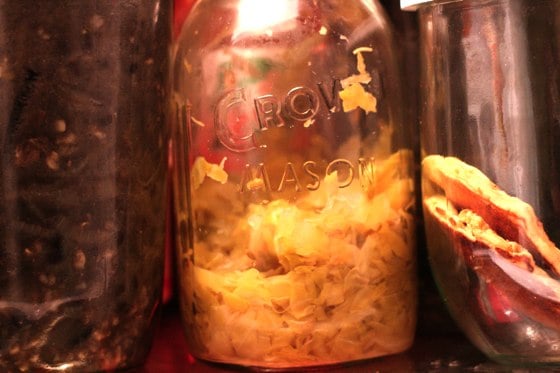
I am now totally sold on homemade sauerkraut, because it was dead easy to make and so much more delicious that anything than came from the store (and there’s something magical about cutting up a cabbage in October and not eating it until February).
We simply thinly sliced the cabbage (a nice big one from the Headhouse Square Farmers Market), put it in the bowl with a tablespoon of salt and a teaspoon of fennel seeds (we didn’t have any caraway, which is the traditional flavoring) and banged it up with a potato masher to break down the cell structure of the cabbage a bit.
Then we packed it into a jar (packed being the operative word) and topped it with a bit of distilled water (just enough to cover the cabbage). Then it just hung out in a corner of the kitchen for about a month. I put it in the fridge after that time, but I do believe that you can also let it spend a bit more time doing its thing.

Homemade Sauerkraut
Ingredients
- 1 head of cabbage cored and finely shredded
- 1 tablespoon good salt kosher is okay, sea salt is better
- 1 teaspoon carraway or fennel seeds
- 1-3 tablespoons of distilled water
Instructions
- Put the sliced cabbage into a non-reactive bowl, add salt and seeds and bang it around with a potato masher or meat tenderizer, until it starts to soften a bit.
- Pack it into a quart jar, using the end of a wooden spoon to really force it down.
- Top it off with just enough water to cover.
- Let it mellow for a month or more, occasionally releasing any gasses that collect in the jar. Just be warned, it will be stinky. If any bloom starts to develop on top, scrape it off.

My husband and I have been making sauerkraut for many many years. Adding the spices is a personal taste thing, we do not add them. There is no need to beat the cabbage up if you layer the cabbage and the salt and just use your hands to squish it down. That should also cause the cabbage to give off it’s liquid and you will not need any water. You would only need water if the cabbage did not get enough during the growing season (dry summers are not good.) You do not say how much that head of cabbage weighs. we use 5 pounds of cabbage to 3 tablespoons of salt. We ferment for six weeks, then taste and usually let it go another week or two.
Add a little more salt and leave out the water.
Hi! I am making sauerkraut today as the cabbage is ready in the garden and thought I would tell you the recipe that I use from a patient I had more than 10-15 years ago. Her recipe is: Put 1/2 teaspoon of canning salt and 1/2 teaspoon of white sugar in the bottom of pint Mason jars. Chop the cabbage and put it in the jars, pushing down some and up to the neck leaving about a half inch space. Add another 1/2 teaspoon salt and 1/2 teaspoon of vinegar on top. Fill jars with filtered water, leaving the half inch clear at the top. Wipe jars down and put lids and rings on just lightly finger tight. Put the jars in a warm place that the temperature does not vary much on. I used and old ice chest that the jars would all fit in and left it in my dining room in a corner that it would not be disturbed in. She told me it would take 2-6 weeks to ferment well and that I would know when it was fermented by the odor. She was right. At that point take the jars out and wash them all down to clean the outside of the jars and then remove the lids and rings and wipe the jars well. She told me to put new lids on, and I did when I made it before. She then kept hers in a refrigerator and did not hot water bath it but she lived a lone and had an extra refrigerator; I do not. I hot water bath canned mine for 20 minutes and it was wonderful. My father-in-law waxed poetic about it tasting like his mom’s used to. I have made it this way since and had never really looked online for other ideas for it. My patient had died several years ago and she never had children of her own but was very happy to give me recipes and plants to pass on her knowledge. I like your forum-blog here. Thank you for sharing. Mommacope
hi thanks for sharing, do you make kimchi as well?? if yes can you share the recipe..thanks
I posted my recipe just a couple of weeks ago: https://foodinjars.com/2014/04/homemade-kimchi/
I want the green Ball jars as I have a green and pink kitchen and they would so enhance the décor. I too found that the blue jars mage my peach salsa as well as my spiced peaches look weird. Will use the green jars for my two week pickles (my grandmother’s recipe) as green pickles will be greener in the green jars.
I HAVE MADE SAUERKRAUT ALL MY LIFE. BUT MY FAMILY THINKS WE SHOULD ONLY MAKE IT DURING THE SIGNS. I HAVE CABBAGE AND WOULD LIKE TO MAKE KRAUT. BUT THEY SAY IT WANT SAVE. WHAT DO YOU THINK? PLEASE HELP ME.
A friend and I have been making kraut for 20 some years now. I originally thought I was jut showing him how to make it when we started and it has turned into a yearly tradition. We used to grow our own cabbage, but I found a farmers market that sells large usually late flat dutch cabbage to us for 1.50 a head. We have an old commercial meat slicer that we use. We are not hung up on crocks, we can go to a local hamburger place and they sell us those green 5 gallon pickle pails that of course are food grade and work just fine. We let them ferment around 70 degrees for 6 weeks before we can them and have always had the best saur kraut. We do around 50 gallons a year and of course wind up giving a lot away. We have local fire depts. and churches asking us to donate for their bingo and brats nights or what ever they have. Just really posting to let people know they don’t have to get hung up on using crocks they are not only somewhat fragile but really heavy and clumsy to move. One thing I did notice is that is you cut back to much on the salt you will get a softer or even mushier kraut. Oh also we have started the last few years making one 5 gallon bucket with jalapenos or Serranos and even chipotele peppers and onions tastes great on brats and dogs
I was just thinking of trying this myself and I have a red cabbage in my fridge to use. Does it matter if it is a green or a red cabbage??
thanks
It doesn’t matter if you use red or green cabbage. Red cabbage will make a deeply purple sauerkraut, but it will taste just as good as the kind made with green cabbage.
My Grand Mother and Mom used the method of making kraut and I learned from them. This recipe is from our people , the Cherokee, but they used crocks and jars. It is crunchy and just enough sour. I forgot to say women that are close or on their period should not help make krout at this time. I found out after I had some to go bad and could not be eat. Now my wife leaves the kraut making to me.
Billy My family makes 100’s of mason, ball type quart size jars a year they live in eastern kentucky and can everything i called them about two weeks ago because i LOVE homemade Kraut i have ate it my whole life straight from the jar with a spoon is my favorite!!! they wash the jars chop the cabbage (they use a cream can with the top poped off works wonderful) add a splash of vinager to the bottom of the jar(white vinager) stuff jar full of cabbage and add 1 and a half to 2 tablespoons of canning salt each jar, then fill with spring water screw on lids and tops and store in a dark place for 6 weeks and its ALWAYS white and crunchy and sour i am dying to eat some now i am 45 i have eaten it prepared this way my whole life i two weeks ago canned some myself here in central florida i hope i make my family proud!! but the theory about a women on her period they swear by noone was allowed to take part in canning if it were her time of the month 😉
I make 25 to 30 qts of kraut each year and sometimes I still run out before the next season. I dont weigh the cabbage but I do pack the jars real good. I add 1 1/2 teaspoons of salt, (good grade) to each quart. I add boiling water to fill to the top of jar. I use a kitchen knife to get all the air bubles out so the water level will be complete. I put the jars out of the light for at least 9 or 10 days ,( according to the temp). I had to start making more because everyone found out that kraut goes good on sausage and biscuits among other foods that can be covered with kraut.
I tried using plastic canning lids and I am here to say it doesn’t work! Lol
I grew cabbage again this year and tomorrow I am going to try it again. I hope it works this time. I don’t buy store bought fresh food due to not knowing what’s in it. (unless I have no choice. I grow Organtic veggies so I try and make enough to last from year to year. I have read about putting it in a crock to wilt I have been using plastic bowls to make and then jar it. Is this ok to do. I know plastic isn’t the best thing to use for anything in my choice. I am going to go and see if I can find a crock in the store or thrifty store. I just want some home made sauerkraut like my grandmother and mother made. I haven’t had any for so long I would even pay for some. Store bought just doesn’t compare to home made.
I have made my first batch of sourkraut a week ago. I had it in a dark cupboard for a few days then put it in the fridge. But from what you are saying Marissa, you keep it in the cupboard for months even. How long will it last?
Also I notice that I am bit gassy now that I am starting to eat it.
Is that normal? Is it because I am using it too soon?
Also does hot weather cause it go off quicker?
Keen to learn more.
Thank you for your help.
I’m not saying that sauerkraut can be kept out of refrigeration for months. However, the fermentation process does best at room temperature for a period of 2-4 weeks, depending on how sour you want it to taste. And yes, it’s normal for sauerkraut to be gassy, that’s part of the result of the fermentation process. The warmer the room, the more quickly the fermentation process will happen. If you store it at room temperature indefinitely, it will start to go off.
Marisa, I have canned kraut for several years and the past two years it did not sour. I am trying again this year because it’s so much better than store bought. I use my mother law reciepe and she is now deceased and I’m hoping you can help. I cut my cabbage, pack it in the jars tight, add 1 teaspoon of salt per jar, add distilled water, seal with lids. I store it in a dark cool room. I can remember smelling it in the past and so far I can’t smell anything and no leaking from the lids. It’s been about 3 weeks so far. What do you think I’m doing wrong?
Dana, you need to pound the cabbage and salt together to draw out the liquid before you pack it into the jars. If the cabbage isn’t covered with the water expressed from the cabbage, it’s not going to turn into sauerkraut, it’s just going to rot. What’s more, you need to release the seals on the jars once every day or so, to allow the developing gas to escape from the jars.
Do you think I need to just toss what I’ve got in the jars now….or do you think I could take it out to pound it and put it back in the jars?
I pickle my peppesr – hot – by washing them, packing them in a sterilized jar, covering with a solution of 5 cups water, 5 cups vinegar and 1 cup plus 2 T kosher salt, boiling so salt is dissolved and solution is sterile, capping with a boiled lid, then sealing with a seal-a-meal. After 3 weeks you have incredible picked peppers. Would this method work with sauerkraut as well?
Dan, to start, your method is not one that is USDA approved for home canning. So I wouldn’t recommend it for anything, let along sauerkraut.
Marisa,
From what I have been able to discover, it is acceptable for pickled foods that are high in acid such as peppers, Okra, green beans, etc., and that the salt plus the vinegar plus the acid foods plus the vacuum is okay. If you have information to the contrary, please let me know.
Dan
I have made two 15-liter batches of sourkraut. Both fermented for 6 weeks. The first came out great, good taste, mildly sour. The second came out REALLY, REALLY sour, almost too sour to eat. Can anyone suggest why?
Will store bought cabbage work?
It works just fine. I’m on about my eighth batch of sauerkraut made from grocery store cabbage.
I just made sauerkraut for the first time. The recipe I found said to put a plastic bag full of water on top to weigh it down. My bag leaked some water, which is chlorinated, onto my cabbage. I tried to scoop it off, but there was some left in the cabbage. I just read where the chlorine will stop fermentation. I started it about four weeks ago. Is it going to be ok?
Carie, I have no idea whether your sauerkraut will be okay or not. You’ll just have to take a look at it and see if it looks like it is continuing to ferment. In the future, you should fill your weight bag with a salt water brine. That way, it if leaks, it won’t damage your sauerkraut.
I’ve done much pickling when lived in New Jersey, but now live in Panama, and finding sauerkraut here is like finding Henry Morgan’s Treasure, (English pirate that burned and looted, Panama Viejo 1600’s), I’m going to try this, love it on dogs and with smoked pork chops, have great cabbage here as same for all vegs, but they do not know about preserving food other than salted and dried.
I’m going to do this tomorrow…is it ok to just leave the jars on the kitchen counter while the cabbage is fermenting or must it be fermenting in the frig?
It needs to be out of the fridge to ferment properly.
Hello, I used to make sauerkraut all the time, when cabbage was on sale. Recently we lost our home and pets to a fire and all my recipes. But I do want to tell you the most awesome cookbook I had, was for things from the garden, can’t remember the name. It had the most awesome recipe. I have racked my brain trying to remember it. I know I packed it in jars after it set and wilted for about an hour. I put mine in an old cake pan and put it in one of the bedrooms we didn’t use. every week or two we would check the jars to add brine water.
Mine was not real salty, it was really good. It is better to put it in a room that does not get a lot of light.
I made sauerkraut yesterday after reading this sight and I added a bit more sea salt than you recommend. I hope that’s ok! I had 3 heads of cabbage and after going threw the proess of beating it and letting it wilt I packed 5 quarts of sauerkraut. I packed it as tight as I could and it seems that even after adding water to top off the jar that it still does not cover the cabbage. I left a half inch head space. So I hope it works. I also used plastic lids instead of the canning lids. Is this ok to do? I thought if you have to open it why waste the canning lids. Thank you! I can’t wait to see if it works and how it taste!
Why is my sauerkaut turning a brownist color on the top? I have lids on but loose; should they be tight? The jars have bubbles on the top but they are not all turning color (yet). Please help!
It sounds like it isn’t submerged beneath the water. You gotta pack it down and make sure it is covered with liquid.
I have the same question as Heather: do you put the jar in the fridge or no?
You keep it out of the fridge while it’s fermenting (for at least a month) and then, once it’s sour enough for your tastes, you either put it in the fridge or process it in a boiling water bath canner.
Wow, is this the first post ever in this blog?
I have been on a expedition clicking the previous button until I found the begining 🙂
Nate, you found the very beginning. Well done!
i can’t find a way to email you directly, so i hope you find this comment on a old post! i want to make this sauerkraut- do you keep the jars to ferment in the fridge, or no? do you need to water-bath them to can? you mention opening the jars every so often to release the gas- how often in a month? thank you.
As for crocks, BTW, I found a great store in Nicholasville, KY just south of Lexington, that had “seconds” for a fraction of the regular price. I bought my 3gal. crock last month for $20! Their “first”‘s were at least twice that, but the inside was perfectly “food safe”.
I read to add the salt to the cabbage and leave it to wilt for an hour. I did that and didn’t need any water at all. I used 2 huge heads of cabbage, shredded, and 1/2 cup sea salt. It was about 10# cabbage. Initially it filled my 3 gal. crock, but within an hour, was only about 3/4 full. It filled a half-gallon, and 3 qt. jars, packed solidly, and had juice over the top of the cabbage in each jar.
Hey, Marisa,
This is an old post–I know. But of course I came to Food in Jars with my canning questions and searched. I want to make sauerkraut because, eventually, I want to make choucroute. Anyway, I’ve been researching recipes and I have a couple questions.
1) Some recipes specify an “earthenware crock” as the vessel the kruat should ferment in. I don’t even know what that means. Does the magic have to happen in any specific type of container?
2)Numerous recipes specify pickling salts. I see here you used sea salt. What’s the difference?
3)The question of water–would filtered water from a Pur filter be fine or do I need to seek out distilled?
I know you are the expert so I thought I’d ask!
CAN YOU USE A STAINLESS STEEL BOWL,CAUSE THE CROCK BOWLS I HAVE IS VERY OLD AND WILL BREAK AND CRACK.??????
I just squish it by hand over and over, no need to pound things if you don’t think the crock will handle it.
Marisa, I want to try to make the quart jar sauerkraut. Would you please help with the sea salt. I have redmond realsalt it says on the package “ancient all natural sea salt” can I use this?
ALL Salt is Sea Salt, so that should be fine, or you can buy sea salt in the bulk section of most markets. no need to pay top dollar for something you can get for under 50 cents a pound in bulk
–Rick
Rick , not all salt is sea salt , unless you count rock salt ( many million years old seas ) as being so.
Strictly speaking yes it is … but ‘sea salt’ these days is where it has been evaporated out of sea water, as against being dug out of a mine.
Sugars turning into alcohol should not prevent a person from enjoying fermented chutney. Indeed, they may add the the fun!
I love your site. I can’t wait to try your kraut recipe, as I have a row of cabbage in our garden and will want to preserve it. I have one question…Do you cover the quart jar?
Dianne, yes, you do cover the pint jar with a standard lid. You may need to open it briefly on occasion as the sauerkraut ferments, to let out of some of the gas. You can test to see whether it’s time by pushing down on the top of the lid. If it doesn’t give at all, it’s time to gas the jars.
Can you just place cheese cloth on the top of the jar with a band? Or does it need to be covered with the lid and ring?
You can do it however you’d like. This is just the way I do it.
Marisa, many thanks for the additional explanations. And a good reminder about what water to use. We are on our own well water, so we should be fine. Thanks again.
What a wonderful thing to have your own well water. Living in the city, I forget that such things are even possible!
I am Ojibwe (Chippewa). Like the Rappahanock, we seem to have lived about a generation behind the rest of America is socioeconomic terms. (Are you familiar with the Cuna-Rappahanock musician, Raffie, whose mum was one of the sisters making up Spider Woman Theater?). Anyhow, my grandmother taught me how to make sauerkraut in jars and water bath it. I cut it up and add as little salt as I can get away with–perhaps as little as two level tablespoons to two and a half pounds of cabbage–your average large home-grown cabbage. Don’t add more. Pack the salted cabbage as tightly as possible into quart jars, using a wooden mashed potato pounder or a small diameter piece of hardwood firewood every few inches deep to smash it until the juice level is higher than the level of the cabbage. This is important, especially when you reach the top of the jar, as it is the natural sugars in the juice that will ferment and protect the cabbage fibers. Put the canning lids and bands on quite loose, as you need bacteria to live inside the jars for fermentation–but you want to keep out fruit flies and other small critters. The jars might overflow a bit. Place these jars out in a sunny spot for at least 10 days–even longer, depending upon temperature (at night especially, and during cloudy spells in late August and September). A grassy spot next to concrete (heat sink) is a good place to put them. The cabbage should appear limp, translucent, and fermented; and it requires a full 72 hours at temperatures in the 70’s to ferment properly–so adjust your number of days depending upon your climate. If it over-ferments a little, all you’ve sacrificed is crunchiness. It is still edible and full of Vitamin C. After the kraut is fermented, bring the jars into the kitchen. Remove lids and bands and clean any bits of cabbage and salt from them. Remove any beige-colored cabbage that was not covered with fermented juice (homemade vinegar from wild “mother”) from the top of the jar. Add a little salt water to the top of the jar to normal head space if cabbage is not covered. Replace same lids you used to ferment (–and yes, I do reuse well-inspected lids from year to year–from water bath jars, not pressure canned jars–and I do not recommend that anyone else do this, for liability purposes). Water bath these quart jars for 15 minutes–at elevations of 300 ft. or less–adapting for higher elevations where water boils at a higher temperature. Even though the kraut is high-acid, it is very dense, and a minimum of 15 minutes is needed to penetrate the packed-in material–so don’t treat it like pickles. I’m guessing that it wouldn’t hurt to leave the jars in for 20 minutes, but I wouldn’t go much beyond that, as it affects texture. Water-bathed kraut isn’t as crunchy as fresh kraut–but the Vitamin C content is pretty good. Vitamin C deteriorates with time and exposure to light–so treat canned goods like revered documents like the Constitution (of the U.S.), limiting candlepower exposure–which is interchangeable in terms of time versus intensity). The old-style cupboards with no wooden doors but cloth over a string kept light off canned goods in jars, preserving their nutrients and other desirable edible qualities–a good way to keep canned goods if you don’t have a root cellar, spring house, or dark basement. You can also put the full jars back into the cardboard box and keep light away from canned goods that way. Label the boxes and tuck them into dark corners. Regarding salt–it is my understanding that the use of “pickling salt” became popular in 20th c. canning recipes, because homemakers were pressured into competitiveness that involved super-clear liquid media in the jars; iodine in salt makes pickling brines turn a little bit cloudy with time–not to be confused with the seriously-cloudy nature of jars with failed seals. My family could care less if the brine is not crystal-clear. Also, the iodine is an important nutrient that prevents goiter–a serious problem in the midwestern (inland) portions of most continents during the late 19th and early 20th centuries–right on up into the 1960’s, until federal programs educated people about the benefits of iodized salt. Anyhow, that cultural push for super-clear pickling fluids also coincided with a movement away from breast-feeding in favor of bottle feeding. Both phenomena were considered “low culture” behaviors–but are now recognized as acceptable, even healthier.
Wow that was really good stuff there Lois!!! Thank you for the additional comments!!!!! I have tried Marisa’s and will be sure to also try yours this variation. I like the idea of using the natural juice.
Marissa, how big was that big head of cabbage? I ask because you mention packing a quart jar. Did you have more than a quart jar (and did you use 1 T of salt total or for each) or just one? it’ll give me an idea for how tight to pack the jar. And although sauerkraut is traditionally a fall & winter fare, there is no reason one could not do it with spring cabbage, is there?
Sylvie, the head of cabbage we used for the sauerkraut was approximately 2 pounds (it felt huge, but I think it was actually a fairly average-sized cabbage). Once cored and chopped, it filled a large mixing bowl. But we bruised it with a potato masher for about ten minutes and then really packed it into a quart jar, so the whole cabbage fit in a single jar with about 1/2 an inch of headspace. We only used one tablespoon of salt for the whole thing. The secret is that you really pack it firmly into the jar.
One thing to remember is that you shouldn’t use tap water as your liquid. Make sure to get spring or distilled water, because the chlorine in tap water will kill the good bacteria that you need in order to get the fermentation to work.
And I don’t see any reason why you couldn’t make it with spring cabbage. I’ve been thinking about making another batch, just because it was so delicious and I hate the idea of waiting several months to have it again.
Hi Marissa,
I tried this recipe but had the same question as Sylvie. If my cabbage is too large for one quart jar and I must use a second jar for the excess, or if I have to use a half gallon jar to contain it all, how does that affect the amount of salt required? Do I simply use one tablespoon of salt per head of cabbage, no matter how many jars it fills, or is the correct ratio one tablespoon of salt per quart of cabbage? Thank you.
Kelli
You want approximately 1 tablespoon of salt for every 2 pounds of cabbage. So if your head of cabbage is enormous, you should use more salt. You can certainly spread the kraut across multiple vessels for the fermentation process, though.
I’ve always wanted to make homemade kraut but have been way too intimidated. I will absolutely try this now, as I’m looking at ways to get more probiotic in our diets. It’s a shame I can’t feed it to the babies though.
It really is very easy, you should do it.